by Dean | Dec 16, 2015 | General
The critics in 1970 were right to adamantly reject Zabriskie Point, the American-made Michaelangelo Antonioni film. It is dumb, anemic and ill-structured.
Signore Director believed the alienation of young people in the 1960s, and of the New Left, was as significant an alienation as that in such earlier Antonioni films as L’Avventura and La Notte. But ZP fails to convince us of that. It has no sophistication whatsoever. Indeed, the straightforward lovemaking between hippies in the desert (presented in a dream sequence) goes on for so long—and ends with a long shot that makes the hippies look like insects on sand banks—that it turns distasteful. Yes, visually the film is often impressive, but junk is junk.
Zabriskie Point is a free-love, essentially anti-cop movie, and so we can hardly help realizing just how right it seems for our shoddy times.

Cover of Zabriskie Point
by Dean | Dec 15, 2015 | General
The Season 2 Christmas episode of Jane the Virgin ended on an alarming note—once again our sympathy goes to Petra—but it was the “mid-season finale” so we’ll have to wait till late January to see what happens.
Alarming or not, though, there sure was a lot of whimsical stuff this time. Jane got so angry over Rafael’s deceptive ways that, yep, steam literally shot from her ears. And she kept appearing in imaginary (story) roles as she tried to write a prize-winning tale—uh, watch the episode online and you’ll understand what I mean.
Jane’s baby wasn’t featured very much this time, and that’s okay by me. Too much wild comedy went on for a tiny tot to often be on camera. Really, it was a pretty festive episode even when things were going wrong for the characters.
by Dean | Dec 13, 2015 | General
The fight with the lion and the final annihilation of the Philistines wrought by Samson between the pillars are dandy scenes in Cecile B. DeMille‘s Samson and Delilah (1949). And if you want sensuality, mostly that of Hedy Lamarr (Delilah), that’s there too.
But there are bad scenes to boot, such as the one where Delilah laughably vows to avenge herself on big Samson (Victor Mature) as the Philistine fields burn. In point of fact, the lady’s will to get even is unconvincing, unlikely. She so loves and moons over Samson this doesn’t make much sense. The screenplay here isn’t as well written as that of DeMille’s The Ten Commandments. Expectably, Delilah is given a much bigger part in the film than she is in the Old Testament account—a stranger and grittier story than this.
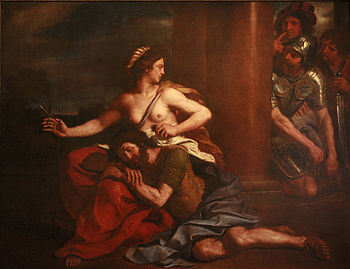
English: Samson and Delilah, Guercino, 1654, oil on canvas. Access number 316. (Photo credit: Wikipedia)
by Dean | Dec 10, 2015 | General
There are hillbilly men behaving badly in Seven Brides for Seven Brothers (1954), but no worries. It all ends happily. Stanley Donan directed with the same sure hand he displayed in Singin’ in the Rain, despite all the backlot shots (Ah, Wilderness?). Male dancing abounds, more so than female dancing, and the males sing too, though appropriately none of them can outsing Howard Keel, the lead. None of the gals can outsing Jane Powell, the female lead, either, who gets to deliver two splendid ballads in a row: “Wonderful Wonderful Day” and “One Man.” The music is consistently pleasant. Congrats to Michael Kidd for his choreography.

Seven Brides for Seven Brothers (Photo credit: Wikipedia)
by Dean | Dec 8, 2015 | General
The 1964 Jean-Luc Godard film, A Married Woman, held my attention for about an hour of its 94 minutes but then became dreadfully dull. The very pretty Macha Meril enacts Charlotte, who spends quality time with both husband and lover but lacks a veritable devotion to either.
The most interesting thing about the film is the Village Voice review it inspired after being re-released this month in New York. To Godard, asserts Calum Marsh, “A sort of mass delusion . . . had begun to seize the young [in Europe], manifesting itself in historical ignorance and prevailing trivialities like TV and fashion magazines”—and thematically this is what A Married Woman is about. I respect this, and I respect that Godard’s visual poetry, though sometimes too obvious in its meaning, frequently hits the mark. But a relatively short picture shouldn’t be this talky, shouldn’t be a slog.
(In French with English subtitles)

Cover of Une Femme Mariee