by Dean | Nov 29, 2015 | General
Frank Capra didn’t always have good ideas for his films, but doubtless he did when he chose to direct a movie version of a Damon Runyon story, the title of which movie is Lady for a Day (1933), with a screenplay by Robert Riskin.
There are no idealists or innocents in this Capra film. Instead we see the interesting phenomenon of small-time mobsters and a pool shark trying to help a financially poor woman—the apple-selling Apple Annie (May Robson)—fool the woman’s daughter into thinking her mother is a society lady. This is the fiction Apple Annie has maintained for years. At first the lowlifes treat their service to the old gal as something extraneous, beside the point, but later it doesn’t quite seem that way to them. Basically they are harmless lowlifes, never even roughing anyone up.
Yes, Lady for a Day has a couple of flaws, but it’s a work of a certain purity for which both Capra and Riskin are responsible. It’s one of Capra’s feel-gooders, energetic and droll but without moralism. The director worked well with his actors, the result being that May Robson is exemplary, Warren William amusingly assertive, and Guy Kibbee charming and commanding.
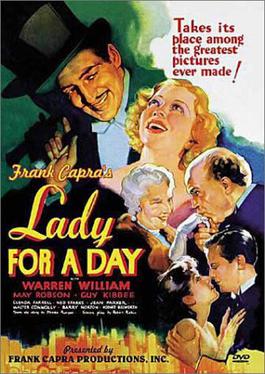
Lady for a Day (Photo credit: Wikipedia)
by Dean | Nov 24, 2015 | General
Among the stories in the 1962 volume of The Best American Short Stories, published by Houghton Mifflin, are two whose themes are related to religious faith. One of them, “The Model Chapel,” was written by Sister Mary Gilbert and has to do with the raising of money to build a new college chapel. It begins with the use of plastic pigs (from a savings and loan company) as receptacles for donated cash—the convent nuns like the idea—but it isn’t long before an examining priest mandates that the pigs be removed. This is one of the narrative details in a story focused, with mild comedy, on the dangers to spirituality: The assiduous work of chapel-financing undermines the nuns’ spiritual devotion. . . Sister Mary writes (or wrote) poetry, and although her prose here is not poetic, it is plainly admirable.
In John Updike’s remarkable “Pigeon Feathers,” 15-year-old David Kern is worried over the question of God and the boy’s future beyond the grave. His mother knows something is wrong, but at last all he gets from her are words of philosophical absurdity. She tells David she believes in God, only to subsequently state that God was made by Man! What’s more, what he hears from his minister is no better. Finally, David eyes the colors on the dead bodies of pigeons he has had to shoot, and there is an epiphany—a surprising, universalist epiphany about immortality and the Deity’s creation.
Published in 1961, these fine fictions are worth seeking out. Remember: The Best American Short Stories (1962).
by Dean | Nov 22, 2015 | General
The only good thing about this poorly written remake of a 2009 Argentine film is most of the acting. Chiwetel Ejiofor overplays his part, but Alfred Molina is still a delight to watch, even in a small role. Julia Roberts is trenchant, moving, and convincingly tomboyish, while Nicole Kidman supplies her assistant-DA character with all the smarts and gravity—and proper voice—she needs. The only problem is you have to watch this asinine movie to observe all this.
by Dean | Nov 20, 2015 | General
Children of Paradise (1945) is the classic 190-minute film by director Marcel Carne and scenarist Jacques Prevert. The paradise of the title is not 19th century Paris, the movie’s setting, but rather the personal paradise in some of the characters’ minds. The “children” are mostly theatre actors; one who is not is an aristocratic, misanthropic criminal (Marcel Herrand)—often a fumbler of his crimes. People with paradise in their minds want what they want, and invariably it involves the self more than other people. Significantly, there is a sequence in which a man named Baptiste (Jean-Louis Barrault), as he tries to catch up with the elegant woman Garance (Arletty), disappears in a big crowd of merrymakers in the street. A self now made anonymous seems to exist here.
(In French with English subtitles)
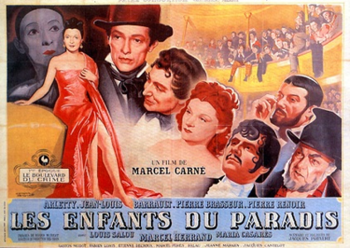
Children of Paradise (Photo credit: Wikipedia)
by Dean | Nov 17, 2015 | General
I don’t understand the meaning of the strange Iranian film, Gabbeh (1996).
Its protagonist is a girl who yearns to wed a man who howls exactly like a wolf but doesn’t seem to be one. He’s a man. A lot happens, even so—a mystifying lot—before the couple elope on horseback. Love, resentment, birth, old age, death—the film poetically touches on all these matters. I haven’t seen any of director Mohsen Makhmalbaf‘s other pictures, but they’re supposed to be political. This one isn’t. It appears to have something to do with existential truth, but is as figurative as it is visually entrancing. I take Makhmalbaf to be an ambitious artist.
Postscript: I have seen the director’s 2001 film, Kandahar, and was much impressed by it.
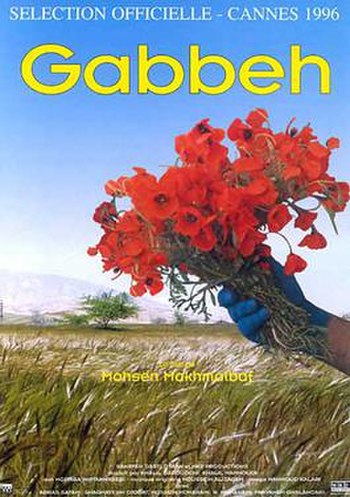
Gabbeh (film) (Photo credit: Wikipedia)
by Dean | Nov 15, 2015 | General
Brian Moore‘s novel, The Colour of Blood, was published in 1987, before the fall of Communism in the Soviet bloc. Its engaging action occurs in an unnamed Eastern European country, and the leader of the Catholic church there, Cardinal Bem, is a man honorable and peaceable and not at all fanatically anti-government.
However, as in his novel Black Robe, Moore, clearly lapsed, attempts to present the Catholic church as morally unworthy—unworthy in a way Cardinal Bem is not. For there exists in this church a politically extremist faction which manages to kidnap Bem with the aim of blaming it on the Communist government. False blame, then, will fall upon the Reds, but honest blame belongs to the Catholics.
Moore understands the far-reaching complexity in countries where there is tension between totalitarians and religious institutions, but he refuses to side with Catholic institutions. Indeed, he tacitly deems the Church philosophically suspect since even the silence-of-God idea springs up before the novel’s last sentence—“The silence of God: would it change at the moment of his death?” To tell the truth, it is no wonder Moore was Graham Greene‘s favorite living novelist. Both men are unsuitable intellectual guides.