by Dean | Oct 16, 2019 | General
Directed and scripted by Lewis John Carlino, The Sailor Who Fell From Grace With the Sea (1976), is based on a novel by Japanese writer Yukio Mishima. The homosexual Mishima wrought a book in which he presented 1) sexual longing, and 2) a pack of odd, early teen boys inclined to reject “adult” morality. Connect the dots. In the movie, and probably the book too (I’d have to read it again to be sure), the creation of the boys is all wrong, a silly embarrassment. Then again, the entire film is preposterous, even if it focuses smartly on the extremes of human experience (namely, sex and death) which are integral to Mishima’s vision.
The cast includes Kris Kristofferson, who sleepwalks through his role, and Sarah Miles, who does some marvelously lived-in acting.
by Dean | Oct 14, 2019 | General
In France’s Renoir, released in the U.S. in 2013, the beloved impressionist (played by Michel Bouquet) has his new muse Andree (Christa Theret) pose for him regularly. This she does contentedly until Renoir’s middle son Jean (Vincent Rottiers)—the future film director whose movie The Rules of the Game would artistically rival his father’s best paintings—returns from World War I to Renoir pere’s house. There, Andree, who was an actual person, grows infatuated with Jean; frustrated too. (The year is 1915. Pierre-Auguste Renoir is an old man.) We learn, in point of fact, that Andree eventually acted under the pseudonym of Catherine Hessling in Jean’s silent films.
Directed by Gilles Bourdos, Renoir uses the quiet existence of an elderly painter as an avenue for revealing life’s rich pageant. . . Regrettably, an unexciting, insignificant story develops here (Andree and Jean falling for each other), which prevents the movie from being anything like first-rate. Yet Renoir has an unfolding aesthetic power. Bourdos is good at creating unassumingly alluring shots and scenes, and the cinematography of Mark Ping Bing Lee is a sensuous wonder.
Really, present-day France with its economic troubles, etc. may have driven Bourdos and Company to the Gallic past, when things were so different. Indeed, it is worth mentioning there is enough female nudity in the film to enrage a present-day Muslim immigrant in Paris.
(In French with English subtitles)

Nude (Photo credit: Wikipedia)
by Dean | Oct 12, 2019 | General
Dillinger (1973), the John Milius film, is not much of a movie—for one thing, it doesn’t really care about character—but it is exciting. Gun battles are battles.
The fine Warren Oates plays John Dillinger, and his character isn’t sanitized. Neither is the violence of thuggish felons, or violence in general. A lot of sloppy writing was done, but at least the film is better than Milius’s The Wind and the Lion.
by Dean | Oct 9, 2019 | General
Elaine May‘s 1971 film, A New Leaf, is a misfire, notwithstanding it was butchered through cutting by Paramount Pictures, a company May sued. I’m skeptical of it regardless, though, since some pretty weak May-written comedy dominates the movie’s first few scenes and, several years later, May was willing to direct a movie as fuzzy and unsatisfying as The Heartbreak Kid.
As the concoction goes on, it gets invigoratingly bright and witty, and Walter Matthau does, as John Simon indicated, “a very neat job of humanizing” a wastrel who needs money and chooses to marry for it (and worse). He rightly praises May, a co-star here, for the same kind of humanizing. All the same, A New Leaf is messy. Despite May’s talent, it isn’t nearly as good a comedy as the Harold Lloyd films I’ve reviewed. Old Hollywood, this time, scores over the Seventies.
by Dean | Oct 7, 2019 | General
Francois Truffaut’s French picture, The Story of Adele H. (1975), is a partly fictitious period piece about Adele Hugo’s unending pursuit of a British lieutenant with whom she once had a romance. (Adele was the daughter of Victor Hugo.) He doesn’t want her, but she obsessively wants him.
The idea was long ago expressed that there is in the one who obsessively and relentlessly loves a person unworthy of that love not only pathology but also greatness. Critic John Simon pointed out that in Adele H. Truffaut failed to see this, and so his heroine’s greatness is casually ignored. This is too bad, but at least the film has themes and beauty and is highly interesting.
Are there people who turn amatory love into a religion? Sure. They’re everywhere. This is one of the themes in the film. Isabelle Adjani enacts Adele and is perfect, supplying the character’s remoteness, determination and sheer fragility. The British lieutenant is too cold—played well enough, however, by Bruce Robinson. Truffaut’s direction is gratifyingly good, with those charming fadeouts and wipes included. The costumes by Jacqueline Guyot and the production design by Jean-Pierre Kohut-Svelko are winning.
Somewhat underrated by critics, The Story of Adele H. needs to be given its due.
(In French with English subtitles.)
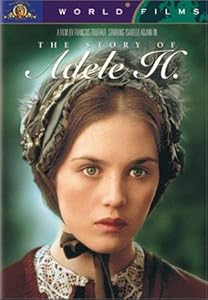
Cover of The Story of Adele H.
by Dean | Oct 5, 2019 | General
Michael Curtiz (director) and Dudley Nichols (scriptwriter) gave us 1959’s The Hangman, a riveting Western about a U.S. marshal out to arrest a popular man. Marshal Bovard (Robert Taylor) is dedicated to his job and distrustful of people, although he becomes a little less distrustful near the movie’s end. The man he’s after, to be sure, rightly knows that a jury will probably pronounce him guilty when he isn’t. There is constantly a specter of legal injustice.
What is most stellar about this movie is the cast, usually because of how inherently interesting and good-looking it is. Taylor’s virility can rattle any cage. Tina Louise, though limited as an actress, is effectually, amicably sensual and has a charming beauty. Mickey Shaughnessy, Mabel Albertson and even Jack Lord all have their appeal. So does Nichols’s relatively simple if imperfect script. The Hangman is a respectable addition to the Curtiz oeuvre (which includes Casablanca).