by Dean | Sep 30, 2015 | General
Re Taylor Swift‘s Red CD (2012), which I recently heard for the first time. (I’m not much interested in her current CD, 1989.)
1) Predictably, there are too many love songs on this 16-track recording. 2) When Taylor isn’t boring me with “I Almost Do,” “Sad Beautiful Tragic,” “Everything Has Changed” and a couple of others, she’s delighting me with . . . the following:
With Liz Rose, Swift wrote the remarkable, nicely worded ballad “All Too Well,” which presents our girl as a country-pop Carly Simon, and by herself Swift wrote the calm, melodically fine “Begin Again.” “22” sounds a bit like Rebecca Black’s “Friday”: it’s optimistic catchiness. The song’s college-girl boyfriend stuff continues in “We Are Never Ever Getting Back Together,” a fun song of exasperation. By herself Swift also wrote “State of Grace,” which could use some better lyrics but is musically vivid and exciting.
Terrific as she is, Taylor Swift is not a great songwriter, but Red is an almost great CD. There is more artistry than art in her many decent-sounding songs.

Change (Taylor Swift song) (Photo credit: Wikipedia)
by Dean | Sep 28, 2015 | General
The director of Ju Dou, To Live, and Not One Less, China’s Zhang Yimou is a brilliant master. Small, amusing and sad, his Happy Times (2002) concentrates on a shortchanged person, a pared-down life—that of Wu Ying, a girl made blind by a brain tumor and treated ignobly by her husband-less stepmother. The man who wishes to marry the stepmother is Zhao, a fiftyish loser of sorts so tired of bachelorhood that he lies to the stepmother about owning a big hotel. Stirred by this, the woman asks Zhao to hire Wu Ying as a hotel masseuse; she wants the girl out of the way. Hence Zhao rigs up a phony massage room and leads Wu to believe she is servicing customers who are in reality Zhao’s helpful friends. The unseeing girl enjoys the “work” and considers these brief days the happiest of her life.
In this film one deprived soul immorally uses another deprived soul. The lying little man is luckless, but the blind Wu Ying is more so, and yet Zhao does do something for the girl. Indeed he can even be very kind to her; such paradoxes! Largely, though, he is merely kind to himself, and things go into a tailspin. For Wu, is it only through deception that happy times can be had? What’s more, self-deception appears to plague both characters.
Zhao Benshan is capital as Zhao with lower-class ordinariness and ingenuous appeal, believable as a puritanical bachelor. Dong Jie is absolutely winning with Wu Ting’s guilelessness and forbearance, but is not a cardboard saint. Zhang’s direction is standard but careful and felt, perhaps reflecting an admiration for contemporary Iranian filmmakers. Happy Times has heart; it has the heart of Not One Less, quite different from Zhang’s earlier great, nigh depressing pictures, although some might find Happy Times depressing too.
(In Mandarin with English subtitles)
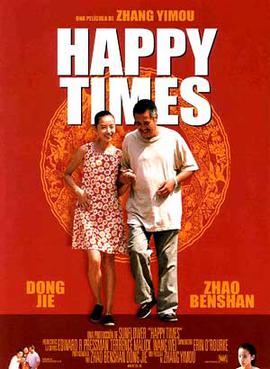
Happy Times (Photo credit: Wikipedia)
by Dean | Sep 25, 2015 | General
Beware if a man in a film noir complains about his humdrum life, as Dick Powell does in Pitfall (1948). He’s destined to have his life stimulated by violence and, possibly, the kiss of a woman who’s not his wife. The said woman is played by Lizabeth Scott, whose boyfriend is in the clink. A nerdy aggressor (Raymond Burr) wishes to take advantage of this imprisonment by running away with lovely Scott, but Powell, the would-be adulterer, remains in the way. . . Whatever Jay Dratler’s novel is like, presumably it was good material for a movie, for a very involving story—solidly directed by Andre de Toth—gets underway. The casting alone is very involving.
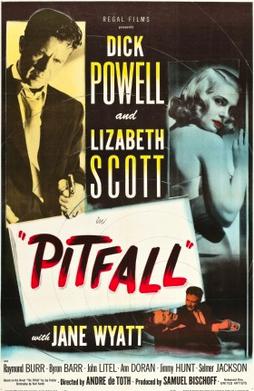
Pitfall (1948 film) (Photo credit: Wikipedia)
Powell and Scott aren’t perfect—indeed, they’re superficial (for more nuance, there’s Jane Wyatt)—but they still fit noir material like a glove. I only wish Pitfall was on DVD: I had to watch it on YouTube.
by Dean | Sep 23, 2015 | General
At bottom Margarethe von Trotta’s German film, Marianne and Juliane, is a bore, just ultra-leftist or radical enough not to condemn a woman who has gone from activism to terrorism in the (figurative) war to end Third World agony, and even in 1981, the year of the film’s release, was such ultra-leftism ludicrous. The terrorist in question is Marianne (Barbara Sukowa), and although von Trotta probably prefers the merely social, not terrorist, activism of Marianne’s sister Juliane (Jutta Lamp), it is abhorrent that she seems little bothered by Marianne’s bombs. How boring this is; we’ve lived with such sentiments for many years now. And it doesn’t improve matters that Marianne is such a bland character.
(In German with English subtitles)
by Dean | Sep 21, 2015 | General
Jake, a black pastor in The Second Chance (2006), is abrasive and insulting, although at other times he is too good to be true. Not a well-drawn character.
Ethan, a white associate pastor, is poorly acted by Michael W. Smith. Steve Taylor’s Christian movie doesn’t work. It has a good feel for inner city life, but is sometimes less than credible: e.g. Ethan doesn’t seem to be secretly hoping other people are watching him give alms in the ‘hood, and yet this is what mean Jake repeatedly accuses him of.

Cover of The Second Chance