by Dean | Oct 15, 2012 | General
The first Atlas Shrugged movie was merely good (if faulty); Atlas Shrugged Part 2 (2012) is terrific.
The word “socialism” is never uttered in the two films, but a corporation-controlling and anti-business U.S. government has emerged and is hitting hard the likes of businesswoman Dagny Taggart. In fact, it is a putatively humanitarian government which desperately tries to cure the country’s economic distress, but is no damn good at it.
The director this time is John Putch, whose sense of composition is finer than that of the first movie’s director. There is effective editing by John Gilbert, even if the lighting by cinematographer Ross Berryman sometimes mars the picture. The cast is new too, with a lovely Samantha Mathis, convincing as a CEO, now enacting Dagny. Jason Beghe has a coarse voice but is commandingly solid as Henry Reardon, the defiant owner of a steel business.
Atlas is an oddity: With its train travel and the fact that no one wears hip clothes, etc., it has one foot in the 1950s, when Ayn Rand’s novel was published, and one foot in the 21st century. Consider the fossil fuel-replacing motor! For all this, the filmmakers manage to maintain more political understanding and honesty than film critics who spurned Part 2 will ever know.

Atlas Shrugged (Photo credit: pursuethepassion)
by Dean | Oct 8, 2012 | General
Viola Davis and Maggie Gyllenhaal are thoroughly credible in 2012’s Won’t Back Down, in which two single mothers, one of them a teacher, become unlikely pro-education activists. They seek to gain school board approval to turn a miserably failing grade school into their own union-free establishment (charter?), thereby bucking appalled union officials.
The film doesn’t stint on showing us how junky public schools have become, and as one who neither fully trusts nor fully respects labor unions, including teachers’ unions, I admire the direction WBD goes in. Nevertheless, it needs to disclose more of what the local union is doing to hinder the good teachers at Adams Elementary from teaching well. It’s not as clear as it should be.
The directing and the utterly appropriate cinematography are stronger than the movie’s script, but the film is robust and interesting. And the always running working-class gal and loving mother Miss Gyllenhaal creates simply cannot be improved on.
Director and co-writer: Daniel Barnz

NEW YORK, NY – AUGUST 03: Actresses Maggie Gyllenhaal and Viola Davis attend the ‘Won’t Back Down’ screening at NYIT Auditorium on August 3, 2012 in New York City. (Image credit: Getty Images via @daylife)
by Dean | Oct 4, 2012 | General
Most of the music (incidental) Felix Mendelssohn composed for Shakespeare’s A Midsummer Night’s Dream I have not heard. But if one has enjoyed the Scherzo and the ever-famous “Wedding March”, which I have heard, even more, surely, will he or she relish the Overture the German master wrote for the play–and wrote when he was only seventeen.
It is extraordinary music. Eleven minutes long, it is all youthful elan as it darts and gallops. Now comic, now majestic and perfect in structure, this, and offering a most gratifying return to theme. I have heard the Berlin Philharmonic performance, on CD, many times.

Cover of Felix Mendelssohn
by Dean | Sep 25, 2012 | General
On The Savages (2007):
A feckless father is now an aging creature of spleen and mental brokenness. He has dementia, and his grownup offspring, Jon Savage (Philip Seymour Hoffman) and his sister Wendy (Laura Linney), must locate an acceptable nursing home for him. They themselves have made little personal progress, though; albeit without spleen, they themselves are feckless. Example: the primary character here, 39-year-old Wendy is rightly chided by Jon for stealing from the federal government after applying for, and getting, FEMA money owing to 9/11 (all her temp jobs were close to Ground Zero, you see). Moreover, she is carrying on with a married man who wants her only for physical intimacy.
Still, Jon and Wendy know they are morally required to be humane to their father. Constantly they feel the tug of selfishness and the tug of responsibility. In a more sympathetic light, they try to preserve happiness and sanity as well as they can and are not wholly successful. At the end of this Tamara Jenkins film, there is no resolution regarding Wendy’s frequent lying and other moral flaws. Jenkins’s people do not change, which is too bad. The Savages would be stronger if at least one of them did.
Not surprisingly, the Savages are involved with the arts, with drama. No doubt they themselves are artists. A drama professor, Jon is working on a biography of Bertolt Brecht (he, too, was a savage), and Wendy is an aspiring playwright. All this probably reflects, on Jenkins’s part, a fondness for art and a desire to create it. And, yes, her movie is an artwork. Minor but still art. Not Brecht but still art. Support the arts and see it.
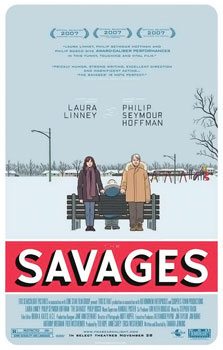
The Savages (film) (Photo credit: Wikipedia)
by Dean | Sep 20, 2012 | General
Most of the finest were written a couple of decades (or more) ago.
For instance, “A Strange Way to Save the World,” by the Christian group 4Him, came out during the ’80s. Here, the singer marvels that God has chosen lowly Mary, a manger, etc. as a means to establishing the greatest thing the world could ever receive. The lead vocal is likable and mild-mannered, the music spare in parts and lovely, while the lyrics are intelligent. “Strange Way” is considered a Christmas song but it’s no more or less than a Christian song, and a great one at that.
The Twila Paris number, “We Bow Down,” also from the ’80s, is one of the most melodic worship songs to come down the pike. Impossible to tell which is more delicate—Paris’s voice or the music. . . A quasi-rock song—plenty of synthesizer here—Petra’s “Love” is a shimmering delight. John Schlitt’s singing is carefree and upper register-friendly. As for the words, they’re only fair but the melody shines.
The heartfelt ballad, “Just Because You Are,” by Phillip Sandifer, is nigh beautiful. It’s about the believer’s duty to love & worship God simply because HE IS. The tune never builds into anything schmaltzy or overripe, and the vocals are down-to-earth and enticing. Good show. . . Like the 4Him song, Chris Rice’s “Smile” is a small masterpiece, released during the Aughts. Bongos introduce the song and there’s a slow tempo until the happy chorus. Nothing original is being said–Chris is waiting to see Christ’s smile in Heaven–but something catchy and meaningful obtains.
For all the pop-ditty limitations, this is music of light. It can all be heard on YouTube.
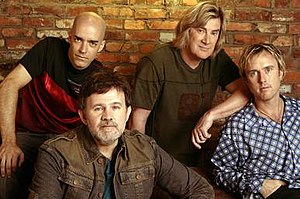
The members of Petra before the band retired in 2006 (l-r): Paul Simmons, John Schlitt, Bob Hartman, Greg Bailey (Photo credit: Wikipedia)