by Dean | Jun 4, 2017 | General
The dreamlike pre-Christian “civilization” of Federico Fellini‘s Satyricon (1970) is employed to reveal history as damned, as lost Sodom, indeed with persons both white and black united in their hedonism and in sexual nihilism. Yes, nihilism: this is what this particular sphere yields. But too much goes on, and with little profundity, in this bizarre, overlong picture. I appreciate Fellini’s decision to show us both hedonists and sufferers (such as those on a slave ship) in this ancient . . . place, and certain sets and other visuals are striking. Satyricon, even so, has no reason to exist. It’s a time waster.
I’ll say this, though: the director-writer exhibits a more acceptable half-male, half-female freak, who’s supposed to be a demigod, in this film than in the rotten Juliet of the Spirits. Interesting, too, is that homosexual behavior here is part of why there is a sentiment of sexual nihilism.
by Dean | Jun 1, 2017 | General
The protag in Pedro Almodovar‘s Julieta (2016), the beautiful Julieta (played as a young woman by Adriana Ugarte) meets and engages in sex with a bearded man called Xoan while traveling on a train. The sex scene is one of the proofs that this movie has in it more than a touch of art despite being a soundly commercial concoction.
Based on three stories by Alice Munro, it’s a pretty decent film about trauma and separation. Julieta is made pregnant by Xoan, so she later finds and marries him, with the first trauma not far ahead. Julieta can be soapy but Almodovar, in adapting his script and competently directing Ugarte, displays misery as vivid as the color red in the film.
As for the subject of separation, the film captures the awful state of a mother whose child (a daughter) chooses to back out of the mother’s life, made worse by Mom’s taking the blame for the backing-out.
The director’s bad-boy tackiness is absent in Julieta; instead, there is a Munro-like concentration on the human condition. Mr. A shows some genuine tenderness, and he refuses to judge his characters. A serious if brightly colored middlebrow artwork is what we have here, and actors Carmen Suarez, as the middle-aged Julieta, and Rossy de Palma, as a soul frumpish and melancholy, know what they’re doing.
(In Spanish with English subtitles)
by Dean | May 28, 2017 | General
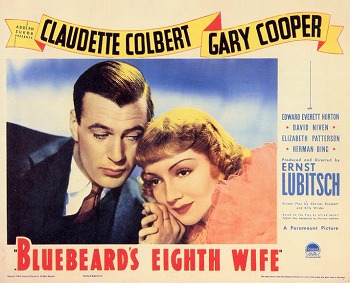
Bluebeard’s Eighth Wife (Photo credit: Wikipedia)
The film, Bluebeard’s Eighth Wife (1938), is an adapted work for sure: it is based on the English translation of a play. And it’s made pleasant by director Ernst Lubitsch, surefooted and keeping the charm flowing, and actors Claudette Colbert, Gary Cooper and David Niven.
Curiously, it deals with a married couple devoid of, well, relations—of any kind. They aren’t even kissing. This is because, not long after marrying him, Nicole (Colbert) wishes to divorce millionaire Michael (Cooper) and get from him a lot of prenup money. Wow, you say. She must be depraved. Er, no. Not quite. Watch the flick to the end. One thing which is certain is that the plot action is not obvious.
Both enjoyable, Colbert and Cooper do everything they can to flesh out their characters, but they’re a bit hamstrung because no real psychology exists here. Still, it’s diverting—for a long time, a happy-go-unlucky movie, which keeps it interesting.
by Dean | May 25, 2017 | General

Catch-22 (film) (Photo credit: Wikipedia)
I dislike Joseph Heller’s Catch-22, which never should have been made into a movie. It was, though, by Mike Nichols and half-talented scenarist Buck Henry.
About Nichols, Stanley Kauffmann was correct: “at whatever level, he was born to direct,” and the material in The Graduate and Carnal Knowledge was worthy of him. But the misguided, sophomoric stuff in the Catch-22 screenplay is not. (Not that Nichols’s direction is mistake-free; note the use of the 2001 music by Richard Strauss.)
Really, the Heller novel has little sophistication—not none, but little. What sophistication, what thoughtfulness, is there, however, hasn’t been passed on to the film, because I don’t believe Henry knew how to do it. Spare me Heller’s Snowden episode, but in the movie it’s no good at all. Neither are the caricatures from Orson Welles, Bob Newhart, and Buck Henry himself, and the comedy is sometimes too raffish. A fantasy scene with full frontal female nudity is blatant and unnecessary. I’m glad Catch-22 did not begin a veritable decline in Nichols’s oeuvre.
by Dean | May 22, 2017 | General
The Heartbreak Kid is a 1973 picture directed by Elaine May and written by Neil Simon.
In it, a Jewish newlywed, Lenny (Charles Grodin), sees just how vulgar and tiresome his wife Lila (Jeannie Berlin) is, and he regrets marrying her. But during his honeymoon he himself turns into a deceitful fool-for-love—“in love” not with Lila but with the lovely goy Kelly (Cybill Shepherd), whom he meets on the beach. Kelly’s father (Eddie Albert) is understandably appalled by the guy, and he instinctively hates him. The movie’s ending is not exactly sanguine, and not exactly explicable.
Marriage here, except for that between the Eddie Albert character and his wife, is a joke—turned into one by the people involved. But too much fuzziness brings on some implausible content, such as the virginal Kelly’s cool-woman teasing of Lenny, a married man. . . What’s it all about, Miss May? You have more reason to be proud of your daughter’s, Miss Berlin’s, fine acting than of the film.