by Dean | Jan 24, 2017 | General
Spring Breakdown (2010), by Melody Carlson, is one of the short books in a series, for young adults, about six teenaged girls. As a brief summary inside the book puts it: “The wealthy fashion students in Mrs. Carter’s boardinghouse spend a quiet spring break in Florida until . . .” Well, until spring breakdown hits. Fun time is over.
The girls are typical teenagers except that two or three of them are Christians, among them DJ and Taylor. Like the unsaved girls (and lover-boys), these two have their faults, albeit for Taylor one of them isn’t boozing now that she is a spiritually delivered ex-alcoholic. THIS isn’t ordinary, but all kinds of ordinary incidents roll into this little bailiwick. The only bailiwick the girls know, it is a mixed bag of the mundane and the fleshly. There is a Rockabilly dance. DJ and Taylor do some harmless skinny dipping at night. Two other girls, Eliza and Casey, get drunk after a bumpy photo shoot. There are, however, some spiritual and emotional challenges for DJ (the main character) pushing to the side all the kids-will-be-kids occurrences.
Carlson’s prose is imperfect—for one thing, she keeps misusing “hopefully”—but her narrative is entertaining and her dialogue is serviceable. It’s a Christian book, but not a preachy one. And it’s meant to appeal to a broad audience. I would rather see devout teens reading Spring Breakdown than buying a fundamentally insignificant Adele or Beyoncé CD.
by Dean | Jan 22, 2017 | General

Family Law (film) (Photo credit: Wikipedia)
In Derecho de Familia (2004), a.k.a. Family Law, from Argentina, Perelman Sr. (Arturo Goetz) practices law. His son, Perelman Jr. (Daniel Hendler), teaches legal ethics at a university, although he too practices law as a defense attorney. That filmmaker Daniel Burman presents the vocational spheres of these two men, father and son, is the most agreeable thing about Family Law. Otherwise there is nothing exceptional here. Nothing new is being said, nothing particularly compelling is done. It’s just a well-made film about a family.
What is being said? A message about the burden of transience; the idea that grown sons recognize themselves in their fathers (as daughters do in their mothers); that anguish has a way of sneaking into any given father-son relationship. Again, nothing new. In truth the film is more intelligent than, say, Cronicas but is less challenging, less gripping, than that South American picture. By no means do I wish to discourage anyone from seeing it, but I must wrap it up by asking a question: Does Burman disapprove of Perelman Jr.’s unwillingness to degrade or embarrass himself in certain public activities involving his little son Gaston, e.g., dressing up as a clown? If so, why? Granted, like Perelman Sr. Perelman Jr. is not an ideal father but he isn’t a bad one either. He has a lot to learn but . . . what is Burman getting at?
(In Spanish with English subtitles)
by Dean | Jan 19, 2017 | General
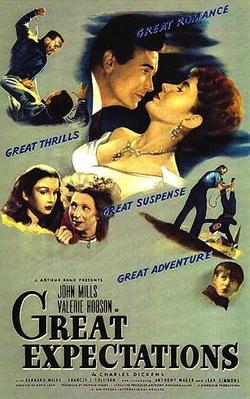
Great Expectations (1946 film) (Photo credit: Wikipedia)
A 1946 British film directed by David Lean, Great Expectations is a civilized and scintillating adaptation, with acting ranging from extraordinary to ordinary—most of it the former. Consider Finlay Currie as Magwitch and Martita Hunt as Miss Havisham. Almost needless to say, GE is visually finer and emotionally deeper than most of the Old Hollywood adaptations of classics, nifty as these can be (e.g. Cukor’s Little Women). Granted, its simple humanitarianism is boring now, but at least the film avoids moralism. And it itself isn’t boring.
by Dean | Jan 17, 2017 | General
I was worried that Martin Scorsese‘s Silence (2016), based on the fine Shusaku Endo novel, was ready to deem Christian apostasy no more unfortunate or dismaying than Christian commitment, but happily it refuses to do so. The honest and truthful content in Endo’s book about tortured and executed Catholic believers in 17th century Japan is properly transferred to the film—making it a soberly Christian film—though perhaps with too little understanding of the inclinations of the faithful.
Two Jesuit priests (Andrew Garfield and Adam Driver) sail to Japan to find a missionary padre (Liam Neeson) said to be “lost” to the Church. This man, Father Ferreira, was a real-life figure driven to apostasy by torture, albeit before his death he supposedly recanted. When Ferreira tells Father Rodrigues (Garfield) that Japanese converts who are martyred die not for Christ but for the ministering priests, it does not ring true at all. Yet there is no one in the film to positively belie this. To me this is a flaw, but at any rate Silence is benignly spiritual and winningly profound. Its concerns must be respected. The inhumanity and suffering are relentless, with one of those concerns being the silence of God while His servants are agonized. The Japanese authorities might as well be ISIS or (possibly) the North Korean government. But, truth to tell, it is Christ Who subtly prevails.
Scorsese’s movie is just as notable a work of art as the novel. Its 165-minute length underscores that time keeps bringing to the Christians the necessity for making hard decisions, for thinking how to stave off further horror. There is, sadly, much to figure out.
by Dean | Jan 15, 2017 | General

Cover of Edmond
Indisputably, people don’t know why they exist. Are they in hell? IS there a hell? Edmond, the anti-hero in Stuart Gordon‘s film Edmond, would like to know. Really, it is David Mamet‘s film too; he authored the script and Edmond is the 2005 screen version of his Eighties play.
His protagonist (William H. Macy) leaves his wife and wanders into an ugly urban environment, one requiring too much money for a prostitute and a measure of furious self-defense. Temporarily losing his mind, Edmond knifes to death a waitress played by Julia Stiles. Along with being intelligent, the film is unspeakably grim and, in the end, grimly perverse. Which is why I don’t like it.
As it happens, hetero Edmond gives in to, and starts an intimate relationship with, an incarcerated black man who threatens to kill Edmond if he doesn’t sodomize the creep. It’s an instance of prison rape. Mamet means this to counteract Edmond’s earlier racist outbursts after some black-on-white crime occurs, for his protag, you understand, enjoys the relationship. He takes comfort where he can find it, but it’s an unacceptable counteraction. No true insight, no true uplift, and not much plausibility exist in this. . . Until the finis, Mamet’s screenplay (and play) is savagely honest, but also too hideously pessimistic and sans the brilliance of the play Edmond is famously reminiscent of: Buchner’s Woyzeck.