by Dean | Sep 22, 2016 | General
If you like the film comedies of the silent era, you should try the Roscoe “Fatty” Arbuckle short, Fatty’s Tintype Tangle (1915), directed and starred in by the comic actor.
Arbuckle is forcefully funny and entrancingly winsome as the harried Fatty, who is driven to maniacal behavior by his shrewish mother-in-law. Worse than she, however, is the monster of Misunderstanding, arising in the minds of not only the two women in Fatty’s life but also the jealous husband (Edgar Kennedy) of Louise Fazenda. Fazenda? Yes. Married to movie producer Hal Wallis, she was as gifted for slapstick farce as Arbuckle.
There might be too much reliance on the jealous husband’s mad gun violence in Tintype Tangle, but it’s a zippy, lurching jewel all the same. And only 20 minutes long.
(Available on the DVD, The Forgotten Films of Roscoe “Fatty” Arbuckle.)
by Dean | Sep 20, 2016 | General
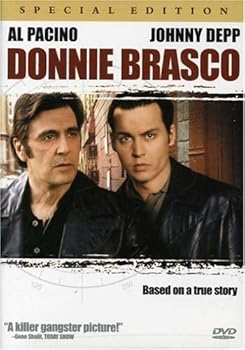
Cover of Donnie Brasco (Extended Cut) [Blu-ray]
Notwithstanding he made the repelling Four Weddings and a Funeral, it helps that DB was directed by the talented Mike Newell, who, together with scenarist Paul Attanasio, has borrowed for their enterprise the true story of Joseph Pistone, an undercover FBI agent who fooled and eventually ruined a formidable crime family. A regrettable fact here is that Pistone, known by the fake name Donnie Brasco while undercover, is an almost completely unsympathetic figure, and Newell and Attanasio never quite catch on to this. True, they wish to convince us of Donnie-Joseph’s potential for meanness and violence—the traits we see time and again in the mobsters he is working against—but they push it too far. Happily they know what they’re doing, though, when they show Pistone at home, or at the marriage counselor’s, with his wife Maggie, and we see the ugly strain the undercover work is having on their marriage. Everything about this is on the mark.
They know what they’re doing in other areas as well. After quarreling with and being slapped by Pistone, Maggie (Anne Heche) is shot by Newell in closeup before a slow dissolve removes her from the screen and replaces her image with that of the streets where Pistone does his job; there is a certain poignancy to it. The contrast between the gangsters’ nasty doings in New York City and their amusements on the beach and at a motel swimming pool in Miami leaves its mark on the mind, as does the excellent sequence in which Al Pacino, Michael Madsen, and another fellow, all gangsters, have just been told by the FBI of Donnie’s being an undercover agent and they are uncertain and bewildered as they stand outside a pool hall.
The acting is thrillingly effective—that of Johnny Depp (Pistone) less so, however, than that of Pacino, Heche, and others.
by Dean | Sep 18, 2016 | General

Cover of Black Rain
Japan’s Black Rain (1988) is about disease. And Hiroshima. The disease is radiation sickness, ergo the cause is the bomb.
The film begins on August 6, 1945, when Hiroshima got it in the neck, and a more horrid city catastrophe you will not find in a movie, albeit to his credit director Shohei Imamuri does not rub our noses in it. Several screen minutes later, it is 1950 in a prosaic Japanese village; inhabitants live their quiet lives there. But, tragically, many of these inhabitants were in or near Hiroshima five years ago, and some are getting ill. The film’s narrative, adapted from a novel by Masuji Ibuse, is pivoted on an aunt’s and uncle’s efforts to marry off their 25-year-old niece Yasuko (Yoshiko Tanaka), about whom there are village rumors that she too is ill. The aunt and uncle have radiation sickness, but what of Yasuko, who was never actually in Hiroshima? Are the aunt and uncle lying to themselves in thinking their niece may be physically fit for marriage?
For two full hours Black Rain gives us much to see and a goodly amount to think about. It is reticently angry, hating the weapons of warfare (with no vicious Japanese soldiers appearing); it is bleak and compassionate. Some of the finest scenes include the one where, outside Hiroshima in a boat on a river, Yasuko’s young face gets spattered by the titular “rain” that is the result of the awesome explosion. And the one where Yasuko’s aunt, so sick she is hallucinating, imagines she sees four men whom radiation sickness has already killed brazenly opening the windows of her home. Too, a semi-charm emerges in the scene where a brash young man kisses and tells Yasuko that he loves her (before losing his balance on a pile of rocks he is standing on), but no charm at all can be found—of course—when, some time later, Yasuko examines her face in a mirror, looking for evidence of the malady. And does she think she sees it?
Imamura has done superlative work here. Since I haven’t read Ibuse’s novel, I can’t say whether the film does justice to it but it immediately makes you suspect that it has. One takes pleasure in being unable to detect hardly any artistic flaws at all, certainly no serious ones. It reminds us of the greatness of the most skillful Japanese films.
by Dean | Sep 15, 2016 | General
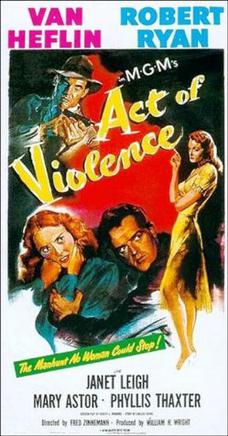
Act of Violence (Photo credit: Wikipedia)
An early Fred Zinnemann flick, Act of Violence (1948), is at least plausible: A vengeful lame man (Robert Ryan) with a nice girlfriend is hunting a married suburbanite (Van Heflin) who wreaked terrible damage by turning into an informer for the Nazis. Both men were in a German concentration camp; now Ryan wants to kill Heflin.
To me, this mere plausibility pleases less than the movie’s momentum—and Zinnemann’s control. How well he works with his actors! Ryan is perfectly somber without being a goon. Heflin is every inch an ordinary suburbanite reduced to a pursued wreck. Vincent Minnelli couldn’t get much energy from Mary Astor in Meet Me in St. Louis, but Zinneman does in this film.
Act of Violence ends with an unfortunate stinting on sympathy for the Janet Leigh character (who is married to the ex-informer), but at any rate Leigh, too, gives a committed, vigorous performance. And she looks like a million bucks.
by Dean | Sep 14, 2016 | General
![Cover of "Minority Report [Blu-ray]"](//ecx.images-amazon.com/images/I/51uRGD7j7sL._SL350_.jpg "Cover of \"Minority Report [Blu-ray]\"")
Cover of Minority Report [Blu-ray]
Washington D.C. in 2054 has apparently solved the social problem of murder through the use of a trio of humans known as “Pre-Cogs,” who mystically predict when homicidal deeds will occur. Tom Cruise‘s John Anderton is at the helm of the Justice Department’s precrime unit which employs the Pre-Cogs. The plot crisis breaks out when it is predicted that Anderton himself will soon murder a man he does not even know; did the Pre-Cogs make a mistake? Anderton believes he is being set up, but by whom? And how?
Anything but dull, this Steven Spielberg science-fiction picture is nevertheless a flop. Anthony Lane, in The New Yorker, declares that “Spielberg the liberal is asking what the dangers might be when law and order submit to logic and nothing else.” Okay. But the liberal Minority Report is not exactly early John Dos Passos. In reality, law and order are not always submitting to logic in the film: it is asseverated that the Pre-Cogs occasionally disagree with each other about a future homicide. Yet an arrest is made anyway. The film is not so much about dystopia logic as dystopia injustice. Unfortunately, the Scott Frank-Jon Cohen screenplay (based on a Philip K. Dick story) is maddeningly absurd, especially with all that Pre-Cog fairy-tale stuff. Things are hardly improved by the aging character enacted by Max von Sydow. I like von Sydow, but not the part Spielberg gave him to play.
Tom Cruise’s part is fine, vital, but Cruise performs uninterestingly. Janusz Kaminsky provided Spielberg with the locker-room hazy, supremely dank cinematography the director wanted. But why did he want it? Alex McDowell’s futuristic production design is easer to take, for even the cinematography can’t undermine it.



![Cover of "Minority Report [Blu-ray]"](http://ecx.images-amazon.com/images/I/51uRGD7j7sL._SL350_.jpg "Cover of \"Minority Report [Blu-ray]\"")