by Dean | Nov 29, 2012 | General
It was a funny comic strip, Peanuts was, even if it relied too heavily on eccentric Snoopy for its humor.
The first of all the Peanuts TV specials, “A Charlie Brown Christmas” (1965) was so painstakingly written by Charles Schulz that it ended up being a comic masterpiece which didn’t need any heavy reliance on Snoopy. It just needed a lot of imagination and some top-notch jokes. To Schulz it needed to be meaningful too, and with Linus quoting the Gospel of Luke (and the singing of “Hark the Herald Angels Sing” at the end) it did become meaningful in a way other Christmas cartoons on TV never did.
Vince Guaraldi’s music is famous now, with its hooks and charm, and the voices—Peter Robbins as Charlie Brown, Kathy Steinberg as Sally, etc.—are unbeatable.

A Charlie Brown Christmas (Photo credit: Wikipedia)
by Dean | Nov 27, 2012 | General
In the John Updike short story, “Made in Heaven,” written in the Eighties (and from the collection titled Trust Me), something important is concentrated on. The piece chronicles the years of marriage between Brad and Jeanette Schaeffer, and it begins with the words, “Brad Schaeffer was attracted to Jeanette Henderson by her Christianity . . .” Christianity, or something like it, is there, to be sure, but it doesn’t last. The “something important” which happens is that unbelief masquerades as belief, for a long time. It’s an unbelief afflicting both Brad and Jeanette, who seem unable to do anything about it, and I myself certainly suspect they can’t. Can it not be said their minds are being blinded—yes, blinded—to the light of the gospel? (See II Cor. 4:4.) To me it can, notwithstanding this is hardly a point Updike is making.
What is doubtless true is that “Made in Heaven” reflects the erosion of Updike’s own recognized faith in orthodox Protestant doctrine.
It’s in a story such as “Augustine’s Concubine” that Updike introduces us to true believers, converts. A 1970s work included in the collection, Problems and Other Stories, “Concubine” revolves around the love life of Augustine and of his married lover before Augustine’s conversion in the fourth century. And before hers. Updike makes it seem inevitable that Augustine will surrender to God, but not that she will. Yet she enters a cenobium.
What comes about after all the illicit sex is not only chastity but also asceticism (“She, too, could taste the dry joy of lightness, of renunciation”). A tribute to the former concubine concludes the story: “She was a saint, whose name we do not know. For a thousand years, men would endeavor to hate the flesh, because of her.” What comes about, then, is a history of (Catholic) chastity and asceticism, something Updike, with his understanding of people’s faith in orthodox doctrine, sympathetically presents.

Cover of Problems and Other Stories
by Dean | Nov 26, 2012 | General
I saw about an hour and 50 minutes of the Robert Zemeckis film, Flight (2012), before the projector’s audio went down and the theater crew was unable to fix it. It’s okay, though; by that time I was tired of the movie anyway. It’s yet another film about a serious alcoholic (this time a pilot) and it’s a bit draggy. Its most powerful and suspenseful shot-series comes rather early, after which the movie is often good but not that good. It’s good in the sense of not being utterly routine—and there is superb acting aplenty. Denzel Washington is masterly as the pilot.
Another thing: Parents, pay attention to the R rating.

Denzel Washington (Photo credit: Dalboz17)
by Dean | Nov 19, 2012 | General
Abbie Cornish is an intelligent actress playing an intelligent but non-cerebral woman in Bright Star (2009), written and directed by Jane Campion. Her, Cornish’s, Fanny Brawne is dignified, passionate, agonized; in short, the performance is magnificent. Ben Whishaw, who enacts the English poet John Keats—Brawne’s real-life lover—is unerring, and the film is a gem. It centers on the John-and-Fanny romance and suggests that amatory love, when it isn’t painful, is as beautiful as a Keatsian poem.
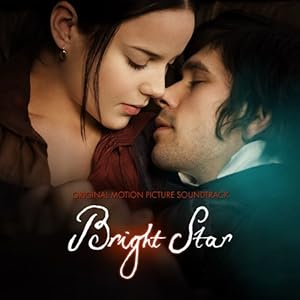
Cover of Bright Star
by Dean | Nov 16, 2012 | General
Most, though not all, of the novel The Just and the Unjust (1942) is taken up with a trial wherein two reprobates stand accused of murdering another reprobate, a drug dealer. Abner Coates is the assistant district attorney who helps to prosecute the men, hoping for a severe verdict.
Abundant human evil and human folly are featured in this engrossing novel by James Gould Cozzens, the latter of which—folly—Abner himself demonstrates by unfairly disliking a county chairman called Jesse Gearhart. An admirable man, Abner is also a flawed one. He has a disdain for “things as they are” in his environment, which in his case reflects an attitude not fully adult (or fully righteous).
Subplots spring up in the book, such as one about a schoolteacher tried for lewd conduct—a subplot which, alas, turns offensively sexist for a brief bit. Also, Cozzens’s prose is frequently as sloppy as I suppose Dostoyevsky’s is in the original Russian. At any rate, it wouldn’t surprise me if The Just and the Unjust was one of the best novels about the law and the courts ever written. It does a good job of showing us, as has been accurately pointed out about the book, that the law is only as strong as the people who handle and make use of it. It’s smart and exploratory.
Critics have attacked Cozzens for siding with privileged characters (e.g., an assistant district attorney). What fools. Privilege has to go to somebody. Does it also offend them that Job and Abraham and Solomon were rich?
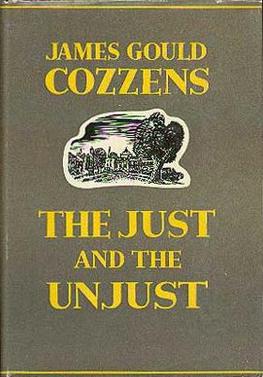
The Just and the Unjust (Photo credit: Wikipedia)
by Dean | Nov 12, 2012 | General
The Expendables 2 (2012) is less insipid and annoying than its predecessor. Sylvester Stallone has more vitality, but is still a frowning bore. Most of the characters are bores too, although at least the woman-warrior named Maggie (Nan Yu) doesn’t go around acting like a man but displays a certain femininity instead. The movie is rated R for its violence—there’s a compelling end-of-Bonnie and Clyde shooting of a lone bad guy, for instance—and the explosive action scenes, though well filmed, are less thrilling and interesting than what goes on in the TV shows, Breaking Bad and The Walking Dead.
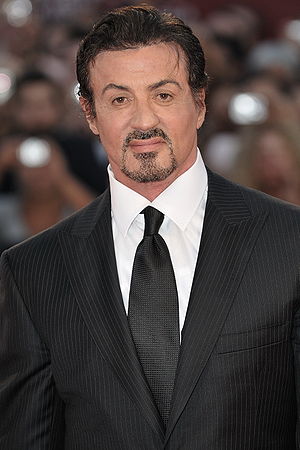
66ème Festival du Cinéma de Venise (Mostra), 11ème jour (12/09/2009) Tapis rouge pour la soirée de cloture du Festival de Venise 2009 Sylvester Stallone (Photo credit: Wikipedia)
by Dean | Nov 8, 2012 | General
L’Auberge Espagnole (2003), from France, is a coming-of-age story concerning Xavier (Romain Duris), an amiable French fool who moves to Barcelona for a year to study global economics. The first proof that he is a fool, however inexperienced in life he is, is his willingness to cheat on lovely Audrey Tautou, his Parisian girlfriend—and to do so with a married woman!
In the great Catalan city, Xavier is selected for tenancy in a modest apartment by the other, European inhabitants of the apartment: a German, a Spaniard, an Italian, a Dane. There are also a Belgian lesbian and an English girl, Wendy, who like Xavier ends up cheating on a lover back home. If you suspect that the apartment is a metaphor for the European Union, you know French thinking, and possibly the thinking of writer-director Cedric Klapisch.
For a long time Klapisch’s film is a good one. What’s finally wrong with it is that nearly all the vicissitudes and infidelity are followed by easy resolutions, quick reconciliations. Xavier even gets to be not the businessman he didn’t wish to become but (oh dear) the professional writer he does. Regarding the political point, Klapisch lets go of art and pushes pro-EU propaganda. The bouncy pleasures of L’Auberge come to a screeching halt with the way Klapisch wraps it all up, even tossing in a jot of meaningless anti-Americanism. If the dear man wants to be anti-American, that is his right; but meaninglessness is meaninglessness.
Klapisch’s directing is lively and loose but not too loose. He concentrates on getting as much out of a scene or sequence as he can, without blatancy. So slapdash is his screenplay, however, that most of the European students Xavier lives with are stick figures; only Wendy, her visiting brother, and the lesbian are not. I’m surprised the diversity-loving Klapisch didn’t do more with them. His deficiencies as an artist—and, yes, he is an artist—are many.
(Mostly in French with English subtitles.)

Pot Luck (2002 film) (Photo credit: Wikipedia)
by Dean | Nov 5, 2012 | General
The fifth season of the TV series, Mad Men, is on DVD now, and I’ve been watching it.
The writing is still solid, and so far I’ve detected very little nonsense. What’s more, the first eight episodes—the totality of what I’ve seen—provide an excellent depiction of a marriage in well-to-do America, that between Don Draper and Megan. Don remains a disturbing man but not a complete heel, for he’s intent to love Megan and avoid cheating on her. Then again, he’s still a newlywed. His sexual hunger for Megan, running parallel with sexual madness (such as that of Pete Campbell) in other quarters, contributes greatly to the marriage’s palatability. No surprise there. Yet Don’s selfishness too easily interferes, and Megan reacts to it with imprudent emotion. That she rather fears Don is evinced when she runs in alarm from him, half-comically, inside the couple’s home in a very good episode called “Far Away Places.”
I hope Season 5 continues to be worthy. The marriage stuff has been memorable. Mad Men is a minor work of art with clever dialogue. Jon Hamm needs to loosen up a bit as Don, but his acting is largely honest and his presence impressive. Jessica Pare does loosen up as Megan and is engaging as well as character-probing.
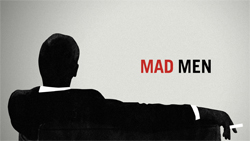
Mad Men (Photo credit: Wikipedia)
by Dean | Oct 25, 2012 | General
Wal-Mart is a morally imperfect corporation.
Robert Greenwald’s 2005 film about it—Wal-Mart: The High Cost of Low Price—is morally imperfect propaganda.
Propaganda in itself is not bad, but Greenwald’s film could use a little smart analysis and some evenhandedness. Let it glorify labor unions all it wants. Let it approve of the interviewed man who asserts, “I think the government should have more control” over the company owing to Wal-Mart’s being a “monopoly.” What spells trouble for the film is Byron York’s charge in National Review magazine (Dec. 5, ’05) that the doc’s information is deceptive. The above comment about government control issues from a citizen of Middlefield, Ohio, where the family-owned H & H Hardware was ostensibly driven out of business by a newly built Wal-Mart store. Not so, says York: “H & H closed before Wal-Mart even opened in Middlefield”—three months before. And ineffective business decisions had a lot, if not everything, to do with it.
I don’t entirely trust the words of the Wal-Mart CEO and conference speaker whom Greenwald repeatedly shows us, but even less do I trust a knee-jerk propagandist. “Wal-Mart Drives Down Retail Wages $3 Billion Every Year” we read on the screen. Actually, it just might be illegal immigrants who are doing that—or will in the near future. In any case, I’m skeptical. York’s article tells us “there is . . . serious disagreement among economists about Wal-Mart’s effect on wages.” The High Cost of Low Price, however, is not interested in that. . .
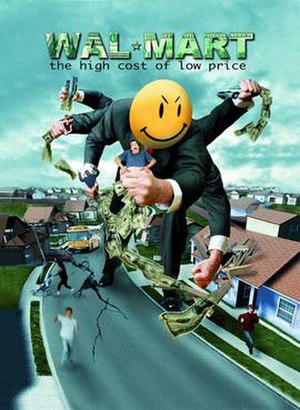
Wal-Mart: The High Cost of Low Price (Photo credit: Wikipedia)
by Dean | Oct 23, 2012 | General
Remember the name of the genre—horror—because images very unsettling keep meeting the eye in Scott Derrickson’s Sinister (2012). It’ll remind you of real life—existential terrors. The movie begins, after all, with a grainy old film shot of four members of a family being hanged.
Ethan Hawke plays Ellison Oswalt, a writer who, though he loves his family, loves even more the thought of writing another true-crime bestseller. He seeks to discover what happened to the fifth, and missing, member of the murdered family, but unwittingly he must begin to mingle with supernatural dark forces.
Yes, there are spooky children here, which has long been old hat, but committed work has been done in Sinister, with agreeable plotting and visual expertise. A few years ago Derrickson directed The Exorcism of Emily Rose, a film I didn’t like, but there I could at least see traces of talent. Even more talent is evident in the current movie. An occasional lack of freshness does not diminish the gripping nature of the technical effects—or the energy and depth of Hawke’s performance.

English: Director Scott Derricson (Photo credit: Wikipedia)