by Dean | Jul 19, 2013 | General
A 1970 Robert Altman film, M*A*S*H is a war comedy too desultory and frivolous, not to mention unrevealing about character. We learn very little, really, about Hawkeye Pierce (Donald Sutherland) and nothing about Trapper John (Elliott Gould). It has some of the most casually presented material I’ve seen in a movie.
Further, the film is mockingly sacrilegious and—any feminists who dislike it are right to do so—flatly degrading of women. Sally Kellerman’s Hot Lips doesn’t stand a chance.
As far as I’m concerned, no one should give this movie a chance.
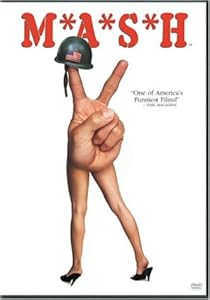
Cover of M*A*S*H (Widescreen Edition)
by Dean | Jul 14, 2013 | General
The comic movie Bachelorette (2012) is slight. Not slight-but-good, in my view; just slight. And it shouldn’t be.
The three main women in the film (based on a play by Lesyle Headland, the movie’s director) are obnoxious and distasteful, two of whom (Isla Fisher and Lizzy Caplan) are cokeheads and one of whom (Kirsten Dunst) is simply bitchy. Motivations for Fisher’s drugged-out behavior are naught but a mystery, and not much is done with Dunst’s character either. Some of the movie’s scenes are amusing, and the acting is spot-on, but too often the film tries to get its laughs merely through obscene talk. It’s a unremittingly profane film. Indeed, profanity or not, for Regan (Dunst) to urge an overweight friend to adopt a vindictive “F**k everyone!” attitude is, or should be, offputting.
The very pretty Miss Kirsten is a good actress now, deserving better pictures than she has been in lately, Bachelorette included.

Kirsten Dunst (Photo credit: Wikipedia)
by Dean | Jul 12, 2013 | General
Notwithstanding I am one who never wants to see chickens escape their farmyard concentration camps, I had a good time observing the efforts of all the freedom-seeking fowls in Chicken Run (2000), by the creators of the well-known “Wallace and Gromit”—viz. Peter Lord and Nick Park.
A family picture, it serves up conventional and wholesome humor as well as clay animation not exactly at its most attractive (I’m thinking of the chickens). Oh well. Nearly everything about CR comes off. Screenwriter Karey Kirkpatrick manages the one-liners skillfully. Consider: it is a frightful, awful place, this chicken farm, and by and by the fowls find out they are to be ruthlessly transformed into chicken pies. “I don’t want to be a pie,” blurts out a dumb but sweet chicken called Babs. “I don’t like gravy.” Even funnier are many of the nonchalant utterances of Rocky, an American rooster on whom the chickens depend for salvation. I note that he’s American because all the other animated figures are British, which leads me to an observation: Emanating from Brits, this picture depicts British know-all and American muscle (Rocky’s), but never American know-how.

Cover of Chicken Run
by Dean | Jul 10, 2013 | General
River’s Edge, a 1987 film directed by Tim Hunter and scripted by Neal Jiminez, is a mankind-bashing drama which borrows its subject from an incident in Milpitas, California in 1981. A teen boy has just strangled his girlfriend and left her naked body on a riverbank. All but one of his teen buddies keep mum about it, and to be sure the adults in the film hardly inspire confidence regarding the disclosure of such information. . . A bitterly tragicomic concoction, this, but one whose plot is very rickety and essentially unsatisfying—and whose musical score is intrusively bad. It’s fine that Jiminez hits the adults as hard as the kids, but this doesn’t mean the adults are represented intelligently. They aren’t.
Pauline Kael was right that River’s Edge is “a slack mixture of ‘important’ and mediocre.”

Seal of Milpitas, California (Photo credit: Wikipedia)
by Dean | Jul 7, 2013 | General
World War Z (2013)—Z stands for zombie—is a war movie. Or, at any rate, it is until it reaches the World Health Organization facility where it proves itself to be a medical thriller as well. But, yes, the film displays the continual military firing upon fast-moving zombies, as if Allied warriors were fighting supernatural Nazis.
At first, though, Gerry Lane (Brad Pitt) struggles to protect his family from the zombies in a well-executed busy street sequence. Later, Gerry is called upon by his old employer, the U.N., to help look for a solution, and sheer mayhem and desperate soldiering follow. An adaptation of a novel by Max Brooks, the story eventually becomes more far-fetched than it should—what makes Gerry so sure the people the zombies are leaving alone are sick?—but the good news is this:
1. The stupidity that exists in the entertaining Fast and Furious 6 does not exist here. 2. Director Marc Forster keeps the movie kinetically thrilling and visually compelling. The looted supermarket stuff is an example, as are the shots of undead critters climbing the high wall of Jerusalem and soon getting shot at by Israeli aircraft. Just as powerful, however, is a relatively quiet scene where Gerry tries to fend off a zombie at the WHO facility.
World War Z is quite the dreadnought. But, hey, Mireille Enos (The Killing) has too small a part as Gerry’s wife. Moviemakers, let’s see what Enos can do. We’ve long been aware of what zombies can do.

Brad Pitt (Photo credit: Wikipedia)
by Dean | Jul 5, 2013 | General
Written and directed by Neil LaBute, The Shape of Things (2003) is based on LaBute’s play of the same name. What the four-character piece tells us is that amatory love is squalid, innocence is repulsively assaulted, and contemporary art—yes, there’s even something about art—or pseudo-art is ludicrous, sometimes hurtful, folly. Indeed, it is something for the Messalinas of the world to obsess about.
Unfortunately LaBute has wrought a specious plot, thus causing a misshaping for The Shape of Things. But at least the film isn’t frivolous or boring. The bulk of the acting I l like since, for one thing, Gretchen Mol, like Rachel Weisz (the film’s Messalina), knows how to be nuanced. Paul Rudd, on the other hand, does not quite convince as a man who changes into something other than a shy naif.

Cover of The Shape of Things