by Dean | Feb 26, 2013 | General
Dark Blue World (2001) is a Czech World War II film with a nifty story and well-known themes. The dramatis personae includes Franta, a Czech pilot imprisoned by the Communists of his homeland because he fought German aircraft for the RAF and is now feared to be dangerously pro-freedom.
Flashbacks to the Forties exhibit Franta and his best friend Karel leaving Nazi-occupied Czechoslovakia for England in order to join the British armed services, and after a number of months they and other Czech pilots are allowed to fly missions. One of them leads to Karel having to bail out of his plane and meeting an English lady whose soldier husband has been missing in action for a year. Karel, liking her, puts the moves on her but Susan, the lady, is unattracted to him. As it happens, she wishes to ease her loneliness with nice Franta, who, though he knows of Karel’s love for Susan, acquiesces. The missing husband is forgotten.
What all this means is that Franta mistreats his best friend even after Karel valiantly saves Franta’s life in an air battle. When the truth about Franta and Susan becomes known, the friendship dies; Karel is unforgiving. There is, though, an instance of magnanimity which I must be sufficiently decent not to disclose. After the war Franta, the lost soul, returns to a different Czechoslovakia. It appears the pilot’s purgatory is right around the corner since he suffers in a Communist prison. 1951 is when Czech pilots like Franta were set free from the prisons, although the film tells us they perforce lived as outcasts. In truth, Dark Blue World honors them.
The movie was directed by Jan Sverak and written by Zdenek Sverak. Ondrej Vetchy, as Franta, is capable of force but has an easy manner. Krystof Hadek displays boyish anger and purity of heart as Karel. With now womanly good looks Tara Fitzgerald (Susan) is compellingly grave and as English as they come.

Dark Blue World (Photo credit: Wikipedia)
by Dean | Feb 22, 2013 | General
Hitchcock’s Frenzy (1972) is excellently directed rubbish, without even the gripping force of Psycho and The Birds. Anthony Shaffer’s script has to do with a psychopathic rapist-murderer in London, and there’s nothing wrong with the movie’s realism per se. But, directorially, the man obsessed with and rebuffed by Tippi Hedren (and others?) is intent on getting even with women, and this renders the film loathsome. Murdered females lie dead with their tongues hanging out. The corpses of women are desecrated in one way or another, and female nudity is somewhat overdone. Every woman but Vivien Merchant—Merchant is too good for this tripe—is at least close to being bitchy.
Shaffer’s writing is far less than first-rate, but morally the film itself is barely third-rate.

Cover of Frenzy
by Dean | Feb 20, 2013 | General
The 1965 short film, Black Girl, is the only feature I’ve seen by the late Ousmane Sembene, a Senegalese writer and director.
Mbissine Therese Diop, who plays Diouana, the black girl of the title, is not much of an actress and the voiceover narration is awfully repetitive, but BG‘s subject matter is formidable and the direction sophisticated without artiness. Something else the film is without is the once fashionable Marxist beliefs Sembene held, for all it attacks is racial pride and condescension among postcolonial Europeans.
In Dakar, Senegal jobs are hard to get. Eagerly, then, Diouana goes to work for a white couple that hires her to care for their three children. Some time later the couple leave the Senegal the French had once colonized for the glorious Riveria, taking Diouana with them but also—a thousand pities—turning her into a virtual slave. She cooks and cleans, nothing more, and is for a long time unpaid.
Never is the white couple caricatured, which makes their free-floating racial pride, their racist state of mind, that much worse. A basically harmless rebel in a state of despair is what Diouana becomes; she accomplishes nothing. Her rebellious streak does her no more good than do the pretty dress and glamorous wig she wears for her time in France.
Despite some defects in Black Girl, and despite its being low-budget, it is nice to see an African work of art. Sembene takes a situation with ordinary hopes and desires, with mundane necessities and activities, and turns it into something tragically grotesque.

Black Girl (film) (Photo credit: Wikipedia)
by Dean | Feb 18, 2013 | General
Metropolitan (1990) is the fascinating Whit Stillman’s first film. I staunchly disagree with those critics who say it’s his best; I think it’s his weakest. In its last few scenes the movie’s story self-destructs incorrigibly, and there is some mild sentimentality besides. But the film is a very watchable literate comedy, the usual brainy confection. The characters here are young men and women usually called preppies—or, as one fellow would have it, U.H.B. (Urban Haute Bourgeoisie).
Stillman zeroes in on the disconnect between these people’s smart conversation with its political dimension and their inactive, deb-society lives. Often they’re lovable frauds, but all of them need to move on. There’s growing up to do. All the same, several of the young men ask themselves whether those of their generation are decisively “doomed to failure.” Stillman seems comfortable with the idea that yes, they’ll become failures, but no, they’re not doomed.
by Dean | Feb 4, 2013 | General
I can hardly stand music videos, and “Good Time” by Owl City and Carly Rae Jepsen is the kind of catchy pop song you get tired of after about ten listenings. But bring together “Good Time” and its accompanying little film, and you have a likable entertainment.
The subject matter of the video is simple: Adam Young (he’s Owl City), Carly Rae and other young people go camping—enjoying every minute of it. With the music, the film is charming; solo turns by Young and Jepsen are properly shot and seductively pleasant. And, hey, the kids never get drunk or high. One supposes the black girl with the cross around her neck would never go for that. There isn’t even any amorous kissing.
Also, the video is unpretentious, unlike scores of other music videos.
Needless to say, the “Good Time” flick is available on YouTube.
by Dean | Jan 30, 2013 | General
Apparently some of the material in the Kathryn Bigelow film, The Hurt Locker, was rather laughable; certain bomb-disposal soldiers found it so. Certain bits and pieces in Bigelow’s Zero Dark Thirty (2012), written by Mark Boal, probably are as well, while other details are simply false, such as the intel about Osama bin Laden’s courier being acquired through waterboarding. But no matter. The politically unbiased Zero is sufficiently honest to communicate that waterboarding, form of torture though it is, can be effective. It does so without condoning or despising it, however; rather it shows it journalistically and reticently. It is this that has drawn fire from the liberal elites.
Strong and involving, this hunt-for-bin Laden docudrama is all about CIA activity, especially that of Jessica Chastain’s Maya. It tells us that a strong nation always puts up a fight against a Hitlerian enemy, even with a temporarily failing intelligence agency (which is what the CIA is here). Notice I said “temporarily.” In truth the film respects the CIA.
Regrettably, Maya is not a fully realized character and far less interesting than Carrie in the TV series Homeland. Chastain does what she can with her, though, which is a lot. Jason Clark is vivid and gripping as CIA officer Dan. The British actress Jennifer Ehle, this time with an American accent, succeeds beautifully.
I have lately seen some meaningful and significant political films: Won’t Back Down, Lincoln, Atlas Shrugged Part 2, and now Zero Dark Thirty (a military phrase, by the way, meaning 30 minutes after midnight). The more this kind of cinema irritates the liberal elites, or at least challenges their views, the better, for then we have cultural diversity of thought and sentiment. It makes for a healthier situation in the arts than we have had.
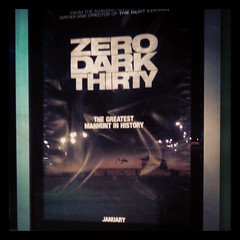
Zero Dark Thirty: This one felt important (Photo credit: MikeOliveri)