by Dean | Nov 5, 2012 | General
The fifth season of the TV series, Mad Men, is on DVD now, and I’ve been watching it.
The writing is still solid, and so far I’ve detected very little nonsense. What’s more, the first eight episodes—the totality of what I’ve seen—provide an excellent depiction of a marriage in well-to-do America, that between Don Draper and Megan. Don remains a disturbing man but not a complete heel, for he’s intent to love Megan and avoid cheating on her. Then again, he’s still a newlywed. His sexual hunger for Megan, running parallel with sexual madness (such as that of Pete Campbell) in other quarters, contributes greatly to the marriage’s palatability. No surprise there. Yet Don’s selfishness too easily interferes, and Megan reacts to it with imprudent emotion. That she rather fears Don is evinced when she runs in alarm from him, half-comically, inside the couple’s home in a very good episode called “Far Away Places.”
I hope Season 5 continues to be worthy. The marriage stuff has been memorable. Mad Men is a minor work of art with clever dialogue. Jon Hamm needs to loosen up a bit as Don, but his acting is largely honest and his presence impressive. Jessica Pare does loosen up as Megan and is engaging as well as character-probing.
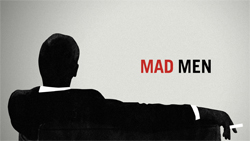
Mad Men (Photo credit: Wikipedia)
by Dean | Oct 25, 2012 | General
Wal-Mart is a morally imperfect corporation.
Robert Greenwald’s 2005 film about it—Wal-Mart: The High Cost of Low Price—is morally imperfect propaganda.
Propaganda in itself is not bad, but Greenwald’s film could use a little smart analysis and some evenhandedness. Let it glorify labor unions all it wants. Let it approve of the interviewed man who asserts, “I think the government should have more control” over the company owing to Wal-Mart’s being a “monopoly.” What spells trouble for the film is Byron York’s charge in National Review magazine (Dec. 5, ’05) that the doc’s information is deceptive. The above comment about government control issues from a citizen of Middlefield, Ohio, where the family-owned H & H Hardware was ostensibly driven out of business by a newly built Wal-Mart store. Not so, says York: “H & H closed before Wal-Mart even opened in Middlefield”—three months before. And ineffective business decisions had a lot, if not everything, to do with it.
I don’t entirely trust the words of the Wal-Mart CEO and conference speaker whom Greenwald repeatedly shows us, but even less do I trust a knee-jerk propagandist. “Wal-Mart Drives Down Retail Wages $3 Billion Every Year” we read on the screen. Actually, it just might be illegal immigrants who are doing that—or will in the near future. In any case, I’m skeptical. York’s article tells us “there is . . . serious disagreement among economists about Wal-Mart’s effect on wages.” The High Cost of Low Price, however, is not interested in that. . .

Wal-Mart: The High Cost of Low Price (Photo credit: Wikipedia)
by Dean | Oct 23, 2012 | General
Remember the name of the genre—horror—because images very unsettling keep meeting the eye in Scott Derrickson’s Sinister (2012). It’ll remind you of real life—existential terrors. The movie begins, after all, with a grainy old film shot of four members of a family being hanged.
Ethan Hawke plays Ellison Oswalt, a writer who, though he loves his family, loves even more the thought of writing another true-crime bestseller. He seeks to discover what happened to the fifth, and missing, member of the murdered family, but unwittingly he must begin to mingle with supernatural dark forces.
Yes, there are spooky children here, which has long been old hat, but committed work has been done in Sinister, with agreeable plotting and visual expertise. A few years ago Derrickson directed The Exorcism of Emily Rose, a film I didn’t like, but there I could at least see traces of talent. Even more talent is evident in the current movie. An occasional lack of freshness does not diminish the gripping nature of the technical effects—or the energy and depth of Hawke’s performance.

English: Director Scott Derricson (Photo credit: Wikipedia)
by Dean | Oct 18, 2012 | General
Some of the lame stuff Amy Grant has given us many moons ago is almost nonexistent on her 1991 recording, Heart in Motion, a worthy achievement. It isn’t overtly Christian except in the gospel-pop song at the end, “Hope Set High,” but implications of belief plainly abound.
“Good For Me” is a walking-on-sunshine ditty with no-nonsense percussion. “Baby Baby” is as feisty as it is pleasant. The charming “Galileo” is sort of a grade-school song with midtempo hooks (and it’s a love song: “You are starlight / I’m Galileo”). A heartfelt item with verve, “Ask Me” is not so much about the sexual abuse of a child—although it is—as spiritual deliverance through conversion.
The hit track, “Every Heartbeat”, is a good tune but vocally Grant can’t quite manage it. (She’s an imperfect singer.) Unlike “I Will Remember You,” which satisfies, “You’re Not Alone” is a bore, and a couple of others don’t cut it either. Still, this may be Amy’s best album. The finest cut on it is “That’s What Love Is For,” whose melody and harmony Gershwin and Irving Berlin would have envied. It comes on strong but not ill-fittingly so, and it boasts a decent lyric: “Sometimes I wonder if we really feel the same / Why we can be unkind.” It is only in the mind of a genuine and concerned Lover that such a thought springs up.

Heart in Motion (Photo credit: Wikipedia)
by Dean | Oct 15, 2012 | General
The first Atlas Shrugged movie was merely good (if faulty); Atlas Shrugged Part 2 (2012) is terrific.
The word “socialism” is never uttered in the two films, but a corporation-controlling and anti-business U.S. government has emerged and is hitting hard the likes of businesswoman Dagny Taggart. In fact, it is a putatively humanitarian government which desperately tries to cure the country’s economic distress, but is no damn good at it.
The director this time is John Putch, whose sense of composition is finer than that of the first movie’s director. There is effective editing by John Gilbert, even if the lighting by cinematographer Ross Berryman sometimes mars the picture. The cast is new too, with a lovely Samantha Mathis, convincing as a CEO, now enacting Dagny. Jason Beghe has a coarse voice but is commandingly solid as Henry Reardon, the defiant owner of a steel business.
Atlas is an oddity: With its train travel and the fact that no one wears hip clothes, etc., it has one foot in the 1950s, when Ayn Rand’s novel was published, and one foot in the 21st century. Consider the fossil fuel-replacing motor! For all this, the filmmakers manage to maintain more political understanding and honesty than film critics who spurned Part 2 will ever know.

Atlas Shrugged (Photo credit: pursuethepassion)
by Dean | Oct 8, 2012 | General
Viola Davis and Maggie Gyllenhaal are thoroughly credible in 2012’s Won’t Back Down, in which two single mothers, one of them a teacher, become unlikely pro-education activists. They seek to gain school board approval to turn a miserably failing grade school into their own union-free establishment (charter?), thereby bucking appalled union officials.
The film doesn’t stint on showing us how junky public schools have become, and as one who neither fully trusts nor fully respects labor unions, including teachers’ unions, I admire the direction WBD goes in. Nevertheless, it needs to disclose more of what the local union is doing to hinder the good teachers at Adams Elementary from teaching well. It’s not as clear as it should be.
The directing and the utterly appropriate cinematography are stronger than the movie’s script, but the film is robust and interesting. And the always running working-class gal and loving mother Miss Gyllenhaal creates simply cannot be improved on.
Director and co-writer: Daniel Barnz

NEW YORK, NY – AUGUST 03: Actresses Maggie Gyllenhaal and Viola Davis attend the ‘Won’t Back Down’ screening at NYIT Auditorium on August 3, 2012 in New York City. (Image credit: Getty Images via @daylife)