by Dean | Oct 9, 2018 | General
Taylor Swift‘s liberal politics are boring (“any form of discrimination based on sexual orientation or gender is WRONG”). But no wonder. Her music is moving in a boring direction too. Such songs as “Delicate” and “Dress” have their hooks, but they’re wasted on insignificant lyrics. They’re pedestrian. “Look What You Made Me Do” does the same score settling we got from “Shake It Off.” Really, Taylor’s subject matter is no good now. She isn’t actually maturing—in all the ways that count. Maybe next time.
by Dean | Oct 7, 2018 | General
The nocturnal robber in the 1948 He Walked by Night ends up murdering a police officer and thereby brings down on himself a load of professional energy for his seizure. Played by Richard Basehart in what is supposed to be a true story, Roy The Killer is a loner obsessed with electronics, for, after all, he himself is an alienating machine. No emotion, no conscience. He even shoots and leaves paralyzed a second cop.
He is L.A.’s public enemy no. 1 (so it seems) and gets his comeuppance in the huge dark city sewers. The pursuit there is a visually striking scene, with direction by Alfred L. Werker and an uncredited Anthony Mann. Crane Wilbur is the main writer for this filmic procedural with good gunfights.
by Dean | Oct 5, 2018 | General
The border separations of children from their illegal-immigrant parents are infinitely sad. The makers of Law and Order: SVU are probably very proud of last night’s episode dealing with the matter, but they need not be.
Regarding certain individuals, such as a federal agent whom Liv (Mariska Hargitay) orders to be arrested, it was highly unlikely, and it emitted the usual sentimentality. Annoyingly, the show used Hargitay for liberal agitprop—fatal for fiction—and I am prompted to opine something about the scriptwriters: they are blithely unaware that the family separations problem is not a simple issue. This is owing to Trump’s responsibility to uphold federal law and to the weak policy of catch-the-illegal, release-the-illegal. These things were not mentioned in the SVU episode.
by Dean | Oct 4, 2018 | General
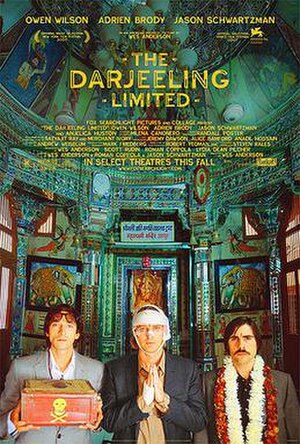
Image via Wikipedia
The search for spiritual discovery needs a more sophisticated treatment than it gets from Wes Anderson’s The Darjeeling Limited (2007), very interesting though the film is for about an hour. The title refers to a “poshly anachronistic Indian train” (Ross Douthat) carrying three American brothers whose minds are far from sanguine. The first sixty minutes are nearly enough to make you gleeful, especially since they’re oddly divided into two disparate parts. But after that, Limited is muddled. It makes the not uncommon mistake of simultaneously glorifying temple-filled India and amounting to nothing philosophically.
The Sixties’ rock on the soundtrack doesn’t help.
Sixties’ rock?
by Dean | Sep 29, 2018 | General
The Bachelor and Bachelor in Paradise are crummy TV programs, as is The Bachelorette; they’re offensive and phony. However, they do offer something to the male ego when they confirm that women still want to be loved (with eros) by men. And they offer something to the female ego when they show how it pleases a man to win a woman’s heart and that even he can get weepy when he fails to do so.
Weepy: a problem exists in that we don’t know how phony these programs are in their creation of drama. Did Kamil in Bachelor in Paradise (2018) feel pressured to reject Annaliese so the show could end more dramatically, more stimulatingly, then it would have otherwise? I hope not, but who knows? Me, I’d rather see this televised junk produce happy couples than ones who weep via fraudulent drama.
by Dean | Sep 25, 2018 | General
For a long time the noir item, Scarlet Street (1945), is to me interestingly artificial and almost quaint as it focuses on an innocent played by Edward G. Robinson who falls in love with an alluring slugabed (Joan Bennett). Er, well, she’s not just an alluring slugabed: she’s doing the will of a reprehensible con artist (Dan Duryea). By and by the flick, directed by Fritz Lang, grows much less artificial (or stylized) and its almost-quaintness disappears.
SS is based on Jean Renoir’s La Chienne, itself based on a novel, and it is as sexy, nice-looking and perceptively cast as it is unoriginal. Robinson knew how to enact an innocent—one who is foolish and finally miserable. Duryea is never false with his two-faced character, not even when he abuses his glamorous girlfriend, Bennett. The powerfully feminine Joan, with fine range, is the best thing about the film.