by Dean | Dec 27, 2017 | General
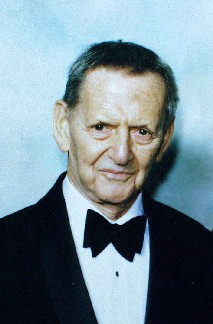
Actor Tony Randall (Photo credit: Wikipedia)

English: Edie Adams in a 1965-1966 commercial created for Muriel Cigars. Actress and singer Edie Adams was also Mrs. Ernie Kovacs. (Photo credit: Wikipedia)
Quite a bevy of characters shows up in Lover Come Back (1961), a Rock Hudson-Doris Day farce. There is a highly competitive (and rightly so) female professional at an advertising agency (Day), a smart but unprincipled Lothario (Hudson), a top-tier insecure neurotic (Tony Randall), a not-quite-innocent Southern cutie (Edie Adams), a grumbling, misanthropic chemist (Jack Kruschen). They live in a nonthreatening New York City, albeit the only good character is Day.
As in other early ’60s Hollywood comedies, a colorful, lighthearted title sequence precedes the fluffy, likable action. With talent Stanley Shapiro and Paul Henning have churned out a script which is a cross between Mad Men and You’ve Got Mail.
And I’m sure, after they finally get together, that the Lothario will treat the female pro as right as rain.
Directed by Delbert Mann.
by Dean | Dec 26, 2017 | General
In 1965, with Fist in His Pocket, Italy’s Marco Bellocchio proved he was an able film artist. His movie is about a wretched family living wretched lives. They, the people, are morally and existentially wretched: One of them (Lou Castel) is an epileptic who dabbles in incest with his sister. Disturbingly dark stuff.
Families, the film says, are often invaded by existential nightmares, although the oldest son in the present clan (Marino Mase) has a good chance of escaping it in the family he will start with his nice fiancee. Who knows? Life is hell, though.
To me, Fist in His Pocket is a bit tiresome. It has been called nihilistic. Actually, if it is, it slowly becomes so preoccupied with pathology that the nihilism—and everything else—seems like an afterthought. This is a flaw. To be honest, there isn’t much to the film. Bellocchio, all the same, directs scintillatingly, and Castel, Mase and Paola Pitagora (pitiful Sis) have interesting faces and perform compellingly.
(In Italian with English subtitles)
by Dean | Dec 22, 2017 | General

Cover of Romeo & Juliet
The famous 1968 Romeo and Juliet, by Franco Zeffirelli, tries too hard in its cinematic realization. Much is overdone, such as the loathsome performance of John McEnery as Mercutio; and, withal, too much of the text is cut. The killing of Paris, for example.
I agree with Philip T. Hartung about “the terrific fight between Romeo and Tybalt,” and—except for Juliet’s distracting cleavage in the balcony scene— the film’s sensuality works quite well. Leonard Whiting and Olivia Hussey play the classic lovers and they’re not bad, but they’re defeated by something: the film lacks tragic anguish, true tragic darkness. We don’t feel the wound. The movie is too noisy, too busy, and too commercial for tragedy to force its way through. I said it tries too hard, but with tragic anguish it doesn’t try hard enough.
by Dean | Dec 19, 2017 | General
There is excellent work from actors Laurie Metcalf, Lois Smith (as a nun) and Saoirse Ronan in Greta Gerwig‘s movie, Lady Bird (2017), and pretty appealing work from Gerwig as well. Ronan enacts “Lady Bird,” or Christine, McPherson, an adolescent girl who attends a Catholic high school and who frequently fights with her intolerant if concerned mother (Metcalf).
Director Gerwig wrote the intelligent screenplay, never lapsing, unlike other small-film scenarists, into smug pseudo-intellectualism. Up to a point, even so, her writing is schematic: Lady Bird drifts away from her best buddy and befriends a cool beauty, who disappoints her. Chastened, she then returns to her best buddy with customary sentimentality resulting. A letdown, this. Also, the film could use more psychological believability, as when the defensive Lady Bird literally pleads with her mother to be reasonable about her going to an Eastern college.
But many jewels are glittering in Lady Bird. It presents interesting characters and dialogue, and it boasts a lovely ending involving a church and a phone call. It is, I think, a film that believes in God, along with being respectful of its few devoutly Catholic figures.
by Dean | Dec 18, 2017 | General
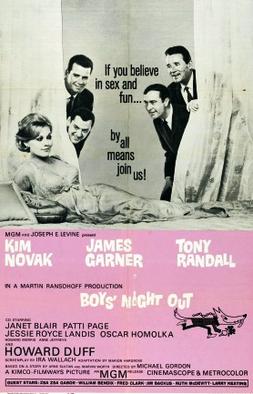
Boys’ Night Out (film) (Photo credit: Wikipedia)
A top-notch comedy, Boys’ Night Out (1962) proffers three corrupt married men who want an out-of-town pad where they can be serviced by a willing girl. Under protest, a bachelor friend played by James Garner finds for the men both the pad and the girl (Kim Novak), who is not what she seems. Instead of a floozy, Novak is a sociology student intending to study the suburban gents. Falling for her and pitching his woo, Garner is confused, for he doesn’t understand the masquerading girl’s personality. Naturally, after the wives of the corrupt men learn of their husbands’ adultery, there is zany pandemonium.
The film was deftly directed by Michael Gordon, who fashioned Pillow Talk. Scripted by Ira Wallach (adapting it from a story), it’s mildly charming and moderately funny, which means it’s funnier than most of the old black-and-white screwball comedies, good as they are. The restrained farcical acting of the cast is proper, although none of it is too restrained. Kim Novak is more feminine than Doris Day but has less personality, and yet she is credible. Tony Randall and Fred Clark make a splash.
Boys’ Night Out tells us that the sex drive, though men obey it, is not all that strong, really. It says this while being decent enough to maintain a respectable attitude toward Novak’s lovely non-sexpot and, more or less, the other women in the film as well.
A sapid romp. –
by Dean | Dec 14, 2017 | General

Film poster for The Brown Bunny – Copyright 2004, Wellspring Media (Photo credit: Wikipedia)
In The Brown Bunny (2005), a film he wrote, directed, edited, etc., Vincent Gallo stars as a motorcycle racer whose amatory attachment is to Chloe Sevigny‘s Daisy. The pair being separated, the racer tracks Daisy down in Los Angeles after purposefully abandoning three female strangers with whom he might have gotten intimate. The two lovers are messed-up people, one more messed-up than the other. This is Daisy, a doper and possible tramp. . . The film is evocatively directed—it evokes human isolation—and there are certainly people who do not find it monotonous. But I do. And that’s not all.
Gallo considers himself a conservative and, for sure, no sexual liberalism exists in this movie. And yet it was made, finally, in a pornographic spirit. A scene of fellatio goes on forever. It’s distasteful. Is Gallo trying to say that love and tramp-y, non-marital sex do not go together? I rather doubt it, but there is no way to know.