by Dean | Aug 3, 2015 | General
Directed by Robert Mulligan, The Stalking Moon (1968) is a rough-hewn Western wherein a white woman (Eva Marie Saint) kidnapped long ago by the Apaches, and now rescued, struggles to keep the Indian father of her half-Indian son from taking the boy away. Helping her in this effort is a retiring army man (Gregory Peck) voluntarily serving as her escort. The likable action scenes hardly redeem this picture once it starts failing to make sense—perhaps the novel from which it is adapted is more illuminating—and since it too quickly and casually ends. As it happens, Moon is one of the weakest Westerns of the past few decades.

Cover of The Stalking Moon
by Dean | Jul 31, 2015 | General
To have one’s mind taken away is to lose one’s personhood. This is what happens to the people of Santa Mira as the outer space body snatchers do their demonic possessing in Don Siegel’s Invasion of the Body Snatchers (1955). Once the bodies are snatched, the people feel no love or any other emotion, caring only about self-preservation. In the interest of this, in fact, they know how to mimic people who still have their humanity. Miles (Kevin McCarthy) and Becky (Dana Wynter) still have theirs, and they themselves rush about for the sake of self-preservation. There is a fascinating panic in the film. Siegel never makes a misstep, and the tale, based on a Collier’s magazine serial, is unerringly crafted.

Cover of Invasion of the Body Snatchers
by Dean | Jul 29, 2015 | General
Without harshness This Is Spinal Tap (1984) satirizes hard rock musicians: the few who make up the British band Spinal Tap are blokes with very little going for them. Rob Reiner’s modest film is a mockumentary, still as funny as ever, with dandy cameos by Fran Drescher, Patrick Macnee and Fred Willard.
Principal cast members, Christopher Guest among them, wrote the script, which outdoes later mockumentaries which Guest himself directed.
Note: The sight of a long-haired, shirtless Harry Shearer is not one I care to see again.

Cover of This is Spinal Tap (Special Edition)
by Dean | Jul 28, 2015 | General
It’s a pity that American movies declined in quality in 1975 and did not recover at all until the Nineties. Granted, they were not much better during the Sixties, but the years ’70 to ’74, for all the consistently adult material, told a somewhat different story. To be sure, I hate M*A*S*H and McCabe and Mrs. Miller, the Robert Altman offspring, but Badlands, Carnal Knowledge, Chinatown, Slaughterhouse-Five and three or four others are solid artistic successes. The Godfather might be, too, but I need to see it again to be sure. Even such films as The Conversation and Save the Tiger, though failures, are at least interesting and non-homogenized. A late ’70s film like Breaking Away, on the other hand, is interesting and homogenized.
A problem arose in that most of the artistic stuff failed to make money. Chinatown did okay, but the weird Slaughterhouse-Five? Forget it. The 1975 Michael Ritchie picture, Smile, didn’t make the commercial grade either, by which time Hollywood had had enough. It very much wanted stuff that was tamer and less ambitious. The truth is that to an extent moviegoers had let down the artists.

Cover of Carnal Knowledge

Save the Tiger (Photo credit: Wikipedia)
by Dean | Jul 26, 2015 | General
From Taiwan, in 1994, came Ang Lee’s Eat Drink Man Woman, whose title might betoken a loopy comedy; but, no, the film is merely a serious comedy, or comedy-drama, not a loopy one. The four-word expression refers to food and sex, and it may well occur to us that in Lee’s film not much gets in the way of “eat drink” (for such is life in a developed country) but much does get in the way of “man woman” (quite common in any country).
The major characters are Chu, a middle-aged widower and master chef, and his three daughters, Jia-Chien, Jia-Jen and Jia-Ning. None of the daughters is married yet or even has a boyfriend, although beautiful Jia-Chien, a white-collar airline employee, attracts the attention of two handsome men with whom she might become only superficially involved, if at all. Jia-Jen is a Christian who teaches chemistry and is virtually regarded as an old maid, but has eyes for a public-school volleyball coach. Jia-Ning is a teenager who works at Wendy’s and gradually wins over a co-worker’s beau.
Physical needs and wants must be tended to; they make up the routine. But Chu wants to know if “eat drink man woman” is all there is to life. A person like the religious Jia-Jen proves it is not, and yet the complete blocking of physical, or sexual, pleasure means the denial of sexual-amorous love. This latter, sexual-amorous love, is on the horizon for Jia-Ning, the youngest daughter, but Jia-Chien, albeit she has been sexually active, is simply groping for it and Jia-Jen is beginning to grope for it (for the second time in her life?) until success occurs.
The film is perfectly, imaginatively directed by Ang Lee—a fine artist—who wrote the script with two other men. An unpredictable, moving story it is, played out by admirable actors. And there is superb music by Mader, sometimes jaunty and sometimes sweet in an Erik Satieish way. To me, this early Lee achievement is one for the ages.
(With English subtitles)
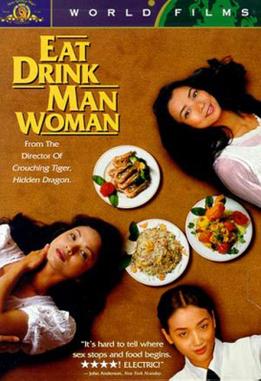
Eat Drink Man Woman (Photo credit: Wikipedia)
by Dean | Jul 23, 2015 | General
It is post-World War II, in 1948, and New York City marches on, busy and packed with the citizens. Jules Dassin’s Naked City is the most urban movie I’ve ever seen, giving Serpico and An Unmarried Woman (you’re so Manhattan, girlfriend!) a run for their money partly because of the black and white cinematography.
How productive the Big Apple is! Ah, but as the police know, the jewel thieves are out there, and so are the murderers. There are no dirty cops in this film, fortunately. They’re very amiable, whereas the felons, especially the killer of one Joan Dexter, are not whitewashed. Sinners are true sinners in Naked City.
The screenplay by Malvin Wald and Albert Maltz is generally credible, and Dassin has so directed as to almost produce pictorial art. It’s the biggest canvas you’ll find in film noir.
The movie stars Barry Fitzgerald, Howard Duff and Don Taylor.

The Naked City (Photo credit: Wikipedia)