by Dean | Oct 11, 2015 | General
Future technology permits five elderly people to go back to age 20 and thus elude death, but the supervisor of the project, Dana, has difficulty making these people happy about it and even keeping them in line. This constitutes part of the action in Lee Blessing’s splendid play, The Hourglass Project (2015), mounted for a very short time, as college theatre is, at the University of Tulsa.
What happens as well is that Dana fights to prevent her parents, who paid for the creation of the rejuvenating technology, from wholly erasing the subjects’ memories. Mom and Pop are cruel—just like the society in Never Let Me Go, another work which warns about the uses of technology. With the looming erasure, though, the play disappoints a little, but not much. It is still fresh and incisive enough, not to mention tragicomically sad. The same shattering effects that life brings to people near the end of their earthly time (Alzheimer’s, for example) emerge for these people after this particular scientific intervention.
TU’s production is the premiere of The Hourglass Project for regional theatre. The talented Blessing himself helped with the staging, and indeed it was—last night, October 10th—a fine production.
by Dean | Oct 8, 2015 | General
2008 saw the publication of the Marilynne Robinson novel, Home, which explores such common themes as religious faith, old age, personal failure, and forgiveness. But, as it relates what occurs between Christian believer Glory Boughton and her prodigal brother Jack, it yields a boatload of meaning which is not terribly common at all in world literature.
It affirms that for spiritual and unspiritual persons alike, life happens, as when Glory and Jack’s elderly father, a Presbyterian minister, develops severe dementia. Glory’s ex-fiance declined to tell her he was already married, and here the book paves the way for a message about how difficult it is for even a Christian to forgive. Alas, more than once Glory proves she is, to an extent, an unforgiving believer.
In addition, Home is about the mystery of the salvation of the soul. Glory says she is not certain what a soul is, but what is also evinced is that the salvation the minister father has long had is to Robinson so important that Jack wishes to convince the old gent that he now sees theological belief as valid. Nothing less than validity would cause the author to wrap up the novel with the sentence, “The Lord is wonderful.”

Cover of Home: A Novel
by Dean | Oct 5, 2015 | General
The first time I read Milan Kundera’s novel, The Unbearable Lightness of Being, I enjoyed it; when I started it a second time I was bored—an effect I don’t think any of the great classic novels of earlier decades would ever have on me with further readings. In some measure this may be because I don’t accept that an “unbearable lightness of being” exists, or might exist, as Kundera does. As a Christian I believe that being has decisive weight, which is another way of saying it means something.
However, even if it didn’t, Philip Kaufman’s 1989 adaptation of the book is not the film to convince us of it, of anything philosophically dark and enigmatic. The novel is suffused with thought; the film is only superficially thoughtful. For example, only once or twice is the titular lightness mentioned, which is hardly enough for the concept to be dramatically emphasized. Like the book, the film gets boring, though only after the first hour and a half, and the mitigation of this boredom, I must admit, comes with the occasional nudity and sex.
But via these elements Kaufman says virtually nothing; he just thinks he says something. A nexus between sex and thematic meaning seems as wispy here as the shots of the 1968 Soviet takeover of Czechoslovakia are fancy and cloying—wretched, in fact. The movie was a mistake.

Cover via Amazon
by Dean | Oct 4, 2015 | General
In The Intern (2015), director-writer Nancy Meyers creates a female character, Jules, who has it all. Or she nearly does. At the same time, Meyers has fashioned two of the kind of male characters she will value and cherish for the rest of her life: i.e., men who are enlightened about women and their jobs. One of the problems with the film is that one of these men, Ben (Robert De Niro—Jules’s intern), is a paragon of righteousness, having no faults to speak of. This is not quite the case with the other man, a stay-at-home dad to whom Jules is married. And yet . . .
The Intern is not the most realistic feminist pic you could see, and, what’s more, it’s pretty bumpy—“clumsy” (Joe Morgenstern). Truth to tell, it’s a failure, but an interesting one in which we get to see a well-grounded and sensitive performance by Anne Hathaway as Jules, in addition to Meyers’s curious imagination. Alas, there is an immature, unfunny shlub too (Zack Pearlman’s Davis)—here because every American comedy-drama has to have one.
by Dean | Oct 2, 2015 | General
Nothing spoils contest goods, such as those won by Jimmy Stewart’s Bill Lawrence in The Jackpot (1950), like Uncle Sam via the IRS. Bill gives the right answer to a radio-show question and receives the loot the federal government becomes so eager to tax, understandably prompting Bill to loudly inquire whether the “STATE [government]” will be just as grasping. You got that right, boy.
But it isn’t merely the IRS that is setting traps for Bill. The winnings eventually shake up his marriage to Amy (Barbara Hale), who sees good reason for jealous suspicion. . . Walter Lang’s playful conservative flick is, like innumerable other Old Hollywood comedies, not very funny but still entertaining. It is also forgotten—except by YouTube—but why should we forget something that has Jimmy Stewart and two very good-looking women: Barbara Hale and Patricia Medina (as a Frenchie)? More, it provides the right amount of sentiment for its unmawkish romance.
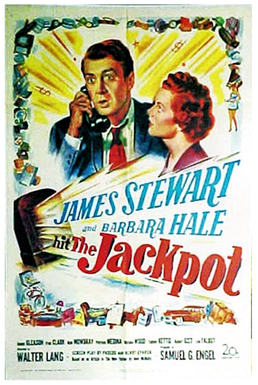
The Jackpot (Photo credit: Wikipedia)