by Dean | Jul 23, 2015 | General
It is post-World War II, in 1948, and New York City marches on, busy and packed with the citizens. Jules Dassin’s Naked City is the most urban movie I’ve ever seen, giving Serpico and An Unmarried Woman (you’re so Manhattan, girlfriend!) a run for their money partly because of the black and white cinematography.
How productive the Big Apple is! Ah, but as the police know, the jewel thieves are out there, and so are the murderers. There are no dirty cops in this film, fortunately. They’re very amiable, whereas the felons, especially the killer of one Joan Dexter, are not whitewashed. Sinners are true sinners in Naked City.
The screenplay by Malvin Wald and Albert Maltz is generally credible, and Dassin has so directed as to almost produce pictorial art. It’s the biggest canvas you’ll find in film noir.
The movie stars Barry Fitzgerald, Howard Duff and Don Taylor.

The Naked City (Photo credit: Wikipedia)
by Dean | Jul 21, 2015 | General
I suppose that at bottom Private Hell 36 (1954) is Ida Lupino’s film. Don Siegel directed it, but Lupino starred in and co-wrote it—originally for the screen, hooray!—with Collier Young. She plays a bar singer who falls for a now admirable, now dirty cop (Steve Cochran) intent on making his distressed partner (Howard Duff) dirty as well.
The movie is right up Siegel’s alley, with hard-nosed conflict, unobtrusive mystery, human interest, and a car chase. The cast is estimable: what Lupino and Cochran do cannot be improved on.
I am inspired to add, too, that there is nothing feminist about the Collier-Lupino script. The bar singer, Lillie, is not a “liberated woman” but simply an adult: she talks like an adult, likes to be with other adults, and is never to be patronized. That she isn’t at the center of the cops-and-crime story here doesn’t alter the evidence that Lupino and Siegel were meant to be together.
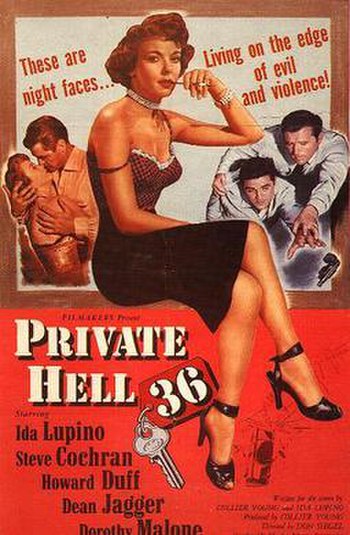
Private Hell 36 (Photo credit: Wikipedia)
by Dean | Jul 19, 2015 | General
Big adolescent Seth MacFarlane has come out with Ted 2 (2015), a sequel to Ted.
Just because the jokes in a comedic flick are sometimes politically incorrect doesn’t mean the flick is a good one. The concept of a talking teddy bear (who’s a stoner) is pretty puny, pretty mediocre, and thus it doesn’t well serve the movie’s plot. Yes, although Ted 2 is too vulgar, it is often funny, and yet some of those jokes seem a bit desperate. Example: a black woman comments on slavery by saying that, first, you’re working beside an African river; then, the next thing you know, “you’re being f**ked by Thomas Jefferson.”
Did Thomas Jefferson f**k a lot of slaves? Or is it just that McFarlane’s movie is f**ked up?
by Dean | Jul 15, 2015 | General
1958’s The Left Handed Gun is a Billy the Kid movie—Paul Newman enacts the Kid—directed by Arthur Penn, who holds his own among other Hollywood directors of Westerns. In fact he proves he can be a bit daring.
Billy and his two buddies engage in a lot of mischief while, at the same time, an undercurrent of dire threat exists—as in Penn’s Bonnie and Clyde. Penn said he and writer Leslie Stevens, adapting a television play by Gore Vidal, tried to demonstrate that in the Old West life was cheap (if that is indeed true). . . Gun is a pretty good movie, and Newman’s attention-grabbing talent is evident. The film is superior to every other Arthur Penn work I’ve seen, though I’ve yet to lay eyes on Mickey One, and miles above his rotten Western The Missouri Breaks.

The Left Handed Gun (Photo credit: Wikipedia)
by Dean | Jul 14, 2015 | General
Author of High Fidelity and Juliet, Naked, Nick Hornby has said he believes reading novels ought not to be hard work any more than watching television is. Certainly he has made good on this view with his latest novel, Funny Girl (2015), but has also, for good measure, set his narrative in the world of television: BBC television. Not the BBC now, but the BBC of the Sixties (the beginning year is 1964), with the novel not so much about comely, ambitious Barbara Parker, the “funny girl” of the title, as about her and her cohorts as they mount a weekly sitcom.
To me the book is a page-turner, as Hornby wanted it to be, although like your typical TV show it doesn’t seem to be saying much. In this it differs from High Fidelity. All the same, I enjoyed the people and the dialogue in Funny Girl, despite the funny girl’s not being a fully realized character. It’s a kick to see Barbara, a.k.a. Sophie, dissociating herself from the celebrity she physically resembles: Sabrina, a British pinup and actress born in 1936 and known for her splendid curves.