by Dean | Dec 23, 2014 | General, Movies

The Magnificent Ambersons (film) (Photo credit: Wikipedia)
George, the young man played by Tim Holt in The Magnificent Ambersons (1942), is not only a cad but a fool as well. Maybe, just maybe, he’ll learn not to be callous to the father of the girl he desires to marry.
This Orson Welles picture is quite unlikely—and quite thin too. Unlike other Old Hollywood films, however, it has a strong tragic dimension (similar to that in Citizen Kane) and its visual artistry still pleases. The best thing about it is that uncommon air of mystery mentioned in 1963 by William Pechter. It’s a classic, but needed to be far better.
by Dean | Dec 22, 2014 | General
 A terrific Swedish film adapted from a best-seller called Swedish Heroes was given the U.S. title of Expectations (1997), which is fitting because human expectations run rampant here. Some are dashed, others are fulfilled. One of them abides in an aging fellow who has wasted his life and concerns a beautiful female angel!
The film examines parent-child, husband-wife relationships, etc. with humor and charm and directorial skill from Daniel Bergman. There is so much ultimate sanguinity, though, that Expectations is practically feel-good stuff, but that’s okay. It’s not as though everything in the film is pleasant. Swedish acting, by the way, is as estimable as it ever was.
by Dean | Dec 19, 2014 | General
The writer Larry Woiwode knows America to be a land that will never truly renounce Christianity both Catholic and Protestant, and this is glowingly reflected in his fiction about the Neumiller family of North Dakota.
Much of this fiction is in the form of short stories like “The Suitor”, whose protagonist, Martin Neumiller, proposes marriage to Alpha Jones. Martin is a Catholic Christian who receives bad vibes from Alpha’s feisty, drunken father and shortsighted Protestant mother; but the standard attachment to a major institution—i.e. marriage—brings resolution. The parents are happy their daughter was proposed to.
The incidents in “Marie” take place many years later, after Alpha has passed on and Martin intends to remarry. Marie is the youngest child of the couple: she has grown up without a mother and knows she cannot possibly fill the woman’s shoes for the family (“I can’t do anything right”). Yet, as Marie points out, she is the one who’s alive, she is here, albeit Woiwode demonstrates his firm belief in God by making it seem that Alpha Neumiller is not really a person of the past. Somehow she lives too, her death not looked at through a nihilistic lens.
Woiwode is a man of faith whose prose is soothingly subtle and gently penetrating.
“The Suitor” and “Marie” can be found in his book The Neumiller Stories.
http://gty.im/159463818
by Dean | Dec 14, 2014 | General
Suspend disbelief here and there, and you’ll enjoy the Francois Truffaut flick The Woman Next Door (1981) which, though it isn’t saying much, was seen by more Americans than any other foreign film in ’81.
Again, as in other Truffaut movies, there is amatory passion. Adele H. never quite committed adultery, however; Gerard Depardieu and Fanny Ardant do. Woman is about the monstrousness of temptation. Depardieu’s first mistake is not informing his nice wife that before he married he once had a love affair with new neighbor Ardant; he keeps it a secret. Naturally he soon learns that he and Ardant can’t be just friends. The tragedy which ensues is especially jarring in a movie this typically lyrical and basically simple, plainly lacking in gravity. Film buff Truffaut insisted on his achievements being serious but not grave, which is why there is something of Hitchcock in this tragedy. But whereas I am not convinced the estimable Hitchcock was an artist, I believe Truffaut was.
(In French with English subtitles)

Cover of Fanny Ardant
by Dean | Dec 11, 2014 | General
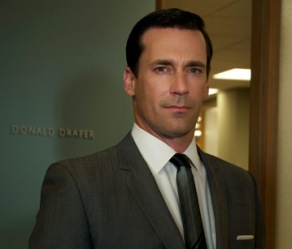
Don Draper of Mad Men works on Madison Avenue (Photo credit: Wikipedia)
Since there’s a dearth of serious, intelligent movies right now (a common event), I’ll cast an eye on the serious, intelligent TV series Mad Men.
There is nothing mad about these men of Madison Avenue: they’re perfectly sane, and usually efficient. But they can be self-defeating. I’ve been re-watching the fourth season, in which Don Draper (Jon Hamm) loses to cancer the only friend who has ever truly known him and consequently feels defeated. In following episodes, though, we see the proclivity to be self-defeating that in Draper we are used to seeing.
Probably Don wins our sympathy in this season more than in the first three, but it is unfortunate that his religion is Coming Out On Top. This leads him to some puzzling behavior, as when he expresses a preference for charming Megan (Jessica Pare) over the woman with whom he is already in a relationship: the affable, highly supportive Faye (Cara Buono). Then again, Faye might deserve better than the two-timing Don, but what about Megan? ‘Tis hard for a woman to come out on top when Draper strives to do so, for all the blessed privilege that comes her way. (Ah, the unprecedented wealth of America!) Mad Men looks at privilege warily. After all, Don’s ex-wife Betty (January Jones) is very privileged, and she unjustly fires the black nanny and won’t even give her a good recommendation.
That’s almost mad!