by Dean | Oct 2, 2014 | General
In Wild Strawberries (1959), an old man and esteemed professor gets, in a way, bludgeoned for being less virtuous than others would suspect. (He’s expressionistically bludgeoned.)
Is there anything that saves this famous Ingmar Bergman film? NO. It’s tiresome glop. When it isn’t fatuous (the despairing husband who also serves as figurative judge) it’s sentimental (the old man’s gentle eyes fixed on a remembered Bibi Andersson). Plus the protag’s selfishness, etc. is usually revealed through exposition, not drama. . . In truth, art should not be as unentertaining as this.

Wild Strawberries (film) (Photo credit: Wikipedia)
by Dean | Sep 30, 2014 | General

English: Sir Alan Ayckbourn was lunching with Critics’ Circle members at the National Theatre on 22 April 2010, on the occasion of the presentation of the Critics’ Circle annual award (Photo credit: Wikipedia)
The Alan Ayckbourn play, The Norman Conquests, and its televised performance (in 1977 and available on DVD) make for a magnificent experience.
This is actually a triptych of plays featuring six British characters, all but one of them related. Many a fault, or sin, is manifest among them; many a sad moment arises. Norman is an assistant librarian and a great, rather promiscuous, lover unhappily married to a woman he nevertheless yearns for. He conducts an affair with Annie, who inwardly recoils from such a feckless man but is subtly resisted by the naïve chap, Tom, of whom she is fond. Matronly Sarah nags her husband Reg mercilessly, but is disappointed enough with her marriage to enjoy the odd attentions of the Norman she deplores.
A serious play, then, but, as everyone knows, Ayckbourn writes comedies—which is why his plays get mounted—so there is no depressing content. The cast is superlative. Tom Conti (Norman), for example, is nearly startling in his nuances. Penelope Wilton was as good an actress in her thirties as she is now, and had better material in Norman than she does in Downton Abbey. As Annie, she can be fiery but yearningly sensitive as well.
Also, I’d like to say this: Again, it is a 1977 production, and it’s refreshing to see a show which never questions whether a character who is less than a he-man, e.g. Norman, is genuinely heterosexual (instead of, say, bisexual). Behind such questioning is the wish to see homosexuality as more pervasive than it really is. No, The Norman Conquests is a strictly heterosexual comedy.
by Dean | Sep 25, 2014 | General
Federico Fellini’s 1954 film I Vitelloni (“Overgrown Calves”) proves just how satisfying an original screenplay can be. Three heads, one of them Fellini’s, produced it, and the result is a sure artistic success about life as lived by five young men in a provincial Italian town. Unambitious about traditional living—traditional living, to be sure, in an arid town—the callow “overgrown calves” are indifferent to the social values their elders know must exist.
Fellini’s direction is careful and winningly imaginative, serving a film as buoyant as it is sad. Precisely the sympathy for freakish people we want, but don’t always get, from a Fellini movie exists in spades here. Better, everything is made engaging, from characters to details.
(In Italian with English subtitles)
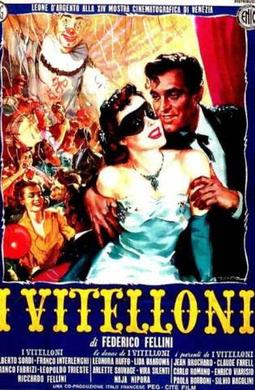
I Vitelloni (Photo credit: Wikipedia)
by Dean | Sep 23, 2014 | General
The quicksilver farce in They Came Together (2014) is reminiscent of that in the TV shows Arrested Development and 30 Rock. Just as both of those series were low-rated, David Wain’s movie failed to open in very many theatres and few people have heard of it. It’s now on DVD and Blu-Ray and (in my opinion) manages to be properly structured and brashly hilarious.
A full-length parody of romantic comedies, it features Paul Rudd and Amy Poehler doing expert work as lovers Joel and Molly, and although much of the humor is not integral to the parody, that’s fine; it keeps the laughs coming. . . I used the word “brashly.” Brash because, for one thing, it’s often, but not constantly, bawdy (from the silly title on). Also, it can get pleasantly weird, as when the couple are in bed after having sex and are fully clothed. Or . . . did they have sex? It’s agreeable, too, that Wain likes his characters while he does his crazy lampooning.

English: Amy Poehler at the 2011 Time 100 gala. (Photo credit: Wikipedia)
by Dean | Sep 21, 2014 | General
The 1994 David O. Russell film, Spanking the Monkey, has, or seems to have, something important to say about family incohesiveness and breakdown, but that didn’t prevent me from seeing it on my first viewing as shoddy and on my second viewing as a shoddy bore. All that stuff about college boy Raymond’s lovemaking difficulties with the high school girl meanders enough to make it a bore. When Raymond and his mother childishly play with some cheese they’re supposed to be eating, it constitutes some of the tackiest film footage to be shown in ’94 and probably beyond. As for the gradual mother-son incest, why bother to comment? It doesn’t offend; I just have no idea why it’s there, why it occurs. Is it merely because mother and son are sexually starved? Not viable. Spanking the Monkey is an independent film—independent of taste and brains.

Cover of Spanking the Monkey