by Dean | Sep 17, 2014 | General
The best pop songs, besides being melodic, intelligently concern the human condition, which is exactly what the pop musical God Help the Girl (2014), by Stuart Murdoch, does, book and all. That book and those songs were penned by a bloke who proves he is one heck of a talent; moreover, Murdoch (of Belle & Sebastian fame) also directed this vigorous pic.
Eve (Emily Browning), who has been in a mental hospital, longs to make music and hopes to initiate a new life. She takes up with two new friends, one of whom—James (Olly Alexander)—wishes to love her and solidly aid her in a pop music career. Both aims prove to be a trifle too challenging.
The story grows thinner than it ought to, but the movie itself is never less than intelligent and musically delightful. Although the songs were not written specifically for the film, Browning has a lovely voice for them and is a fitting, touching actor for Eve. . . Not at all inappropriate is Giles Nuttgens’s grainy, charily lit cinematography, and the clothes too (by Denise Coombs) are fetching. With its nice characters, God Help the Girl is utterly harmless, an often cheery paean to pure pop but unsentimental about life.

Cover of Stuart Murdoch
by Dean | Sep 14, 2014 | General
The work of cinema’s most notorious nonbeliever, the Spanish lapsed Catholic Luis Bunuel, The Milky Way (1968) is a surrealistic and of course sardonic potpourri picture about 1) Catholic history, and 2) our Christ-haunted Western civilization.
Toward some things Christian Bunuel is in a sympathetic mood, but the mood doesn’t last; before long, he snickers at what he myopically considers ludicrous and trivial. Consider: a papist-hating heretic beholds an apparition of the Virgin Mary, later informing a kindly priest of it, and there is in all this a certain sweetness, no sardonicism. Afterwards, however, a beautiful girl surrealistically pops up in the heretic’s (or ex-heretic’s) room at an inn, which prompts the priest to start lecturing the fellow about the ugliness of sexual impurity and the sacredness of virginity and celibacy—all to Bunuel’s displeasure. He creates biting irony in this whole miracle-followed-by-sexual-morality spectacle, as though nothing of the sort could possibly emanate from a deity.
Most of the film’s surrealism flounders. This being a “history,” Jesus appears in the century in which He lived (as a man) but not for a second do I accept Him as the Jesus of Scripture. He is kind but so lighthearted He lacks most of the dignity I believe the Savior of the world would have. In point of fact, Bunuel doesn’t even allow Him the dignity, after He has healed two blind men, of keeping them healed, for it isn’t long before the blindness mysteriously returns. Our atheistic director could never have accepted that Jesus actually worked those New Testament miracles, but is this a good way to show it?
Or maybe he simply wanted to symbolize the figurative blindness of some of Jesus’ future followers, since Christians in this film often persecute heretics and oppose each other, but is this a good way to show that? To me it isn’t, but even if it were, I wouldn’t want to hear it from a creepy pseudo-thinker like Bunuel.
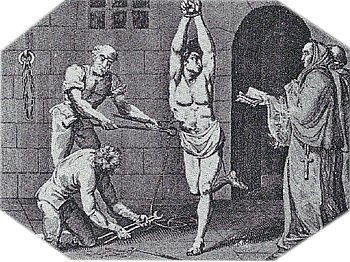
Two priests demand a heretic to repent as he is tortured. (Photo credit: Wikipedia)
by Dean | Sep 11, 2014 | General
The Doomsday Marshall, from 1975, is another transport-the-prisoner Western with flinty Marshall John Rye as the transporter and disgraceful Luke Braden as the prisoner. Braden is en route to being hanged, but has a purty wife hoping to free him and former friends hoping to kill him before he blabs what he knows.
Written by Ray Hogan, TDM is a book, not a movie, albeit it would make a good movie. Ne’er a dull moment is here, ne’er a plot point (as I recall) to make you wince. As for Hogan’s style, it is ordinary and palatable—perhaps not needing the kind of editing some oaters call for but don’t get.
I liked it. But, boy, those Old West duties were hell!
by Dean | Sep 9, 2014 | General

Cropped screenshot of Randolph Scott from the trailer for the film Follow the Fleet. (Photo credit: Wikipedia)
Budd Boetticher’s candy-colored Western, Decision at Sundown (1957), is a fine movie. It presents us with Randolph Scott aiming to kill the man with whom his wife, before committing suicide, had an affair. But Bart Allison (Scott’s character) is misguided, intent on dueling when, in this instance, the act would be stone foolish.
The tale is smart, the characters interesting, and the scene rhythms suitable as the film earnestly concentrates on men being forced to see their own lack of virtue. The acting, including that of Scott despite his stiffness, is good. True, some of it comes close to being phoned in, but it generally rises above such a level and is realistically restrained.
by Dean | Sep 7, 2014 | General
In the 2005 Junebug, the appallingly vulgar art of a Southern crank brings Chicago art dealer Madeleine (Embeth Davidtz), with her odd taste, to North Carolina to make him an offer. Madeleine travels there with her Southern-born husband George (Alessandro Nivola) and meets his commonplace family. A lot of decency and a lot of indecency are thrown her way, in a locus of little understanding, even in Madeleine herself, and much disappointment. George’s sister-n-law Ashley (Amy Adams), for example, doesn’t understand her terrible excuse for a husband–Johnny by name (Benjamin McKenzie)—but Johnny doesn’t seem to understand why he has made the choice of impregnating and marrying a naïve girl. He’s loutish, but we pity him (because screenwriter Angus MacLachlan pities him).
Phil Morrison, the inventive director, has an itch to scrutinize this Carolina milieu, and he lets many of its suburban sights sink in as we watch. A focused movie, this, and at the same time a rather casual one. Compassionate too.

Cover of Junebug