by Dean | Jun 29, 2014 | General
In the movie version of Jersey Boys (2014), Vincent Piazza does deft work as Tommy DeVito, an obnoxious member of the Four Seasons pop group. The part is an Italian stereotype, though, which is hardly surprising for a film that has zero character exploration.
Here and there Clint Eastwood’s semi-musical is as likable as the Village Voice critic says it is, but it is also insipid. A nun takes a swallow of wine and burps. Every girl either sashays or makes a fool of herself, often while listening to the Four Seasons. The movie is obtuse.
Winning performances come from Christopher Walken and Renee Marino (who plays Frankie Valli’s wife). Also from John Lloyd Young (Valli)—in his singing. It was his falsettos that were in the Broadway show.
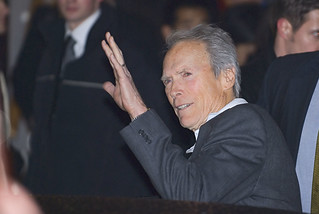
Clint Eastwood (Photo credit: Siebbi)
by Dean | Jun 26, 2014 | General
SPOILER ALERT if you haven’t seen the latest (June 23) episode.
In my view, the final season of the old 24 series was lousy. For one thing, Jack Bauer committed the immoral act of shooting down an unarmed Katee Sackhoff. In the reboot, he throws an unarmed Margot Al-Harazi (Michelle Fairley) out of a high window—just like Jezebel—but no one cares because Margot is so incredibly, appallingly evil. Just like Jezebel.
Other individual deaths have occurred as well. Sorry to see you go, Jordan. . . I’m not sure whether Margot’s daughter Simone (the very pretty Emily Berrington) is dead 0r not, but I don’t think so. She’s had quite an experience with vehicles lately (being hit by a bus, being involved in an insane car chase). Everybody is waiting to see when Steve Navarro (Benjamin Bratt) gets it in the neck. How do so many cold-blooded “moles,” which is what Navarro is, manage to get inside CTU? Why such background check deficiencies?
by Dean | Jun 19, 2014 | General

Cover of Driving Miss Daisy (Keepcase)
Bruce Beresford often fashions wonderful endings for his movies, and Driving Miss Daisy (1989) is no exception. Nowhere does the film display more heart, more humanizing feeling, than in its last sequence. The feeling doesn’t seem as legitimate as that in, say, the Taiwanese picture Eat Drink Man Woman because Miss Daisy (Jessica Tandy) is not quite as sympathetic a character as those in Ang Lee’s film; she doesn’t change much in the course of the piece. She is scrappy and sharp-tongued from start to finish, but that in no way means we don’t like her, don’t care about her, and a moving ending is a moving ending. The one encouraging fact about her is that she ultimately acknowledges her black chauffeur, Hoke (Morgan Freeman), as her best friend. Miss Daisy is a white Southerner. She’s also Jewish, though, and seemingly less inclined toward racial pride and prejudice than many, or most, Southern white Gentiles. She and her grown son Boolie (Dan Aykroyd) are liberals in the Fifties and Sixties.
Written by Alfred Uhry and based on his play, Daisy is minor Beresford but, like his Breaker Morant, beautifully transferred from stage to screen. The Aussie’s directorial care is a pleasure to behold even in a comparatively unambitious work like this. On the minus side, there is an excess of music; on the plus side, it is a family film. I am persuaded to add, however, that as I watched Miss Daisy, et al. grow older and thus slow down as the years advanced, as I watched Miss Daisy’s increasing fragility, I was saddened to think of all of us having to live in a fallen world of irreversible time.
by Dean | Jun 15, 2014 | Movies
 That critics would fervently praise a mediocre film like James Gray’s The Immigrant (2014) points up that movie criticism is still in the same dismal state it has always been in. No, it’s in a worse state, for, after all, we used to have the fine criticism of John Simon, Stanley Kauffmann, Charles Thomas Samuels, Dwight MacDonald, Vernon Young and—well—Pauline Kael. No more.
Re The Immigrant, it’s an unpersuasive period piece which I refused to watch to the end. No one is paying me to view these films; the expense is mine.
by Dean | Jun 11, 2014 | General
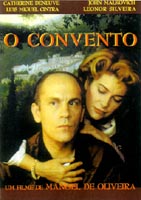
The Convent (film) (Photo credit: Wikipedia)
The Convent (1995), by Portugal’s Manoel de Oliveira, is a Christian film set in a locus of angels and gargoyles, but is, alas, rather tedious and burdened with a confused plot.
It has a monastery, a statue of Mary Magdalene, a statue of a crucified monk, a demonic figure in human form, a devout, purehearted girl who tells the demonic figure, “I miss God”, before dashing away from him, a woman with a gift for “ubiquity,” etc. But it doesn’t have a good story. Oliveira got some noteworthy shots, but held his camera on most of them for too long. Shots of the sky are meant to make us think of God, as is the image of sunlight slowly ridding that crucified monk statue of the dim shade over it and bringing illumination. A pleasant sight, this.