by Dean | Jan 26, 2014 | General
Paolo Sorrentino’s new movie, The Great Beauty (2013), is itself a beauty (great or otherwise) set in beautiful Rome. It is the large-scale film Fellini should have made instead of La Dolce Vita and Satyricon, both failures, for it is a patently intelligent, always captivating satire-and-then-some about the Roman leisure class. Now 65, Jep Gambardella (Toni Servillo) is a writer and interviewer, the heterosexual Truman Capote who sought to live the high life but inevitably feels he has ended up a nobody. Cleverness about Jep’s plight, among other things, scarcely abates: e.g. when the man asks a priest if it is true that he used to be a highly effective exorcist, the priest simply responds with a sacramental over Jep.
Luca Bigazzi wisely photographed with a toned-down attention to beauty, and there is dazzling camera use. Galatea Renzi, Sabrina Ferilli, and others are genuinely lovely middle-aged women. Music and dance are gangbusters. Sorrentino’s film is almost about itself and nothing else, but not quite. It’s better than that.
(In Italian with English subtitles)

Italian film director and screenwriter Paolo Sorrentino (Photo credit: Wikipedia)
by Dean | Jan 21, 2014 | General
I thought movie acting had gotten considerably better than it frequently was in the past, but after seeing the caper flick Swordfish (2001), directed by Dominic Sena, I’m not so sure. John Travolta starts out badly but gets better. Hugh Jackman, Halle Berry and Don Cheadle, however, merely go through the motions, undermining an already rubbishy concoction. How ludicrous Swordfish is we see in just the opening few moments: all those explosives wrapped around the bodies of Travolta’s hostages. From there things just get clunkier, and more foul-mouthed. Gratuitously Miss Barry exposes her Josephine Baker breasts. Needless to say, the film is not only commercial but shabbily so.
![Cover of "Swordfish [Blu-ray]"](http://ecx.images-amazon.com/images/I/51umIkKAadL._SL350_.jpg "Cover of \"Swordfish [Blu-ray]\"")
Cover of Swordfish [Blu-ray]
by Dean | Jan 17, 2014 | General
The Joyce Maynard novel, Labor Day (2009) is, I think, interesting and competently written; but is it also forgettable?
A prison inmate called Frank runs away from the hospital he is in for an appendectomy, then forces Adele, the divorced mother of Henry (the book’s 13-year-old narrator), to drive him to her house where he will hole up for the Labor Day weekend and a couple of days prior to it. Frank is a likable man not wholly guilty of what he was sentenced for; Adele is a sensitive recluse whose children, except for Henry, died on her as surely as her marriage died. Implacably the two begin a hidden romance. Planning to flee to Canada and take Henry with them, Frank and Adele are unaware of certain forces that will firmly block and cripple them.
Appealing details crop up in the novel, and although Frank is a bit too rudely good to be true, the characters are believable. I dislike the many sexual references that exist in modern American novels but . . . the ones here do not seem excessive. Or un-called for. Still, is the book (finally) forgettable?
Actually, I think it comes close to being so, but escapes it by showing the reader what it means when a human life is reduced to the bare necessities, to actions and habits incapable of bringing a person anything like happiness or self-fulfillment. And it is endlessly compelling on the subject of isolation. If it were not for this, Labor Day WOULD be forgettable, the kind of thing we’ve seen before.
Two more items: Maynard’s novel is not a tragedy; it has a happy ending. And it has been made into a movie.

English: Joyce Maynard at the 2010 Texas Book Festival, Austin, Texas, United States. (Photo credit: Wikipedia)
by Dean | Jan 13, 2014 | General
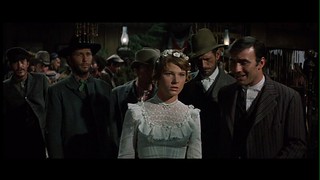
Director Sam Peckinpah had better material to work with in the days when censorship was still noticeably strong in American film, as witness his Ride the High Country (1962), an engaging Western starring Randolph Scott and Joel McCrea. Originally written for the screen, the good (though not great) script by N.B. Stone, Jr. has two aging gents transporting a bank’s gold to a mining camp in addition to helping a hapless young woman (Mariette Hartley) escape her deeply foolish, tyrannical Christian—or “Christian”—father. As a follower of Christ I might have been greatly put off by this depiction but, well, such people as this guy have been a part of human history.
The Hartley character wishes to marry a good-looking but squalid miner (James Drury) from a repulsive family. After the knot is tied, she immediately sees what a ghastly mistake she has made, and the bank guards execute a rescue which precipitates violence. At one point Joel McCrea’s old-timer declares that all he wants in life is “to enter my house [i.e., death] justified,” which is more than the other characters want, including, it seems, the other old-timer (Scott). Human behavior is quite shabby here. The film is about that which bombards, or prevents, self-respect, the knowledge that one is justified in one’s actions. It is in fact conveyed that one always feels justified in working for his bread and butter.
NTF104 hint1 (Photo credit: a75)
by Dean | Jan 10, 2014 | General
Written and directed by John Singleton in his twenties, Boyz n the Hood (1991) is no two-bit feat. It’s explosive. Even so, Singleton’s youth hamstrung him into a great naivete, and a certain decadence develops in this film about South Central L.A.
Hood‘s political significance goes no further than to show an African-American boy giving a picture of Ronald Reagan the finger, which is meant to express Singleton’s own anti-Reaganism, anti-rightism. Or to put into the mouth of a decent man acted by Laurence Fishburne words about how drugs, guns, and even liquor are being transported to the inner cities so that whites can see to it that blacks are gradually polished off. Absolutely nothing belies our suspicion that this is Singleton’s view too.
The film’s early scenes include some lame, idiotic material about an arrogant black boy (sympathetically viewed by our director) who disturbs a white teacher’s (unsympathetically viewed by our director) grade-school class. In the religion department, there is some trite philosophical talk about God, uttered by the South Central “boyz n the hood” themselves, and a Roman Catholic girl named Brandi who, despite her moral beliefs, opts to comfort Cuba Gooding Jr. by losing her virginity to him—a decision Singleton finds touching. After all this, how could I not pronounce Hood decadent?
![Cover of "Boyz N the Hood [UMD for PSP]"](http://ecx.images-amazon.com/images/I/514CX1V1WCL._SL350_.jpg "Cover of \"Boyz N the Hood [UMD for PSP]\"")
Cover of Boyz N the Hood [UMD for PSP]