by Dean | Aug 19, 2013 | General
In Kick-Ass 2 (2013), a frightfully masculine Jim Carrey plays a superhero called Colonel Stars and Stripes, who is as violent as he is humanitarian, and is ostensibly born-again.
It’s an encouraging fact: Never does Jeff Wadlow’s sequel to Kick-Ass disparage the born-again Christian label, any more than it scoffs at the crimefighting gay guy who has been bullied in his life. This rowdy pop movie is as inclusive as it is illiberal, as anti-criminal as it is comical.
Again there is Aaron Taylor-Johnson’s Dave/Kick-Ass and Chloe Grace Moretz’s Mindy/Hit-Girl, who are good friends now. The latter is hitting puberty, with a quickly beating heart over the sight of TV heartthrobs and of Dave’s bare chest. I can do without the teenage queen bee cliches—Mindy confronts the high school skanks—but it’s nice to see Hit-Girl’s vulnerable side and a few affecting moments. It isn’t long, however, before she’s in hair-raising peril and starts cracking skulls.
Like the first Kick-Ass pic, Kick-Ass 2 is politically incorrect to a minimal extent (Dave, posing as a pimp: “I’m the whitest pimp in the world”). Mostly it’s just edgy, and forceful. It’s sort of the cinematic equivalent of a pleasant hard rock song: Nirvana’s “Heart Shaped Box,” say.

Hit Girl is my new favourite character. (Photo credit: Melina.)
by Dean | Aug 16, 2013 | General
In the early Seventies, French director Louis Malle made a film about adolescents which deliberately went in a transgressive direction. This is Murmur of the Heart (1971), not merely a transgressive opus but, more seriously, a vile one as well. The three teenage boys at the center, especially the dominant Laurent (Benoit Ferreux), no one in his right mind would tolerate, but naturally the adults around them do until the story builds to an act of tender incest between Laurent and his freewheeling mother (Lea Massari). It’s nearly the last thing that happens in the film and—transgressively—it’s never censured. It’s condoned.
Whatever its pretensions are, Murmur is basically anti-bourgeois, an easygoing act of rebellion. What’s more, it implicitly believes that the most important thing that goes on between a man and a woman is sexual intercourse. It isn’t. But this absolutely accounts for the incest.
Lest I sound smug, let me put it profanely: Murmur of the Heart is a piece of shit.

Cover via Amazon
by Dean | Aug 14, 2013 | General
I doubt that the Christian film Courageous (2012) speaks to very many nonbelievers since it is overflowing with evangelical spirituality and is not at all subtle. Alex Kendrick did a lot of work here—he directed, stars in, and co-wrote the flick with his brother Stephen—but the finished product is neither art nor admirable craft. It concerns fatherhood, and Christian living for fathers, and although I agree with the religious and pro-family propaganda, propaganda is what it is and so does not belong in fictional cinema.
The Kendricks’ previous film, Fireproof, was somewhat better. For all its weaknesses, it fascinates—and its drama is relevant to subject and theme. That’s not always the case with the un-fascinating Courageous.

Courageous (film) (Photo credit: Wikipedia)
by Dean | Aug 11, 2013 | General
Would that Woody Allen were a major film artist. It would be good to have some artistically successful American comedies about how we live now, and that is not what Allen’s Hannah and Her Sisters, from 1986, is.
To begin with, it takes a long time for any of the movie’s humor to make us laugh (to make ME laugh, anyway, but I can’t imagine anyone finding the first 45 minutes of this film funny). Further, Allen is pathetically sloppy at writing dialogue, which is often thin and banal. And not all of the acting is good: Mia Farrow and Max von Sydow are dull, Allen himself dreadful. Finally, the film, though a comedy, is unpersuasively and even ludicrously optimistic. Michael Caine stops obsessing over and pursuing Barbara Hershey, and an infertile Allen actually impregnates Dianne Wiest!
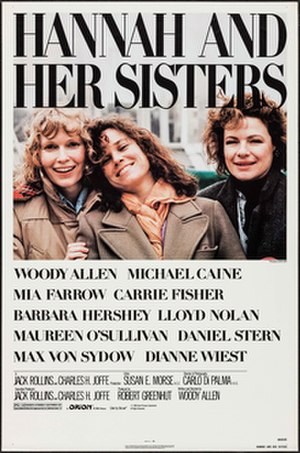
Hannah and Her Sisters (Photo credit: Wikipedia)
by Dean | Aug 8, 2013 | General
The French film La Discrete (1990), by Christian Vincent, is a revenge tale in which revenge becomes, first, methodical and dispassionate and, second, unimportant to the man avenging himself. This is Antoine, an aspiring writer whose paramour leaves him for another guy, whereupon Antoine remarks to a friend of his, a publisher, that he would wreak revenge if he knew how. The publisher explains how: Antoine can get even with the female sex in general–and become a published author to boot—if he will find a girl at random whom he will court, sleep with and then abandon, and concomitantly put the details of all this into a diary. The diary will be turned into a book.
A newspaper ad calling for a typist is what the blackguards use as bait to acquire a girl, and a student named Catherine is the one who comes along. At first revolted by Catherine’s near-plain visage, Antoine nevertheless initiates a romance with her and, yes, he sleeps with her. Not at all a bona fide woman-hater, however, the restless writer loses all desire to betray the girl, much to the publisher’s disgruntlement. And yet—though I will not elaborate on it—Catherine gets hurt, feels abandoned. The film is about how life inevitably moves on after plans are dropped, after evil is decided against, after scores no longer have to be settled. And it’s about loneliness and solitude: Catherine, it turns out, is consigned to isolation. Too, there is the theme of the malice which sometimes lurks behind loneliness: we see this in the publisher. Solitude prevails whether scores are settled or not.
Christian Vincent directed with taste and shrewdness, and co-wrote the talky but intriguing script. He seems very surefooted with actors too. Fabrice Luchini gives Antoine a perfect intellectual glitter and seductive extroversion. Catherine is made appealing, and this despite a certain self-effacement, by young Judith Henry. Maurice Garrel fills the bill, with virile sobriety, as the publisher. Once again we feel like celebrating French acting as much as we have celebrated British acting.
(In French with English subtitles)
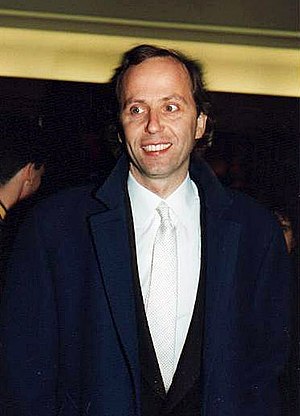
English: Fabrice Luchini, French actor Français : Fabrice Luchini, acteur français (Photo credit: Wikipedia)