by Dean | May 29, 2018 | General
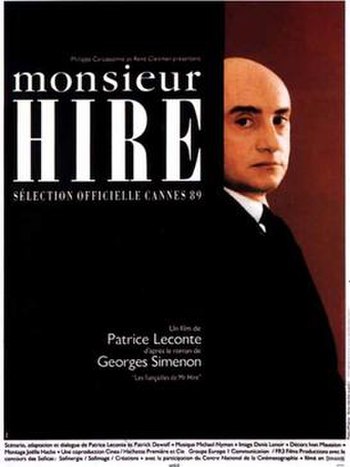
Monsieur Hire (Photo credit: Wikipedia)
A reclusive man (Michel Blanc) who constantly spies on his neighbor (Sandrine Bonnaire), in the French film Monsieur Hire (1989), may have murdered a young woman. A police detective suspects he has. What we learn, however, is that he has fallen in love—an un-eccentric act. Is it eccentric, or abnormal, that the Bonnaire character, Alice, might be falling in love with him?
Directed by Patrice Leconte, Hire reminds us that we can never predict what other people will do, except when we can. I haven’t read the Georges Simenon novel from which the film is adapted, but without a doubt, in my head, the film is worth seeing—and worthy. It isn’t dated and its cast fills the bill agreeably. In ’89 it proved French movies could still be respectable.
(In French with English subtitles)
by Dean | May 27, 2018 | General
Make no mistake about it: as I have said before, the rich man in the Parable of Lazarus and the Rich Man (Luke 16) represents the Jews of Judah. Judah the man, after whom the Israelite tribe was named, had five brothers, and Judah the tribe acquired great wealth, great privilege. If Mr. Sumptuous, upon dying, goes to Hell, almost all the Judah Jews of history go there as well. It isn’t enough for them to go through the Holocaust. They must also be placed in a locus of everlasting torture.
But it is hard to believe any Jew will be damned in Hell when it is declared by Isaiah that “all the descendants of Israel will find deliverance in the Lord and will make their boast in him” (Is. 45:25, NIV). The prophet who wrote Ezekiel 37 seems to confirm this—seems to be teaching the universal salvation of the Jews. The words above from Isaiah 45 follow the staggering statement about ALL people swearing what is probably allegiance to God. Saul and Jeroboam are left out of this, and will simply suffer forever?
by Dean | May 25, 2018 | General

Cover of Loulou
In the 1980 French picture, Loulou, by Maurice Pialat, people drift (rather quickly) into intimacy and betrayal and pain as they lead dismayingly unconventional sex lives. Nelly (Isabelle Huppert) resists her unimaginative husband (Guy Marchand) and finds, or think she finds, both sex and love with jobless ex-convict Loulou (Gerard Depardieu). Loulou is a thoroughgoing catalyst, gaining male enemies, prompting a female acquaintance to voluntarily stand topless before him. He can turn anything on its head. Depardieu is right for the role but offers a little too much facial play, whereas Huppert’s facial play is proper.
Huppert is superb, making Nelly as ordinary as she is combative, as stubborn as she is weary. Marchand is marvelously true and subtle. Pialat’s direction never goes clunky or flat, and with Yann Dedet’s editing the film’s pace is good. I might add that Loulou also makes you feel like a bit of a snoop.
(In French with English subtitles)
by Dean | May 22, 2018 | General

Blue Like Jazz: The Movie (Photo credit: Wikipedia)
Steve Taylor‘s Blue Like Jazz (2012) is based on a memoir by Donald Miller. In it, an evangelical kid—Miller—is so stunned by his Christian mother’s having an affair with a youth pastor that he flees to the Portland, Oregon liberal-arts college his pagan father has enrolled him in. The student body there is eaten up with leftism and tends to glorify sex and drinking, with the result that young Donald happily dismisses conservative evangelical belief. What we end up with is a basically Christian film, but one which expects Joe Christian (in this case, Don) to duly apologize to the world for the shabby conduct of the devout. This includes everything from the Crusades to “U.S. foreign policy.”
Nice try, Steve Taylor, but no cigar.
True, the film is reasonably intelligent, but not without many flaws. It seems to consider the Southern Baptist denomination a “strange church” (i.e., not liberal). The action of the story is rather forced, the characters are scantily drawn and, to me, Marshall Allman (Don) is not a very likable actor.
by Dean | May 18, 2018 | General
Boy, do the people in Cafe Metropole (1937) need—and want—money! And how careless and devious they can be in trying to acquire it! Even Tyrone Power‘s Alexis, so young and callow-looking, is a needy louse; he just doesn’t seem like one. The whole movie doesn’t seem to be about corruption and irresponsibility. Frothy, it isn’t satirical or mocking, but genial—and with inoffensive Loretta Young.
Teaming up again with Power (who is miscast), this time in a droll non-farce, she is deeply palatable. Unlike Power, she has charisma and can match the dignity of Adolphe Menjou, who is also in the film. Congrats to the supporting cast. CM is moderately entertaining.