by Dean | Aug 10, 2017 | General

Cover of Army of Shadows – Criterion Collection
Jean-Pierre Melville‘s Army of Shadows (1969), adapted from a Joseph Kessel novel, would be a mere adventure story if it were not for its impressive sophistication and excellent execution. It follows the actions of Philippe Gerbier (Lino Ventura) and other French Resistance members in German-occupied Marseille.
The Nazis in the film are scumbags, suspicious and inhumane. The qualms about violence the resisters often exhibit never arise in the hearts of the Germans. But the resisters do kill, for various reasons; yet, alas, the Nazis are able to shockingly push them against the wall. Watch the entire movie and you’ll see what I mean.
Treated unfairly in France—for one thing, it was thought the Resistance ought not to be glorified after the Algerian conflict—Shadows is long and slow-moving but, to me, fascinating and effectual.
(In French with English subtitles)
by Dean | Aug 8, 2017 | General
Dunkirk (2017), written and directed by Christopher Nolan, presents war in Europe within the broadness, or openness, of time—and even within a relatively brief duration of time. Three time periods meet, in all of which men are warring and struggling to survive; all demand endurance.
How credible some of the details in the film are I don’t know, but an enthralling and exciting enterprise this is. Although it contains more heroism than (British) patriotism, patriotism is there. So are great surprises and little mysteries, as when a charitable old man compliments the British soldiers but never makes eye contact with them. And when two of the soldiers quickly haul a wounded grunt on a stretcher a strikingly long way to a seabound ship, where, as it turns out, the grunt is in greater danger than he was before.
Unlike other war movies today, Dunkirk never becomes even slightly boring until, I’d say, the last 15 minutes. But, as well, it is gratifying to see that it bounces back a bit before those minutes are over.
by Dean | Aug 7, 2017 | General

Cover of 3 Women – Criterion Collection
Director Robert Altman had “a succession of dreams” and afterwards based one of his movies—Three Women (1977)—on these dreams. Hence the film, though linear, is profoundly weird.
It is the story of Millie Lammoreaux (Shelley Duvall) and Pinky Rose (Sissy Spacek)—as well as a nonverbal painter named Willie (Janice Rule)—who work at a rehab center with mineral baths for the elderly. Millie is talkative, but very few people listen to her (funny, this); which easily leads us to infer that social interaction in the film amounts to almost nothing. And yet, ironically, the shy Pinky quasi-worships Millie, seeing a certain perfection in her. And there is nothing sexual in this—Pinky, like Millie, likes men—but . . . a question must be asked: Is Pinky a psychotic who actually wants Millie’s personality for herself?
The film never indicates that someone is dreaming this dreamlike story. Is it reality, then? Is it a work of art simply meant to resemble a dream—in other words, a work that is only about itself? Three Women is unceasingly perplexing. There are fine performances from Spacek and Duvall, though. The former is suitably eccentric and beautifully nuanced. With her diffident, little-girl face, the latter is oddly beguiling, improvising nicely. For improvisation is certainly here—but what about a raison d’etre?
by Dean | Jul 30, 2017 | General
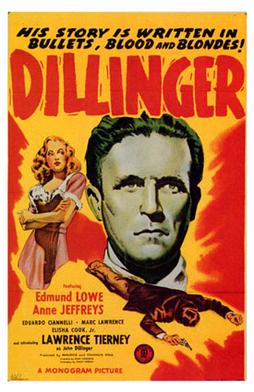
Dillinger (1945 film) (Photo credit: Wikipedia)
There is a useless prelude here in which a movie audience watches newsreel about John Dillinger the gangster before Dillinger’s father shuffles out on the stage to deliver his own information about the man. It actually promises to be boring.
The prelude belongs to the 1945 Dillinger, which isn’t boring, starring a very limited Lawrence Tierney as the ever-active bank robber and murderer. The screenplay by Philip Yordan is intermittently dopey—the movie, in point of fact, is near-trash—but not without heat and punch. Max Nosseck (who?) directed with only modest ability, notwithstanding he gives us a nifty scene where Dillinger, after having a tooth pulled, wakes up from the anesthesia only to be nabbed by waiting police officers.
I’m glad I saw Dillinger, but I can’t value it much. . . Speaking of very limited acting, Anne Jeffreys plays Dillinger’s love interest, and is one of the most beautiful blondes in American cinema.
by Dean | Jul 27, 2017 | General

Cover of The Good Girl
The Good Girl, from 2002, is a flop.
Jennifer Aniston plays Justine Last, a retail store assistant who attempts to escape her hated husband and her hated life by having a no-account affair with a young neurotic (Jake Gyllenhaal). Intelligent people are well aware that the film is dreadfully condescending to small-town Texans, but it is also true that after the condescension finally eases up, scriptwriter Mike White proffers a phony happy ending. We are prompted to ask a few questions: Why, really, does Justine hate her husband (John C. Reilly)? Because he frequently smokes pot? Did she not know what he was like before they got married? Did he have her fooled? No answers are supplied.
White substitutes serious intent for credibility. Eventually Justine’s hubby learns of her unfaithfulness, but, well, he accepts it. He stays married to her. Convincing? No.
Directed by Miguel Arteta, The Good Girl is an unprofound nonentity, the very thing the filmmakers don’t believe it to be. Its cheapness is enough to make it a nonentity. Mike White himself, an actor as well as a screenwriter, plays Corny, a security guard and a Christian, one who turns out to be, in Justine’s words, a “Bible-thumping pervert.” At length he gets beaten up for something he never did, which is, to White, no big deal.