by Dean | Jul 26, 2017 | General

Straw Dogs (1971 film) (Photo credit: Wikipedia)
I’m tired of contemporary Hollywood films that appear to have been scripted by young, liberal know-it-alls (example: Spider-Man: Homecoming). By no means is this the case with a Hollywood item from the past like Sam Peckinpah‘s Straw Dogs (1971), which I reviewed on this site once before. I said the film was not quite a success, but I demur from that now. It is an imperfect but serious and riveting thriller.
A “straw dog” is something that is made only to be destroyed. David (Dustin Hoffman) and Amy (Susan George) are trying to make a life for themselves in Amy’s Cornish village, but shiftless, lascivious rustics soon intend to destroy it. They clearly diss David the intellectual and envy his union with pretty Amy, who is sexually victimized by two of them. Although this has nothing to do with Amy’s not being a strong woman, it is indeed true that she is not strong (a notion the know-it-alls would refuse to brook) , but neither is David. They’re both very human. David is not manly enough until the last act, and he is imperceptive.
Straw Dogs is hard on the human race, which is, as critic John Simon has put it, “eager for compromise, wallowing in reciprocal abasement, and balking at accommodation only when denied even its widow’s mite.” A measure of sympathy, though, goes to the primary characters, to David and Amy, and it is also certain that screenwriters Peckinpah and David Zelag Goodman—the film is based on a novel by Gordon Williams—never pretend to have their understanding of these two persons all wrapped up. As the film runs its course, they constantly probe David and Amy for who they are, what they think, what they want. None of this has anything to do with ideology or intellectual stasis. It has to do with artistic acumen. Although it’s a shame that Dogs may have been Peckinpah’s last good film, at least genuinely young, Millennial-like minds were not behind it.
by Dean | Jul 24, 2017 | General
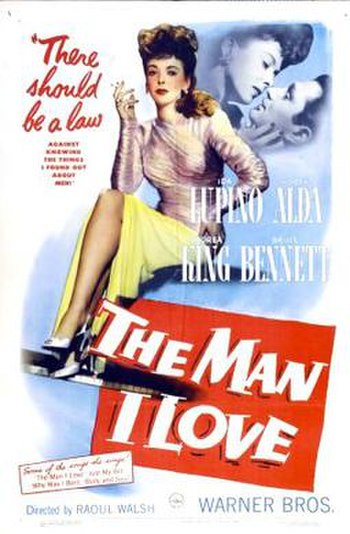
The Man I Love (film) (Photo credit: Wikipedia)
In large measure Raoul Walsh‘s The Man I Love (1947) is about nightclub life, with a chunk of real shadiness tossed in. Ida Lupino stars as a tough-minded but amiable club singer, who doesn’t care much about her job since her boss (Robert Alda) is a cocky heel who makes advances to her. Alda ain’t the man she loves; really, the man she loves seems like a bore and is badly acted by Bruce Bennett. Lupino’s scenes with him are the weakest in the movie.
Other scenes, however, such as those with Petey Brown (Lupino) and her family, are spunky and agreeable. The movie in toto is agreeable, if without the greatest plot in the world.
by Dean | Jul 20, 2017 | General
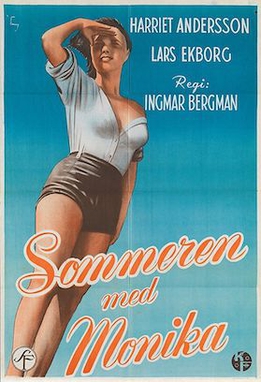
Summer with Monika (Photo credit: Wikipedia)
A Summer with Monika (1953) is a Swedish film directed by Ingmar Bergman from a novel by Per Anders Fogelstrom.
Monika (Harriet Andersson), for a long time a believable character, and Harry (Lars Ekberg), not much explored, are two adolescent lovers. Both are inexperienced and foolish but also harassed and even mistreated. Eventually they marry, but in the film’s final third, unfortunately, Bergman allows Monika to become a surprising tramp. This is, nonetheless, one of the Swede’s few successful movies, remarkably made with its wonderful exterior shots, long takes and (of course) mise en scene.
In addition, it is a famously erotic film—and not just for 1953—albeit Andersson has assets other than those under her blouse. She is an actress so “natural” it is uncanny, as true in her hysteria as in everything else. She creates a good blending of sophistication and innocence, and is enticingly kinetic. It is a great performance in a more-than-okay movie.
(In Swedish with English subtitles)
by Dean | Jul 18, 2017 | General

Cover via Amazon
The commercial Western novels from earlier decades usually had their cowboy heroes fall in love with a young woman who had not yet married. The 1956 Western movie, Seven Men from Now—it too is commercial, of course—offers a hero with a sure liking for a young woman who is married, but he staunchly refuses to start anything. A man of principle, he is played by Randolph Scott, and the seven men of the title are the gold robbers who murdered Scott’s wife and are now being pursued by him.
‘Tis strange that Ben Stride, Scott’s character, doesn’t appear to be suffering much over his wife’s death, and neither does the aforementioned young woman (Gail Russell) seem devastated by the vile murder of her husband (Walter Reed). It’s as though the producers opposed any big-deal, negative emotion (and if they hadn’t, could Scott have delivered?).
All the same, this Budd Boetticher Western, written by Burt Kennedy, is dramatically piercing. A perfect, and not strident, performance comes from Lee Marvin with his big personality. Russell, Reed and others provide a handful of not-bad performances. . . In more ways than one, Seven Men is colorful, another ’50s picture proving how well literal color works for Westerns. Above all, it is just as entertaining as those Western novels from earlier decades—those I have read, anyway.
by Dean | Jul 17, 2017 | General
The novel The Dark Angels (1936), by Francois Mauriac, presents us with the complicated Gradere, a man who allows himself to sink into utterly foul illegality. A particular woman, Aline, is a threat to him because of Gradere’s dirty business practices, and an elderly man named Desbats uses her to deepen the threat. Gradere determines to do something about it.
The novel’s prologue consists of a letter Gradere has written to the village priest, Alain, a good man. The priest recoils passionately from some information in the letter: Gradere was once told by another priest that “there are human souls that have been given to [the Devil].” The reader is left to ask whether this is so. Mauriac seems to see a half-truth in it, but also expresses, of course, his Christian optimism about God, He Who is “greater than the strength of our mad desire to achieve damnation.” Withal, he brings Gradere to faith and repentance.
Frankly, this might be deemed implausible and even forced—it is not like the conclusion of, say, Read’s A Married Man—and yet it takes place at the same time that the priest is afflicted with a troubled, self-doubting mind. This seems to make Gradere’s conversion artistically acceptable. . . The Dark Angels is a wise and poetically written book. As for the title, well, if certain souls (or all souls?) are given to the Devil, maybe it is the “dark” angels, as it were, who effect it.
by Dean | Jul 12, 2017 | General
It looks like director Claude Barras was able to borrow a good story for his stop-motion animated film, My Life as a Zucchini (2017), based on a novel called Autobiography of a Zucchini.
Engaging and sad, it has to do with children in an orphanage, and their big-eyed, almost blasted faces bespeak uncommon hardship. There is no despair here, though, and nothing cheap or uninspired about the exquisite visuals. The movie is not really for kids, but they should probably see it anyway. A dubbed version of this French-Swiss production offers the voices of Nick Offerman and Will Forte.
by Dean | Jul 10, 2017 | General

Jules and Jim (Photo credit: Wikipedia)
In the French film Jules and Jim (1961), from a novel by Henri-Pierre Roche, Jules, Jim and Catherine flow into play, ecstasy and romantic love and then into disappointment and the reality of Catherine being “a dark flame ready to burn herself or anyone else” (David Thomson). Sorry, ladies. This is another Francois Truffaut movie that features an emotionally disturbed woman. It is also one to which he brings his usual love of life and . . . what?
A caveat: I get tired of Jules and Jim because of all the talk and all the episodes. It is not one of my favorite Truffaut films. It is assuredly inferior to Two English Girls and The 400 Blows. Still, it can be delightfully vigorous and intelligent. It makes us glad that Truffaut had a personal style. And it has Jeanne Moreau.
(In French with English subtitles)
by Dean | Jul 6, 2017 | General
Today’s Hollywood trudges on. Multiethnic madness—and villainy—prevail in Edgar Wright‘s Baby Driver (2017), with its speedily moving wild bunch.
Jon Hamm is even better here, playing a married crook turned killer, than he was in Mad Men. Hamm is Buddy, who’s fairly likable until his wife Darlin’ (Eliza Gonzalez), another crook, gets shot up by the police about as intensely as Bonnie Parker does in Bonnie and Clyde. Now Buddy is out for blood—the blood of the dude he blames for his wife’s death: the getaway driver, Baby (Ansel Elgort), who seldom talks and incessantly listens (to rock music). In fact he drives, walks and runs to the inescapable music, and even the shoot-out in which Darlin’ loses her life is a dance routine with firearms.
Edgar Wright is a British director whose technique in Baby Driver is cartoonish but soberingly fun and mostly clever. His compatriot, Lily James, is very pretty and quite pleasing, affecting an American accent, as Baby’s girlfriend. A lot of things go on in this flick, and I was never bored with any of it. It’s utterly propulsive but not punishing (I think)—except to the crooks.
by Dean | Jul 5, 2017 | General

Aliens (film) (Photo credit: Wikipedia)
Aliens, the 1986 sequel to Alien, is a big-time adventure film, and I mean the 153-minute director’s cut from James Cameron. It is less imaginative than the first film (by Ridley Scott), however, and completely inartistic. But the same everything-at-stake suspense and brazen action are there.
So is Sigourney Weaver as Ripley, still behaving like an uncharming man except for being somewhat softened by a little Newt. Excuse me, I mean a little girl called Newt (Carrie Henn)—not a bad addition by Cameron, writer as well as director of Aliens.
by Dean | Jun 29, 2017 | General

Blade Runner (Photo credit: Wikipedia)
Animals have feelings too. And, in Blade Runner (1982), so do genetically engineered replicants. But they can’t be trusted any more than human beings can be. Rick Deckard, Blade Runner (Harrison Ford), is sent out to kill four of them who are on the earth, illegally, instead of elsewhere in the solar system. Necessarily, he sorts of views them as animals.
Replicants live in fear (and for only four years), and it is especially bad when they realize, so human-like, that they’ve done “questionable things.” Which is the case with the homicidal Roy (Rutger Hauer). Roy believes he needs redemption—the nail through his hand is one of the movie’s Biblical images—and, indeed, he ends up saving the beaten-down Deckard’s life.
I don’t know why Los Angeles, the locus for the action, is always dark and rainy (pollution?), but it certifiably contributes to the terrifying effects of this grim pic. All is strange in this world where sophisticated technology co-exists with dilapidation. The presence of the replicants creates for the city a dangerous and extreme peculiarity, as when Deckard hunts among toys for Daryl Hannah‘s Pris. Pris in profile followed by a jump cut to the same character shows her hiding behind a veil, pretending to be a toy but anticipating violence, her violence. This is one of director Ridley Scott‘s pleasurably inspired close-ups.
Certain things in Blade Runner are overdone; the “final cut” is gory. But it is a dazzling achievement which gave Hauer, Hannah, Joe Turkel (Dr. Tyrell) and a couple of others the chance to shine. For the record, it is very unnerving to hear Pris cheerfully say, “Hi, Roy,” before we see the menacing Roy enter a room with his unshakeable purpose. It was Scott’s unshakeable purpose, though, to be unnerving.