by Dean | Jun 21, 2016 | General
Obviously Lucian Pintilie had no love for or faith in perilous Romania when it was Communist. In The Oak (1991), it is often a sick joke and Pintilie’s film a dark but compassionate comedy. The two protagonists are smart and temperamentally strong, but a society where somebody is always needing to be rescued from something—and frequently no rescue comes—gives them a terrible run for their money. No wonder Romanian dictator Nicolai Ceausescu was executed.
Sobering and sassy, The Oak is political satire and then some. It is a fast-moving, post-Red expression of despondency over past nightmares and absurdities, sharply directed by Pintilie. In the leading roles, Maia Morgenstern and Razvan Vasilescu perform superbly, but it is Morgenstern who gets to display an enviable range. Look for her under the heading, “Force and Femininity.”
(On VHS, yes, but DVD and Blu-Ray?)
by Dean | Jun 19, 2016 | General
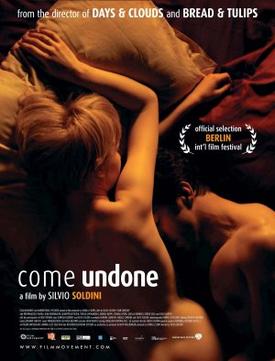
Come Undone (film) (Photo credit: Wikipedia)
I don’t understand why Domenico (Pierfrancesco Favino) prefers his mistress Anna (Alba Rohrwacher) to his wife in the 2010 Italian film about an illicit love, Come Undone. Neither do I think the movie’s moral neutrality is a good idea. Directed by Silvio Soldini, Come Undone is, however, robust and sufficiently imaginative. Its dandy realism breaks down a bit near the end, but I’ll leave it to the reader to decide whether the film is acceptable. It’s available on DVD.
(In Italian with English subtitles)
by Dean | Jun 16, 2016 | General
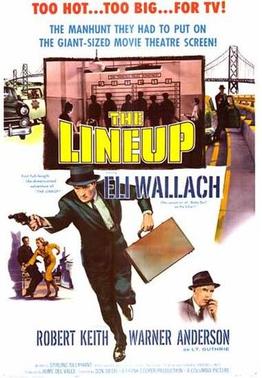
The Lineup (film) (Photo credit: Wikipedia)
The Lineup (1958) is one of Don Siegel‘s crime flicks, and the first third of it shows us nearly no one but the good guys as they investigate the killing of a fellow cop. Then it is predominantly the criminals who appear in this riveting story revolving around postwar America’s increasing attraction to illegal narcotics.
While watching the film, I couldn’t help thinking of the harrowing murders in Orlando, Florida a few days ago. Stirling Silliphant’s script, you see, carries the message that if psychopaths (here played by Eli Wallach) want and are inclined to kill, they WILL kill, even if the money from heroin sales is actually what they’re after.
Wallach is rattlingly credible, with Robert Keith (the gangster Julian) and Vaughn Taylor (“The Man”) also impressively good. Siegel does all he can with the San Francisco setting, producing a wonderful urban starkness. The Lineup is further proof that the Fifties were a great decade for him.
by Dean | Jun 15, 2016 | General
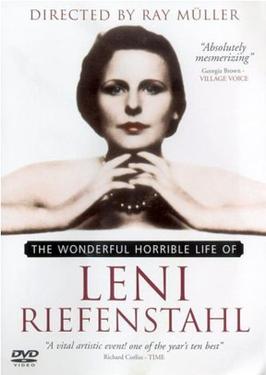
The Wonderful, Horrible Life of Leni Riefenstahl (Photo credit: Wikipedia)
The Wonderful, Horrible Life of Leni Riefenstahl (1993) follows the wonderful, horrible career of Leni Riefenstahl: dancer, actress, master filmmaker. A German in Ray Muller‘s German documentary, she was of course hired by Hitler to make what was for him a Nazi propaganda film (and work of art), Triumph of the Will, which brought her the severest notoriety and contempt.
Muller’s narrator announces that the picture “will approach [Riefenstahl] without preconceptions,” and it does. Although she has no qualms about discussing Triumph‘s virtues, Riefenstahl says she is “deeply unhappy” that she directed the film. She did not then know she and her crew were making “a pact with the devil,” afterwards claiming that the glorification of Nazis was merely the attempt to avoid making Triumph look like a newreel.
(In German with English subtitles)
by Dean | Jun 13, 2016 | General
In my opinion, Batman v. Superman: Dawn of Justice (2016) is worth watching, just not to the end. Kyle Smith is right about its being rather sophisticated, but typically it gets boring too, and befuddling.
On the other hand, the cast is good while production design and cinematography communicate beautifully. Plus there is some genuine sensuality as Lois Lane (Amy Adams) sits naked, without any of her privates showing, in a bathtub.
A bevy of real-life liberals, including Patrick Leahy and Democratic Congresswoman Holly Hunter, is hauled in for further fun and games. A subcommittee hearing regarding Superman (Henry Cavill) is held, and it seems fitting that liberal senators are discussing the excesses of a comic-book figure.
by Dean | Jun 7, 2016 | General
One assumes from watching last year’s The End of the Tour (2015) that author David Foster Wallace (Jason Segel) committed suicide in 2008 because he was so out of synch with ordinary social life. Donald Margulies, the gifted playwright, provides a depiction of Wallace as a shy but defensive weirdo, an often unlikable if brilliant neurotic. He is sans a wife or a girlfriend, has experienced deep depression—and, frankly, doesn’t stand a chance.
Directed by James Ponsoldt, The End of the Tour is a lesser film than Ponsoldt’s The Spectacular Now. Though interesting, it is so short on drama it has only limited potency and appeal.
by Dean | Jun 6, 2016 | General

Cover via Amazon
I’ve never read any of Graham Greene’s “entertainments,” as opposed to his serious novels, but the 1942 This Gun for Hire smacks of a good adaptation.
Alan Ladd is in it, and he ain’t no Shane: he’s an icy killer (suitably acted), while Veronica Lake rightly holds down the iciness she displayed in Sullivan’s Travels. This is her vehicle; with groundedness and class she enacts a singing magician (!) recruited for a righteous cause. I liked her chemistry with Robert Preston. . . Director Frank Tuttle is uneasy with action scenes, but not, apparently, with actors. All the same, the movie is entertaining.
by Dean | Jun 2, 2016 | General
![Cover of "Sideways [Blu-ray]"](//ecx.images-amazon.com/images/I/518xmHIHnrL._SL350_.jpg "Cover of \"Sideways [Blu-ray]\"")
Cover of Sideways [Blu-ray]
An absorbing comedy-drama, piercing and droll, it points up the theme of when the development of liaisons with other people is not matched by moral development, the manifestation of character. These liaisons, these love affairs, are strongly desired, but are guardedly or hastily formed by men who are boys, i.e. Miles and Jack. A boy, even so, can see himself as a loser, as Miles does, and so we sympathize.
by Dean | May 31, 2016 | General
The France wherein jihadists have slaughtered innocents is the France of the 2008 film, Skirt Day—a scathing picture indeed.
Here, Sonia, a public high school teacher who often wears skirts, is trying to teach a drama course to wild, disrespectful immigrant kids from Muslim backgrounds. (They hate skirts.) Astonished to find that a thuggish African boy has a pistol in his possession, Sonia grabs it and is badly bullied for her trouble. Now in shock—and feeling vindictive—she unintentionally shoots the boy in the leg and takes the students hostage, though only with the aim of delivering this day’s school lesson. A police detective, Labouret, is sent to investigate and remedy the situation. Sonia’s estranged husband, too, arrives at the school, enraged at the principal who has long failed to adequately help Sonia with discipline problems.
The film tells us that Muslim boys have learned to be misogynistic, and even misogynistic criminals. They also use the word “kike.” French society here is choking on its racial-ethnic insanity but, what is more, it witnesses the awful weakening of the institutions of school and marriage—and of French customs. The result is that people feel deracinated and fretful. Labouret, for example, understands that his marriage is at an end. Personal angst is running high.
The director-writer is Jean-Paul Lilienfeld (talented), the actress who plays Sonia is Isabelle Adjani (talented—and superlative here). The film’s climax is not that good, but everything else is dramatically skillful and unspeakably provocative, with a sprinkling of bitter humor. Skirt Day may be the most politically honest and disturbing French artwork since The Camp of the Saints.
(In French with English subtitles)

La journée de la jupe (Photo credit: Wikipedia)
by Dean | May 29, 2016 | General

Il bidone (Photo credit: Wikipedia)
Il Bidone (The Swindler) is a notable Federico Fellini film from 1955.
Broderick Crawford stars as a member of a trio of crooks, cheating people out of their money in less than prosperous Italian towns. The Crawford character is forty-eight years old and has a daughter he rarely sees, and, as critic Vernon Young pointed out, he is “a lonely swindler” (my italics). Plus, because of his conscience, he is running out of steam, but not yet ready to let go of degeneracy. Not at all.
Albeit not a great Fellini movie, Il Bidone is truthful and pretty incisive. A little less humanistic than, say, I Vitelloni and Nights of Cabiria (man, thou art vile), it also presents fewer circus-and-Catholicism motifs than those pics. Seeing Giulietta Masina, a Fellini regular (and ex-wife), in this movie nicely erased my memory of her in the last F.F. movie I saw her in: the terrible Juliet of the Spirits.
(In Italian with English subtitles)



![Cover of "Sideways [Blu-ray]"](http://ecx.images-amazon.com/images/I/518xmHIHnrL._SL350_.jpg "Cover of \"Sideways [Blu-ray]\"")