by Dean | Feb 23, 2016 | General
With multiple plot strands working in its favor, the most recent Jane the Virgin (last night) was thoroughly palatable.
The cops/criminals strand was intense and surprising, and the not-very-Catholic Jane now wants to have sex. Temporarily. She understandably thinks it’s weird to be “a virgin mom,” but this droll sex comedy ends exactly as expected.
There was a lot of romanticizing, though—of various things—done by Jane, Xiomara, Luisa. We knew it was there because every instance of it made the screen a rosy color. (You had to be there.) You should have been there, if you weren’t, to witness the conceited actor Rogelio (Jaime Camil) playing the First Male Feminist and regularly kissing a young and pretty Susan B. Anthony. A riot. Also, Petra’s gotten bitchy again.
by Dean | Feb 21, 2016 | General
Thomas Vinterberg‘s film of the Hardy novel, Far from the Madding Crowd (2015), is about the occurrence of discovery—discovery of another’s romantic interest, of responsibility, of sexual pleasure, of heartache. The first hour and the last few moments, the coda, of the film are compelling; the rest of it is too hurried, with short shrift given where it should not be given. In addition, main character Bathsheba Everdeen doesn’t seem entirely human because of course she is a nineteenth century proto-feminist.
Carey Mulligan, who plays her, never does anything surprising but is interesting in the role nonetheless. Even stronger are Michael Sheen and Matthias Schoenaerts. There is no greatness in Madding Crowd, as there is in a period piece like 1973’s The Emigrants. I believe it to be a failure, but a very watchable failure—a near-success, in fact.
by Dean | Feb 18, 2016 | General
Stanley Tucci and Campbell Scott, both actors, scored a lot of points in directing the 1996 Big Night, for which they chose an easygoing but not too slow pace, dabs of effective slow mo, wise medium shots of people, and Felliniesque dramatics. They both act in the film too, and Tucci, talented guy, co-wrote the original screenplay, which has to do with the efforts of Italian brothers to keep their traditional Italian restaurant afloat in the big-city America of the 1950s. Sadly, one of the brothers has given up all integrity. He is desperate, even betraying his pleasant girlfriend (Minnie Driver). A novel idea obtains, then: i.e., moral compromise takes place so that compromise with cuisine (traditional Italian) might be eschewed. Not that the filmmakers condone this compromise, you understand; they don’t. But it does go on.
Honest and endearing, Big Night is one of the cinematic big deals of ’96.

Cover of Big Night (Ws Keep)
by Dean | Feb 16, 2016 | General
Occasionally dopey (groan! those women in the cat costumes), the 1934 Cleopatra is nevertheless Cecil B. DeMille‘s not-bad historical drama about Cleo, Mark Antony and others.
Because she never truly exhibits the Egyptian queen’s ambitiousness (and is a paleface), Claudette Colbert is somewhat miscast in the title role, but not badly so. Released just when movie censorship was getting tight, the film is patently sensual. After an apparent split-second shot of her naked breasts in DeMille’s The Sign of the Cross, and then Cleopatra, Colbert, a future conservative Republican, swore off sexy roles; but there is a physical splendor, a real pulchritude, about her in this picture. Also, her acting outshines that of the other performers.
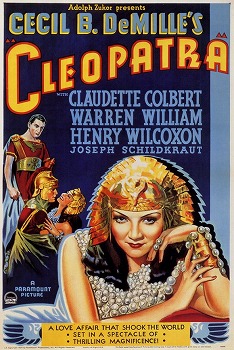
Cleopatra (1934 film) (Photo credit: Wikipedia)
by Dean | Feb 14, 2016 | General
In Room (2015), Brie Larson enacts a woman subjected to the same nightmare the three female victims of Ariel Castro incurred. Remember the kidnapping and imprisonment? The woman has a five-year-old son (Jason Trembley) produced through the Castro-like abductor’s routine rape of the woman. . . Human evil in Room is what it is because it deprives other people of what is good and vital (e.g., freedom). Indeed, it is okay with the abductor (Sean Bridgers) if Jack, the young boy, is deprived of a childhood; it is only his mother who provides him with one to the best of her ability. Childhood during victimization is a theme here.
Though not as well-plotted as it is well-made, Lenny Abrahamson‘s film has riveting dramatic scenes and is deeply moving. The most impressive thing about it, though, is the acting of Larson and young Trembley, who contribute a great deal to making the picture fascinating.
Room is based on a novel by Emma Donoghue, who wrote the screenplay.
by Dean | Feb 11, 2016 | General
The comic film, Sleeping with Other People (2015), starring Alison Brie, tries to be endearing through sex talk. A lot of sex talk. I was so un-endeared I stopped watching after about an hour.
Re the barely talented Beyonce Knowles, I wish her performance at the Super Bowl had never received any comment at all. That way, it would have been a dead phenomenon, deservedly.
by Dean | Feb 9, 2016 | General
A man (Karl Malden) foolish enough to marry a teenage girl many years his junior resorts to bullying and violence. He lives, it must be said, in humiliation, for his wife Baby Doll (Carroll Baker) does not love him and refuses to consummate the marriage until she turns 20. Moreover, through a stratagem on the part of a business rival (Eli Wallach), Baby Doll becomes infatuated with the rival.
The 1956 Baby Doll, written by Tennessee Williams, was directed by Elia Kazan, who gladly called the film “unrealistic.” We mostly believe in its unrealism, though, except when the story grows hyperbolic, hysterical. That’s when we see its basic trashiness, also engendered by bits of third-rate directing by Kazan, as in the big fire sequence. To me the film is a guilty pleasure, but nothing more. It is only partly well acted, by Baker and Wallach.

Cropped screenshot of Carroll Baker from the film Baby Doll (Photo credit: Wikipedia)

Cover of Baby Doll
by Dean | Feb 7, 2016 | General
“You can’t compare yourself to God.”
“Am I not God’s image in your eyes? Is it not to me that you owe your taste for a certain kind of perfection?”
This exchange of words does not take place except in the imagination of Dr. Paul Courreges, the main figure in the Francois Mauriac novel The Desert of Love (1925), which exchange is between Courreges and the woman he has long been passionate about (and it ain’t his wife): Maria Cross. Doubtless Maria is the kind of woman to see “God’s image” in a man she falls for, but Courreges, it turns out, is not that man. Yet the doctor still loves Maria, whereas she gradually falls for Courreges’s son Raymond. What the novel directs us to is, on the one hand, the deep secularization of French society and, on the other, “the desert of love” one encounters after connections are made with the desired person.
Very little is working out for these characters, and not a one of them adheres, as Mauriac did, to any particular religion. The Desert of Love is very solemn and even tragic, though with Christian overtones. Although God is seldom mentioned in the book, when He is, the references are not only sobering but also encouraging. Example: “There could be no hope for either of them, for father or for son, unless, before they died, He should reveal Himself Who, unknown to them, had drawn and summoned from the depths of their beings this burning, bitter tide.”
To think that God would summon from a person a burning, bitter tide! I was prompted to use the word “encouraging” for a reason.

Cover of The Desert of Love
by Dean | Feb 4, 2016 | General
The disco club at the center of Whit Stillman’s The Last Days of Disco (1998) is, in a way, fading or perishing—there is ill-gotten gain there—but much in the lives of the characters is fading or perishing as well. This is true despite all the young-professional effort, all the industriousness, going on, which certainly counts for something but will not necessarily make Charlotte (Kate Beckinsale) or Tom (Robert Sean Leonard) a better person. As always, however, Stillman believes he can afford to be optimistic. It is the optimism of at least one kind of philosophical conservative, one who appreciates “the old world order” (Eric Hynes) and Christianity; and, yes, although the characters in Disco do not genuinely embrace Christianity, maybe an “amazing grace”—sung by Charlotte—will sooner or later embrace them.
(This, by the way, is my second review of the film.)

The Last Days of Disco (Photo credit: Wikipedia)
by Dean | Feb 3, 2016 | General
Edward G. Robinson is the chief member of a likable cast in 1955’s Illegal, a gripping crime drama until it falls apart in its last 15 minutes. Attorney Victor Scott (Robinson) is not much of a character, really; there is little examination of him, even though the machinations that involve him are pleasurably fresh. Jayne Mansfield has little to do, but she too is likable and looks even better than Marilyn Monroe in The Asphalt Jungle.
All the major actors here deserve a better movie.

Illegal (1955 film) (Photo credit: Wikipedia)