by Dean | Jul 29, 2015 | General
Without harshness This Is Spinal Tap (1984) satirizes hard rock musicians: the few who make up the British band Spinal Tap are blokes with very little going for them. Rob Reiner’s modest film is a mockumentary, still as funny as ever, with dandy cameos by Fran Drescher, Patrick Macnee and Fred Willard.
Principal cast members, Christopher Guest among them, wrote the script, which outdoes later mockumentaries which Guest himself directed.
Note: The sight of a long-haired, shirtless Harry Shearer is not one I care to see again.

Cover of This is Spinal Tap (Special Edition)
by Dean | Jul 28, 2015 | General
It’s a pity that American movies declined in quality in 1975 and did not recover at all until the Nineties. Granted, they were not much better during the Sixties, but the years ’70 to ’74, for all the consistently adult material, told a somewhat different story. To be sure, I hate M*A*S*H and McCabe and Mrs. Miller, the Robert Altman offspring, but Badlands, Carnal Knowledge, Chinatown, Slaughterhouse-Five and three or four others are solid artistic successes. The Godfather might be, too, but I need to see it again to be sure. Even such films as The Conversation and Save the Tiger, though failures, are at least interesting and non-homogenized. A late ’70s film like Breaking Away, on the other hand, is interesting and homogenized.
A problem arose in that most of the artistic stuff failed to make money. Chinatown did okay, but the weird Slaughterhouse-Five? Forget it. The 1975 Michael Ritchie picture, Smile, didn’t make the commercial grade either, by which time Hollywood had had enough. It very much wanted stuff that was tamer and less ambitious. The truth is that to an extent moviegoers had let down the artists.

Cover of Carnal Knowledge

Save the Tiger (Photo credit: Wikipedia)
by Dean | Jul 26, 2015 | General
From Taiwan, in 1994, came Ang Lee’s Eat Drink Man Woman, whose title might betoken a loopy comedy; but, no, the film is merely a serious comedy, or comedy-drama, not a loopy one. The four-word expression refers to food and sex, and it may well occur to us that in Lee’s film not much gets in the way of “eat drink” (for such is life in a developed country) but much does get in the way of “man woman” (quite common in any country).
The major characters are Chu, a middle-aged widower and master chef, and his three daughters, Jia-Chien, Jia-Jen and Jia-Ning. None of the daughters is married yet or even has a boyfriend, although beautiful Jia-Chien, a white-collar airline employee, attracts the attention of two handsome men with whom she might become only superficially involved, if at all. Jia-Jen is a Christian who teaches chemistry and is virtually regarded as an old maid, but has eyes for a public-school volleyball coach. Jia-Ning is a teenager who works at Wendy’s and gradually wins over a co-worker’s beau.
Physical needs and wants must be tended to; they make up the routine. But Chu wants to know if “eat drink man woman” is all there is to life. A person like the religious Jia-Jen proves it is not, and yet the complete blocking of physical, or sexual, pleasure means the denial of sexual-amorous love. This latter, sexual-amorous love, is on the horizon for Jia-Ning, the youngest daughter, but Jia-Chien, albeit she has been sexually active, is simply groping for it and Jia-Jen is beginning to grope for it (for the second time in her life?) until success occurs.
The film is perfectly, imaginatively directed by Ang Lee—a fine artist—who wrote the script with two other men. An unpredictable, moving story it is, played out by admirable actors. And there is superb music by Mader, sometimes jaunty and sometimes sweet in an Erik Satieish way. To me, this early Lee achievement is one for the ages.
(With English subtitles)
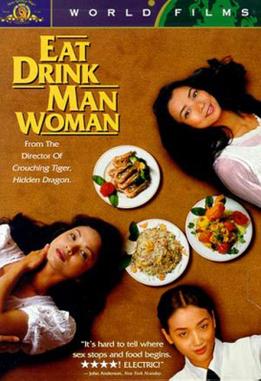
Eat Drink Man Woman (Photo credit: Wikipedia)
by Dean | Jul 23, 2015 | General
It is post-World War II, in 1948, and New York City marches on, busy and packed with the citizens. Jules Dassin’s Naked City is the most urban movie I’ve ever seen, giving Serpico and An Unmarried Woman (you’re so Manhattan, girlfriend!) a run for their money partly because of the black and white cinematography.
How productive the Big Apple is! Ah, but as the police know, the jewel thieves are out there, and so are the murderers. There are no dirty cops in this film, fortunately. They’re very amiable, whereas the felons, especially the killer of one Joan Dexter, are not whitewashed. Sinners are true sinners in Naked City.
The screenplay by Malvin Wald and Albert Maltz is generally credible, and Dassin has so directed as to almost produce pictorial art. It’s the biggest canvas you’ll find in film noir.
The movie stars Barry Fitzgerald, Howard Duff and Don Taylor.

The Naked City (Photo credit: Wikipedia)
by Dean | Jul 21, 2015 | General
I suppose that at bottom Private Hell 36 (1954) is Ida Lupino’s film. Don Siegel directed it, but Lupino starred in and co-wrote it—originally for the screen, hooray!—with Collier Young. She plays a bar singer who falls for a now admirable, now dirty cop (Steve Cochran) intent on making his distressed partner (Howard Duff) dirty as well.
The movie is right up Siegel’s alley, with hard-nosed conflict, unobtrusive mystery, human interest, and a car chase. The cast is estimable: what Lupino and Cochran do cannot be improved on.
I am inspired to add, too, that there is nothing feminist about the Collier-Lupino script. The bar singer, Lillie, is not a “liberated woman” but simply an adult: she talks like an adult, likes to be with other adults, and is never to be patronized. That she isn’t at the center of the cops-and-crime story here doesn’t alter the evidence that Lupino and Siegel were meant to be together.
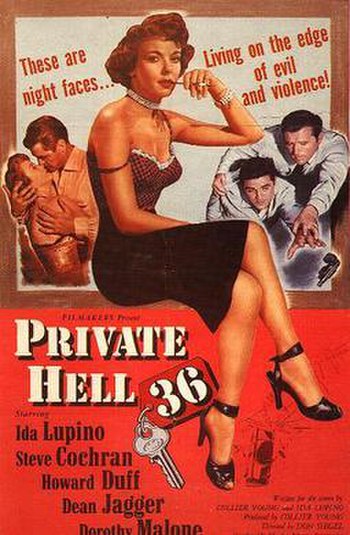
Private Hell 36 (Photo credit: Wikipedia)
by Dean | Jul 19, 2015 | General
Big adolescent Seth MacFarlane has come out with Ted 2 (2015), a sequel to Ted.
Just because the jokes in a comedic flick are sometimes politically incorrect doesn’t mean the flick is a good one. The concept of a talking teddy bear (who’s a stoner) is pretty puny, pretty mediocre, and thus it doesn’t well serve the movie’s plot. Yes, although Ted 2 is too vulgar, it is often funny, and yet some of those jokes seem a bit desperate. Example: a black woman comments on slavery by saying that, first, you’re working beside an African river; then, the next thing you know, “you’re being f**ked by Thomas Jefferson.”
Did Thomas Jefferson f**k a lot of slaves? Or is it just that McFarlane’s movie is f**ked up?
by Dean | Jul 15, 2015 | General
1958’s The Left Handed Gun is a Billy the Kid movie—Paul Newman enacts the Kid—directed by Arthur Penn, who holds his own among other Hollywood directors of Westerns. In fact he proves he can be a bit daring.
Billy and his two buddies engage in a lot of mischief while, at the same time, an undercurrent of dire threat exists—as in Penn’s Bonnie and Clyde. Penn said he and writer Leslie Stevens, adapting a television play by Gore Vidal, tried to demonstrate that in the Old West life was cheap (if that is indeed true). . . Gun is a pretty good movie, and Newman’s attention-grabbing talent is evident. The film is superior to every other Arthur Penn work I’ve seen, though I’ve yet to lay eyes on Mickey One, and miles above his rotten Western The Missouri Breaks.

The Left Handed Gun (Photo credit: Wikipedia)
by Dean | Jul 14, 2015 | General
Author of High Fidelity and Juliet, Naked, Nick Hornby has said he believes reading novels ought not to be hard work any more than watching television is. Certainly he has made good on this view with his latest novel, Funny Girl (2015), but has also, for good measure, set his narrative in the world of television: BBC television. Not the BBC now, but the BBC of the Sixties (the beginning year is 1964), with the novel not so much about comely, ambitious Barbara Parker, the “funny girl” of the title, as about her and her cohorts as they mount a weekly sitcom.
To me the book is a page-turner, as Hornby wanted it to be, although like your typical TV show it doesn’t seem to be saying much. In this it differs from High Fidelity. All the same, I enjoyed the people and the dialogue in Funny Girl, despite the funny girl’s not being a fully realized character. It’s a kick to see Barbara, a.k.a. Sophie, dissociating herself from the celebrity she physically resembles: Sabrina, a British pinup and actress born in 1936 and known for her splendid curves.
by Dean | Jul 12, 2015 | General
The ugly past of 27-year-old Cora (Brittany Snow) consists of helping set a church on fire and badly hurting a female employee therein. Either part or the whole of her sentence is doing community service at a Christian dial-a-prayer site, and Cora, though remorseful, cynically and sourly hates the place. Then she starts accepting it, as she knows she must.
Maggie Kiley’s Dial a Prayer (2015) is a spiritual, even Christian, picture, a would-be Gimme Shelter, and it isn’t very good. If there is one thing the authorities would not have Cora do for her community service, it’s trying to help tormented people by praying for and counseling them. Moreover, the dial-a-prayer ministry is not quite believable with its cheerleader enthusiasm and after-hours volleyball games in which one young employee wears a bikini.
The film can be amusing and affecting, and it’s fine that Cora receives her epiphanies, but the situation with the nice, placid near-boyfriend she meets is hard to swallow. Dial a Prayer needs a far better script. In the realm of cinematic triumphs, it doesn’t have a prayer.
by Dean | Jul 10, 2015 | General
The last episode of the FX series, The Americans (Season 2), was melancholy. An important question the season raised was, what kind of burden do undercover “crusaders” place on their unsuspecting children? Also, the last episode was very artfully made, ending with a whimper not a bang. The acting on the show is utterly expert.
Stan, you’re the man.
What will become of Nina?
I must see Season 3 ASAP.