by Dean | May 11, 2019 | General
I have not read any of Arthur C. Clarke‘s novels, but I am familiar with the reasonable mind behind such short stories as “Into the Comet,” “The Star,” “The Sentinel” and “Death and the Senator.” It is a probing mind too, an instrument for meaningful science fiction.
“Into the Comet” (1960) proves how entertainingly Clarke could write. Here, a spaceship is in peril within the very long tail of a comet. The crew rescues itself by turning to something primitive—or “primitive”—when something technologically intricate, a computer, fails it. How likely such a failure would be I don’t know, but it’s an agreeable story.
The 1955 “The Star” concerns a Jesuit astrophysicist afflicted with doubt about the existence of God after a world civilization is annihilated by a supernova. Clarke assumes there is intelligent life on other planets. There may not be. A pleasantly cerebral piece, it is nevertheless philosophically unremarkable enough to dissatisfy. It means little that Clarke found Belief either difficult or impossible. He did better when probing in other directions, as in his other stories.
by Dean | May 8, 2019 | General
The planet Metaluna will perish under the weapon blows of an alien race, but its inhabitants intend to get abundant help from unsuspecting Earth, especially its scientists. This Island Earth (1955) is, then, a tale of two planets, with all the sinister action emanating from Metaluna. Spoken here is a deceptive promise of peace between peoples, but, no, there is no peace, albeit a single alien (Jeff Morrow‘s Exeter) is decent enough to want to help the Earthlings.
Directed by Joseph Newman, this is standard apocalyptic sci-fi, and it’s not bad. No doubt like the story it’s based on, it is considerably unpredictable and it holds one’s attention from start to finish. I question why the Earth scientists are so naive, though.
by Dean | May 5, 2019 | General
The judge in Ted Bundy’s trial pronounced the serial murderer’s deeds Extremely Wicked, Shockingly Evil, and Vile, which is an inspired title for Joe Berlinger‘s new movie (2019) on Netflix.
As Bundy Zac Ephron is compelling, never phony, never trying for sympathy. Lily Collins is just right and just fine in a good role here: that of Bundy’s anguished girlfriend, Liz. The film partly deals with Liz’s love relationship with a morally worthless man. She herself is far from morally worthless, for, early on, she submits Bundy’s name to the police, afterward suffering long-lived guilt because she doesn’t know whether Bundy is, in truth, culpable for what he is being accused of.
Needless to say, the public-record information in this well-made film is appallingly ugly. I wonder about the pain and shock of all the parents (and other family members) of the daughters whose bodies Bundy treated as though they were foul manure. Again, morally worthless.
Extremely Wicked is recommendable. There are critics who dismissed it. I disagree with them.
by Dean | May 3, 2019 | General
The title character in the D.W. Griffith film, True Heart Susie (1919), is a gentle country girl who is supposedly plain, except that Lillian Gish, who plays her, is not at all plain. In love with a boy named William (Robert Harron), she sacrifices a great deal for him without his knowing it, but it is not Susie who receives William’s devotion. It is a flighty, self-seeking girl, Bettina (Clarine Seymour), whom William marries. . . Although obvious in its moral meaning, the film is terrific, especially if its story (as claimed) is thoroughly true.
Marian Fremont purveyed a sensitive, un-sanctimonious script, wisely directed by Griffith. Susie is a movie not a novel, but, with its rural setting, it is a purely American piece on the order of Tom Sawyer, Huckleberry Finn, Little Women (save for the motorcars in the film) and something like Edith Wharton’s 1917 book, Summer. It partakes of a tradition. And it pleases to see the subtle and touching performance of Gish and the trenchant acting of Seymour, who sadly died many, many years ago, at age 21, in 1920.
by Dean | May 1, 2019 | General

Cover of Gone with the Wind
Does the experience of war ever change people for the better? In Gone with the Wind, it seems to do so for Rhett Butler (Clark Gable), but not for Scarlett O’Hara (Vivien Leigh), who retains her rotten soul. . . After a war’s catastrophe, it is often the quality of determination (such as Scarlett’s)—not, alas, morality—that springs up and creates a person’s destiny.
The 1939 Selznick-produced blockbuster has many weaknesses, but it certainly has its strengths as well. One can’t help admiring its scope, its epic reach, but it is also rich and insidiously seductive enough to be a thoroughgoing crowd-pleaser. Though its last hour is too episodic, GWTW ambles on until it becomes what one might expect it never to become: a properly transporting period piece, however fantastic.
Further, Vivien Leigh, whose high-pitched speech might be an irritant to some, is rightly and fascinatingly vivid as Scarlett.
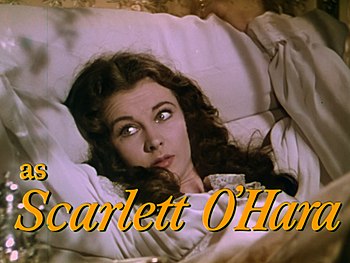
Cropped screenshot of Vivien Leigh from the trailer for the film Gone with the Wind (Photo credit: Wikipedia)
by Dean | Apr 29, 2019 | General
I certainly wasn’t bored by the 1936 film Rembrandt, by Alexander Korda, but I have to consider it kitsch. This is because Charles Laughton, as the great Dutch painter, draws every jot of attention to himself while the other actors are forced to be virtually nondescript. (A near-exception is Gertrude Lawrence.) And because there is too much just-so production design with bric-a-brac and windmills. It is, in fact, an unfortunate stylization. Stylization usually is at least somewhat unfortunate.