by Dean | Apr 4, 2014 | General, Movies
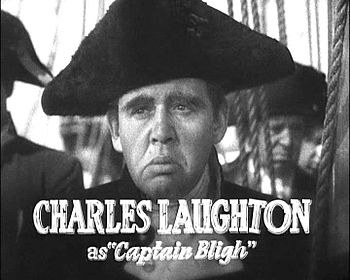
Cropped screenshot of Charles Laughton from the trailer for the film Mutiny on the Bounty. (Photo credit: Wikipedia)
I’ve never read Mutiny on the Bounty, but the ’35 film version, for all the sappy-silly Tahiti material, seems a well-made and even felt adaptation.
Captain Bligh is an expert seaman but also a mean fool, wanting only to impose his ruthless will. Charles Laughton plays him with astonishing aplomb, frighteningly. . . Second in command Fletcher Christian (Clark Gable) simply refuses to have men at Bligh’s mercy any longer, uncondonable though some of the Bounty’s sailors find the mutiny. Incontestable here is an urgent need for the liberalization of the English navy, with the navy itself seen as utterly honorable and necessary by the filmmakers. It becomes almost palpable that the film is liberal—though certifiably separate from today’s liberalism—because it is conservative. It wants what is best for a timeless institution.
A great deal goes on in Mutiny on the Bounty, which is two hours and ten minutes long. Frank Lloyd directed with a fine sense of seafaring adventure and of grandeur. It is, I think, a masterpiece.
- Mutiny on the Bounty (calmaritimelibrary.wordpress.com)
- Mutiny on the Bounty (1935) (movierob.wordpress.com)
by Dean | Apr 1, 2014 | General

Cover of Monsieur Vincent
The year is 1617, and a new priest, Vincent de Paul, arrives in a French town which has had no priest for a long time.
It shows. One of the themes of the 1947 biopic, Monsieur Vincent, is the demanding struggle of the clergyman to tame the unchurched, the brutish, the shallow. Father Vincent’s first stop in the little town is the filthy, abandoned local church, an enormous hovel with cobwebs. Many, not all, of the townspeople are dirt poor, and Vincent, formerly a priest in Paris, wishes to live with and help them. At first they are also sorely afraid of a nonexistent plague. The sequence in which Vincent holds a funeral service for a woman thought to have had the plague, while a crowd of reluctant people walks up and starts crossing themselves, points up a European Catholicism still perfectly imperishable, of course, in the seventeenth century. Director Maurice Cloche handles this scene, and all the other scenes, as he ought to have.
The best handling is by the playwright Jean Anouilh, who wrote the script, purveying such other themes as the question of what to devote one’s life to and the rich’s responsibility, if any, to the poor. With flair Pierre Fresnay enacts Vincent, and the good costumes make us wish the film was in color. All in all, a worthy motion picture.
by Dean | Mar 25, 2014 | General

Fire and Blood (Game of Thrones) (Photo credit: Wikipedia)
Man—such an ill-fated creature.
His ill-fatedness is very much a theme in the HBO series, Game of Thrones, wherein one would expect quite a few of the major characters (not just Ned Stark and the primitive Big Boy married to Daenerys) to tragically die. It’s a terrible world they live in, a very arduous environment, sinful and pagan, natural and magical. There is a lot of surviving, though, and it must be said that the slender young queen, Daenerys (Emilia Clarke), really knows how to triumph as a warrior, as at the recherche end of the show’s first season.
Probably Season 3 is one of the finest “movies” of 2013. (Season 2, on the other hand, was often a lot of noise and meandering.) The drama has engrossing and colorful incidents, such as the dwarf Tyrion’s marriage to young Sansa and the mad battle with the bear, and heart and momentum. The acting is mostly solid: consider Peter Dinklage, Charles Dance (Daddy Lannister), Michelle Fairley (Catelyn Stark). The very pretty Natalie Dormer is also on hand, flavorful and capable of coyness.
I hope it’s not an ill-fated series.
(The photo is of Emilia Clarke.)
by Dean | Mar 23, 2014 | General, Movies

Cover of Top Hat
I’m no judge of choreography, but that involving Fred Astaire and Ginger Rogers in 1935’s Top Hat strikes me as palatable, not silly or clumsy or pretentious. More appealing are the Irving Berlin songs, all of which have decent melodies, one of which (“Cheek to Cheek”) has an outstanding one.
Directed by Mark Sandrich, Top Hat is a delicious musical comedy, as are other Astaire-and-Rogers musical comedies, and one which takes the comedy in its genre seriously, however trivial these nonstop jokes may be. No, they’re not Oscar Wilde but at least they’re funny. As for the actors, they form a rather remarkable comic ensemble, even the two dancing stars: beau-less Ginger, blurting out, “I HATE men!” holds her own. Always, of course, she held her own as a dancer, though with fewer sparks than Astaire, who has among other things the “damn-your-eyes violence of rhythm” (Otis Ferguson).
Top Hat was nominated for an Oscar for best interior decoration, but I’d rather see the damning-your-eyes. The interior decoration is dated now; Astaire’s dancing isn’t.
by Dean | Mar 6, 2014 | General, Movies
Français : Logo de la minisérie THE KENNEDYS. Français : Logo de la minisérie THE KENNEDYS. (Photo credit: Wikipedia)
To me, one of the best “movies,” if you will, of 2011 aired on TV and was eight hours long (eight episodes long). It was The Kennedys, a docudrama not entirely free of blandness but also workmanlike and discerning.
Greg Kinnear is good as JFK, Tom Wilkinson terrific as Joe Kennedy Sr. in all his corruption. As the elegant Jackie, Katie Holmes looks the part but histrionically lacks conviction. The show’s focus is always on the mark, with the Cuban missile crisis covered vividly and painstakingly. An air of sympathy and compassion never goes away even as hagiography never intrudes.
The Kennedys is available on DVD.
by Dean | Mar 4, 2014 | General, Movies
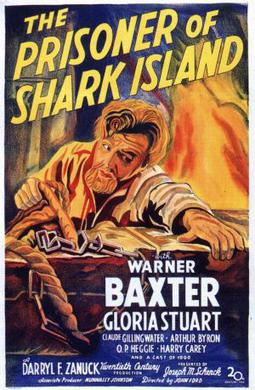
The Prisoner of Shark Island (Photo credit: Wikipedia)
The John Ford film, The Prisoner of Shark Island (1936), is about Dr. Samuel Mudd, who treated the broken leg of John Wilkes Booth shortly after Booth murdered Lincoln and was consequently arrested for conspiracy to assassinate (!) and sent to serve a life sentence in the Dry Tortugas.
When a decent man is victimized by the authorities—this is the message conveyed. As the terrible incidents roll, also conveyed are all kinds of values (and virtues): courage, persistence, belief in God, marital love and, despite the country’s injustice to Dr. Mudd, patriotism. Plus there is military pride, as demonstrated by Mudd’s crotchety father-in-law, an elderly Southern colonel (Claude Gillingwater). Today both he and Mudd would be seen as politically incorrect (yawn): the doctor, you see, is a decent, estimable SLAVER.
Prisoner is still riveting, and I agree with film critic Otis Ferguson about the strength and worth of the prison escape sequence. Nunnally Johnson’s script provides more depth than we generally get from Ford’s Westerns, even if the old American movies never enabled us to feel the ineradicable wound of life. Their unpleasantness was limited.