by Dean | Sep 22, 2013 | General
Wow! Judy Garland in 3D IMAX!
Only in a 3D Meet Me in St. Louis would she look lovelier and, because older, more distinguished. But IMAX screens in 2013 are presenting the redheaded, freckled girl who never should have grown up (to be middle-aged, anyway) in Victor Fleming’s outstanding The Wizard of Oz (1939) and the result is enthralling.
The Kansas twister in this new version is terrifying, the Munchkins pour in (oh, the numbers!) and are emphatically conspicuous, the makeup and costumes become even easier to appreciate. So does Harold Rossen’s cinematography. All the same, critic Alan Scherstuhl is right that Fleming’s film is “performance-driven.” Certain cast members, Judy included, are real grabbers with no shortage of conviction. After a while, it’s true, a lack of logic arises in the narrative, but—well—as everyone knows, the fantasy here is merely a dream. In 3D it seems even more dreamlike.

Cover of Judy Garland
by Dean | Sep 19, 2013 | General
Wayne Watson has written numerous good songs, some of them having a melody as terrific as that in “For Such a Time as This”, a rousing, inspirational Christian song sung by Watson in his usual earnest style. The voice of Canadian folkie Bruce Cockburn is not as pleasant as Watson’s, but his “Lord of the Starfields” has a very nice spare sound and a savory lyric (“Oh love that fires the sun / Keep me burning”).
For a faster tempo there is the great rock tune, “Flood,” by the talented Jars of Clay. Driven by a fierce guitar, it features classical strings in its bridge and a wide range of moods. It’s every bit as enjoyably urgent as, say, Foreigner’s “Seventeen.”
Debby Boone provides a decent vocal for “The Name Above All Names,” a big ballad from the ’80s with a splendid chorus—indeed, a splendid melody—and the sunniest Christian certitude in its finish. Equally fine is the Michelle Tumes song, “Hold On” (not “Hold On to Jesus,” another Tumes track). Granted, the words aren’t very impressive but the catchy, breezy music and the utterly beautiful bridge are. As for Tumes’s singing, it’s nicely feminine and Enya-like.
Fun and reverent, these.

Cover of Debby Boone
by Dean | Sep 17, 2013 | General
After all these years, the Warren Beatty flick Dick Tracy (1990) still offers a good time, even though the necessary action has been palpably upstaged by a host of B movies and TV shows. Tracy‘s value lies in multicolored art design more luminous than any comic strip panel and in the zany makeup for ugly mobsters and in much of the movie’s humor. Kudos to screenwriters Jim Cash and Jack Epps Jr. for that humor—and not, of course, for the hokey tale. Kudos to Beatty, who stars as Dick Tracy and directs a delightful cast, notwithstanding he can do nothing with Madonna.
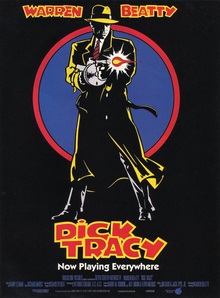
Dick Tracy (1990 film) (Photo credit: Wikipedia)
by Dean | Sep 15, 2013 | General
The recent The Spectacular Now (2013) is an adaptation of what is perhaps a fine novel by Tim Tharp, for the movie itself is agreeable. It deals honestly with young love, with primary characters Sutter and Aimee. The former is a friendly boy who drinks too much and is distinctly uneager to encounter the future. The latter, a very kind, bookish lass, becomes his girlfriend. It transpires that at bottom Sutter is self-rejecting, maybe self-loathing, which is why he denies Aimee’s words that she loves him. The secrets, the secret understandings, that bring tears; the now which leads people to disregard the future; the way people in love inexorably influence each other (as Sutter influences Aimee regarding liquor)—these are among the picture’s themes.
It’s a romantic film which never gets embarrassing or sentimental. Miles Teller enacts Sutter and knows exactly how to be a likable extrovert (maybe he is one). Plus his acting is not without depth. Shailene Woodley, as Aimee, has what John Simon said Joanna Shimkus has: “simple naturalness.” And charm. Not playing the same kind of girl she portrayed in The Descendants, Woodley is certifiably very talented. Despite a glossing-over here and there, The Spectacular Now is winning, directed wisely by Jon Ponsoldt.

English: Shailene Woodley at the Toronto International Film Festival 2011. (Photo credit: Wikipedia)
by Dean | Sep 12, 2013 | General
Hal Ashby’s Shampoo (1975) is the one about George (Warren Beatty, co-writer and producer of the film), a self-absorbed hairdresser who fornicates with a lot of women, including the wife, the daughter and the mistress of an unsuspecting millionaire (Jack Warden)!
A seriocomic, less than credible loser is what this is, since, for one thing, who knows why the women acted by Julie Christie, Lee Grant and Goldie Hawn are so gaga over handsome but dull George? For another, the film has a political dimension, but Beatty and Ashby understand nothing about . . . well, politics. Here, sexual hedonists, especially prosperous ones, allowed Richard Nixon to gain the White House in 1968, or saw to it that he did. That is, they were less concerned about the country than about their own pleasure and satisfaction and material privilege.
A fatuous message.

Cover of Shampoo
by Dean | Sep 10, 2013 | General
No doubt about it: South Korea’s Chunhyang wins the award for Best Depiction of Connubial Love in 2000 and even preceding years. Adoration, sexual play, and sexual lovemaking between husband and wife—Chunhyang and Mongryong—are all over the first hour, as is a Korean singer’s partial narration of the film’s tale in song (and it’s sung before a modern-day audience shown in the movie).
Figures of the 18th century, Chunhyang is a courtesan’s daughter and Mongryong a governor’s son, and they marry anyway. The narrative is not that interesting, although it isn’t boring either. The life of the film is in the visuals, in Im Kwon Taek’s directorial choices. For instance, when the married pair have to part for a long while, Mongryong, ready to leave, gazes in a closeup at his cherished wife. But instead of getting the expected closeup of Chunhyang, the camera simply cuts to a medium shot with the cherished wife still in the background, and she shows Mongryong the skirt, or whatever it’s called, on which he once wrote a pledge of fidelity. A smart move, this.
The exquisite Chunhyang also offers such shots as that of a single pink rose in a pond of sparse lily pads and that of Chunhyang swinging back and forth among forest trees in a scene Watteau would have envied. Moreover, there is a honeymoon sequence with Mongryong removing layers of timid Chunhyang’s clothes in what plays like a calisthenics of nigh amusing sensuality. And the nudity isn’t gratuitous. The first Korean film I saw, Im Kwon Taek’s achievement is one of the few cinematic gems of 2000.
(In Korean with English subtitles.)

Chunhyang (2000 film) (Photo credit: Wikipedia)