by Dean | Aug 8, 2013 | General
The French film La Discrete (1990), by Christian Vincent, is a revenge tale in which revenge becomes, first, methodical and dispassionate and, second, unimportant to the man avenging himself. This is Antoine, an aspiring writer whose paramour leaves him for another guy, whereupon Antoine remarks to a friend of his, a publisher, that he would wreak revenge if he knew how. The publisher explains how: Antoine can get even with the female sex in general–and become a published author to boot—if he will find a girl at random whom he will court, sleep with and then abandon, and concomitantly put the details of all this into a diary. The diary will be turned into a book.
A newspaper ad calling for a typist is what the blackguards use as bait to acquire a girl, and a student named Catherine is the one who comes along. At first revolted by Catherine’s near-plain visage, Antoine nevertheless initiates a romance with her and, yes, he sleeps with her. Not at all a bona fide woman-hater, however, the restless writer loses all desire to betray the girl, much to the publisher’s disgruntlement. And yet—though I will not elaborate on it—Catherine gets hurt, feels abandoned. The film is about how life inevitably moves on after plans are dropped, after evil is decided against, after scores no longer have to be settled. And it’s about loneliness and solitude: Catherine, it turns out, is consigned to isolation. Too, there is the theme of the malice which sometimes lurks behind loneliness: we see this in the publisher. Solitude prevails whether scores are settled or not.
Christian Vincent directed with taste and shrewdness, and co-wrote the talky but intriguing script. He seems very surefooted with actors too. Fabrice Luchini gives Antoine a perfect intellectual glitter and seductive extroversion. Catherine is made appealing, and this despite a certain self-effacement, by young Judith Henry. Maurice Garrel fills the bill, with virile sobriety, as the publisher. Once again we feel like celebrating French acting as much as we have celebrated British acting.
(In French with English subtitles)
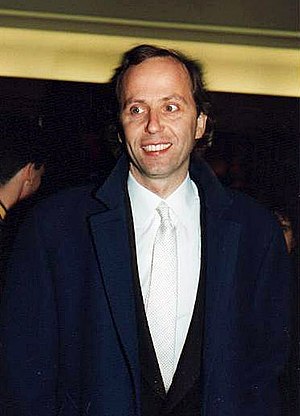
English: Fabrice Luchini, French actor Français : Fabrice Luchini, acteur français (Photo credit: Wikipedia)
by Dean | Aug 6, 2013 | General
Mom gets wildly demon-possessed in James Wan’s formidable The Conjuring (2013) but before that, she and the rest of the family incur “infestation”: unclean spirits in the house, getting all spooky. Mom is played by a magnificent Lili Taylor, who is every bit a mother (of five daughters) in the role, is convincingly worried and appalled, and is creepily demonized without a trace of overacting.
The film itself needed the excess happenings sliced from its plot unless of course the excess went on in real life, for The Conjuring is “based on a true story.” It’s a story involving not only demons but also two Catholic paranormal investigators (Vera Farmiga and Patrick Wilson), who manage to be efficacious in a vital exorcism. And it does this without any jabs at the Catholic church. (Take THAT, Village Voice.)
As a horror director James Wan knows what he’s doing. It’s an expert work visually and photographically, if not so much in its scenario. There’s a clever title sequence at the end, too.
by Dean | Aug 2, 2013 | General
How melodramatically directed, by Brian DePalma, Casualties of War (1989) is!–so much so that the film almost fails. As it is, it is neither quite a failure nor a success; it’s just worth seeing.
Based on a true story about a war crime—the rape and murder of a girl—during the Vietnam War, it has a hero in Michael J. Fox but a very low view of human nature. It does what author John Irving once said the novels of Kurt Vonnegut do: It makes us wish we were more virtuous. It makes us wish the world made greater moral sense, that human nature wasn’t so filthy. The screenplay by David Rabe is earnest and scintillating. Consider: the opportunity to rape a Vietnamese girl prompts Sean Penn’s Sergeant Meserve to laughingly praise life in the army, to which Michael J. Fox responds despairingly, ‘This ain’t the army, Sarge. . . This ain’t the army.” The army, he knows, is honorable, the war crime despicable.
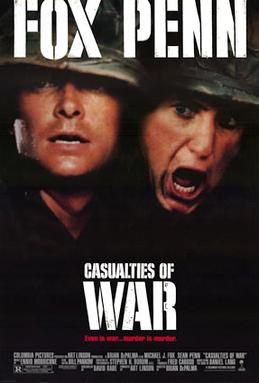
Casualties of War (Photo credit: Wikipedia)
by Dean | Jul 28, 2013 | General

English: AnnaSophia Robb at the July 2006 San Diego Comic-Con International. (Photo credit: Wikipedia)
The new Nat Faxon-Jim Rash movie, The Way Way Back (2013) doesn’t quite work. Fourteen-year-old Duncan (Liam James) takes a trip with his mother, his mother’s boyfriend and the boyfriend’s teen daughter to a beach house whose locale is inhabited by sundry interesting folks. Virtually none of them, I’m afraid, is complex or multidimensional, like actual human beings. Duncan’s mother, Toni Collette’s Pam, is complex enough, but where is the screenwriters’—Faxon and Rash’s—psychological insight? For Duncan, a quiet nerd, to gain self-confidence as rapidly as he does is preposterous.
Duncan’s relationship with a girl played by AnnaSophia Robb, a “love interest”, amounts to almost nothing, and that this girl has a friendship going on with the boyfriend’s teen daughter comes as a near-surprise, so glossed over is it. Even the directing in The Way Way Back—again, by Faxon and Rash—is not always what it ought to be.
What the filmmakers do well is write dialogue. It sparkles. In truth, however, the movie should be seen for its performances. Collette couldn’t be shallow if she wanted to be. Sam Rockwell and Allison Janney display marvelous energy and savvy, although with Janney there is the benefit of charm as well. Steve Carell plays a deeply flawed man adeptly and enjoyably. Ah, but it may well be that by saying the film should be seen for its performances, I’m saying that nothing else about it justifies its being seen.
by Dean | Jul 24, 2013 | General
There are several memorable scenes in what is a truly lousy Sam Peckinpah film—Bring Me the Head of Alfredo Garcia (1974)—which quickly nosedives with an insane script.
Undeniably, a pretty raw experience is offered in this enterprise—raw enough to be offensive. Warren Oates engages in a lot of very dopey, mow-’em-down shooting. Peckinpah strips Isela Vega of her clothes a bit too frequently, and when she confronts Kris Kristofferson . . . well, never mind. See it for yourself if you want to bother.
By the way, I don’t know who Isela Vega is, but her acting has subtlety and quiet appeal. She makes the film seem a little less ridiculous than it is.
The director of Ride the High Country, Major Dundee, and The Wild Bunch made THIS?

Bring Me the Head of Alfredo Garcia (Photo credit: Wikipedia)
by Dean | Jul 21, 2013 | General
Actor Vince Vaughn (a libertarian Republican?) knows perfectly well we have a sub-par economy these days and has co-written, and stars in, The Internship (2013), about two watch salesmen whose company folds and thereby leaves the gents jobless. Afterwards Billy (Vaughn) and Nick (Owen Wilson) decide to become unpaid interns for Google—oh, let us glorify Google; wall-to-wall product placement is here—in the hope of getting hired by the lucrative company. The pair learn a thing or two about computers and how to sell the Internet while blithely taking the young interns who are their co-competitors out of their insulated digital world for a while (not invariably in ways I condone).
Shawn Levy directed, and it is an indubitably superior flick to Levy’s Date Night (2010). Alas, to me it is not much funnier than Date Night but neither is it a total loss as comedic cinema. Far from it. The cast is fun, Vaughn and Wilson most of all—and pretty Rose Byrne and Tiya Sircar are on hand. A few hokey bits pop up, and I regret that the Byrne character is such an easy lay for Nick, but the movie is good at thrusting us into the Contemporary Scene, consisting of young adult worries about employment no less than of computer apps. It’s a genial piece with workmanlike directing, editing and cinematography behind it. In addition, I’d call it . . . libertarian.
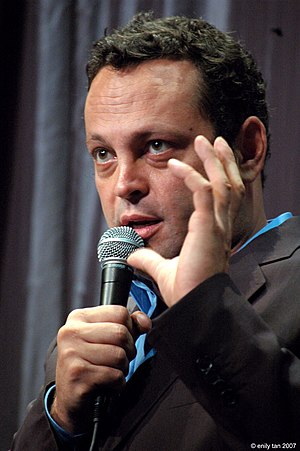
English: Vince Vaughn at CMJ Festival 2007 (Photo credit: Wikipedia)