by Dean | Apr 12, 2013 | General
The Federico Fellini film, Amarcord (1974), is autobiographical and nostalgic and seeks to be genial, amusing and slightly political and religious. In the final analysis, it is an overrated load of insulting grossness. An adolescent picture partially about adolescents, it features a boy who, after getting lewdly physical with an obese woman, feels so guilty he promises his mother he will become a missionary. Forget it, kid: in this movie that seems highly out of place.

Cover via Amazon
by Dean | Apr 10, 2013 | General
Directed by Tom Hooper, Les Miserables (2012) may be the most naturalistic movie musical I’ve seen, though its theatrical character never disappears.
Most if not all the filming of this well-known stage work is smoothly successful, despite a few grating singing voices. Hooper eventually has Anne Hathaway, the movie’s Fantine, looking ugly but, worse, she makes a spectacle of herself when she emotes. The good news is that Hathaway sings well enough and is moving, insufficient as this is.
The song lyrics in Les Miz are not very literate or sophisticated—they’re just okay—but the sober and warm music is admirable. The presence of political revolutionaries makes the Christian vision in the film’s finale rather odd, but, well, Jean Valjean (Hugh Jackman) and Fantine are there too, and it is uplifting.

At the Movies ~ Les Misérables, 2012 (Photo credit: erjkprunczýk)
by Dean | Apr 8, 2013 | General
The 1994 Queen Margot, adapted from an Alexandre Dumas novel, is about Margaret of Valois (Isabelle Adjani), who during the 1500s was forced to marry Henri the King of Navarre (later the King of France) in the midst of post-Reformation violence and conflict. The marriage is essentially no good; as in life, Margaret—Margot—has her lovers, and so does Henri. Yet the Catholic Margot feels compelled to save the Protestant Henri’s life after Margot’s evil mother (Virna Lisi) engineers the massacre of the Huguenots on the eve of St. Bartholomew’s Day. It’s a famous horror in French history. Even after this, Henri remains a marked man since he desires the French throne, while Margot gets together with another man she must try to protect: La Mole (Vincent Perez), her newest lover. He too is a Protestant.
The film is a vivid and bloody historical drama with a dark screenplay by Daniele Thompson, et al. The direction by Patrice Chereau is generally sensible and brave. In the world of Queen Margot, some needed relief emanates through loyalty and through love affairs, but largely there is the chaos of perilous times. What is practiced is the politics of death. We might as well be in Ukraine during the Stalin era. People are fearful, moving with a liveliness that demonstrates the need to escape. . . The movie ends with nasty Anjou, one of Margot’s brothers, poised to take the throne after the death of Charles IX and commenting to his mother that now, in the kingdom, hatred shall come to an end. Empty optimism, I’d say.
(In French with English subtitles.)

Cover of Queen Margot (La Reine Margot)
by Dean | Apr 5, 2013 | General
The old movie The Girl Can’t Help It played in the Big Apple in 2006 and was intelligently reviewed in the Village Voice. So I saw it on DVD, impossible though that makes it to judge the cinematography.
Frank Tashlin’s film is brazen with color, with “laminated sheen” (J. Hoberman), and is a 1956 guilty pleasure. It’s a rock ‘n’ roll quasi-musical starring Jayne Mansfield, Tom Ewell and Edmond O’Brien, and featuring Little Richard, Eddie Cochran and even Julie London. Most of the songs are trash; they’re “classic rock.” Thankfully, some ballads are there. Unthankfully, so is Tashlin’s script.
Enjoy yourself. Mansfield is staggeringly beautiful, and although J. Hoberman is right that her “desire for domesticity” is “unconvincing,” at least it’s there. The girl can’t help it? Right, and she can’t help being highly sensual once Tashlin gets hold of her. Not that The Girl is very hip, though. The presence of the principals, e.g. Ewell, makes the film seem basically divorced from rock music’s feisty world. Jayne ain’t cool . . . I take that back: In a way she is. Whatever the case, the flick is pure Hollywood commercialism. Again, a guilty pleasure.

The Girl Can’t Help It film poster (Photo credit: Wikipedia)
by Dean | Apr 4, 2013 | General
Because she is poor and pregnant and refuses to marry her irresponsible boyfriend, Maria Alvarez (Catalina Sandino Moreno, in a so-so performance)—the protag of Maria Full of Grace (2004)—agrees to become a criminally active “mule” who smuggles drugs from Colombia to exotic New York. She swallows the pellets whole and carries them in her gut before excreting them in the NYC apartment of drug-dealing thugs. The plot advances with the death of Maria’s fellow mule, Lucy, who gets fatally sick and is horribly manhandled by the thugs. The conclusion of this film by Joshua Marston accepts what is indisputably the politically liberal view on illegal immigration (economically Colombia bad, America good, you see) and I have a problem with that.
Doesn’t mean it’s a bad picture, though. Maria is absorbing, non-melodramatic and almost always convincing. I do wonder, however, why Maria fails to perceive the moral seriousness of what she’s doing. Oh well.
(In Spanish with English subtitles.)
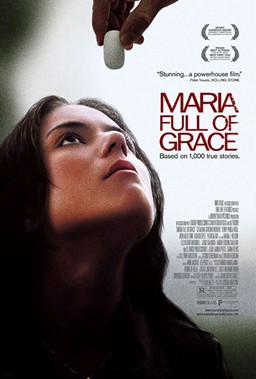
Maria Full of Grace (Photo credit: Wikipedia)
by Dean | Mar 29, 2013 | General
How many a cappella pop songs exist in the world I don’t know, but “Easter Song” by Glad is likely to be one of the best. The lead singer is enthrallingly good, both sober and cheerful, while collective vocals fill the bill superbly. (This on the studio recording.) A certain restraint is here but so is utter passion, summoned, of course, by the Resurrection. Too, you’d better believe the song has hooks.
Edifying.