by Dean | Dec 21, 2012 | General
Something needs to be done with Andy’s charming toys now that Andy is 17 years old and bound for college in the outstanding Toy Story 3 (2010). Almost all of them are supposed to go in the attic (which is good—it’s still the owner’s house) but they’re somehow transported to Sunnyside Daycare instead (which is bad). A pink toy bear there has grown malevolent and becomes the enemy of Woody the cowboy, Buzz Lightyear, et al. He is unfortunately aided by Ken, who falls in love with Barbie, another toy at Andy’s house; she belonged to Andy’s preteen sister, Molly. The adventure proceeds apace. Led by Woody, the band of good-guy toys must fight for freedom and survival, thwarting the will of the bear-despot.
Yes, Lee Unkrich’s animated film is funny, but it is not as funny as it is entertaining in its drama. And moving. It more or less sheds tears over the harshness of reality. When the pink bear, a big baby doll, and a toy clown discover they have been unintentionally left behind after a family vacation, they are shown in all their sad vulnerability. Later, all the toys of Andy find they must resign themselves, for a while, to dying in a terrifying inferno. Toy Story 3 has no politics, albeit it does have victimization—and a penal colony for toys in Sunnyside Daycare.
Still, this is a powerful comedy, wildly fun. Risque humor in a family film was never more hilarious. The funniest joke is when Mr. Potato Head finds he must transfer his parts to a tortilla. The flick is every bit as good as The Incredibles—nay, better.

Sheriff Woody (Photo credit: Wikipedia)
by Dean | Dec 17, 2012 | General

Cover of Leoš Janá?ek
Leos Janacek, a Czech composer, completed his Sinfonietta just a couple of years before his death in 1928.
It is over 20 minutes long and consists of five movements, the first of which is bold with horns. Timbre and harmony delight during the second movement, a brightly sweeping andante creation. The slower third movement offers romance and gravity, and in the 7-minute fifth movement there is a marvelous Finale.
Janacek wrote Sinfonietta in honor of the Czechoslovak military, but it is much more than a martial opus. There is something mysterious about, and in, great art, and this piece is no exception. It’s a wonderland of sound with its own profundity.
by Dean | Dec 12, 2012 | General
All the accepted ignorance and universal dumbing-down, all the pop culture foolishness and great-unwashed breeding have taken their toll in the world of Idiocracy, a 2006 film by Mike Judge.
A science experiment goes wrong: an otiose soldier (Luke Wilson) and a cynical prostitute (Maya Rudolph) placed in artificial hibernation end up awakening in the year 2505, soon discovering that the entire human race is pitifully dumb. Education is nil, though handed-down technology exists; stupidity, obscenity and certain forms of violence are everywhere. National problems go unsolved. It is hoped, even so, by the fun-loving President of the United States that Wilson’s soldier, who has the highest I.Q. in the world now, will save the country from future starvation. Crops fail to grow because the citizens are stupidly watering them with a sports drink.
As one can see, there is satire here. The humor, though hopeful, is barbed and frank—and funny. Consider that a character’s favorite TV show is titled (profanity alert) Ow, My Balls! How’s that for an attack on commercial entertainment? But this leads me to mention that this film which focuses on so much societal vulgarity, especially sexual vulgarity, is itself rather vulgar. And it is not always smoothly written; the movie sputters here and there. But no matter. Idiocracy has a raison d’etre. It’s serious. We’re better off with it than without it. Duh! anyone?

Cover of Idiocracy
by Dean | Dec 11, 2012 | General
I’m glad I never saw the deeply leftist films, if that’s what they are, of Paul Haggis. But his The Next Three Days (2010), a thriller that means business, I did happily see—and do recommend. It’s a remake of a French picture I’m unfamiliar with, so, yes, it’s lacking originality; but what the heck? The action is a grabber, Haggis directed with panache and, despite a story which strains credulity, wrote the screenplay acceptably.
by Dean | Dec 3, 2012 | General
The world Steven Spielberg creates in Lincoln (2012) truly does not seem far removed from the one in which no one saw slavery as a moral issue: the world of colonial America, for example. It’s the nineteenth century, however, and President Lincoln insists on the passage of the slavery-extirpating 13th Amendment—the subject of Spielberg’s and screenwriter Tony Kushner’s film.
I don’t care for the director’s sentimental hyperbole, but Lincoln is a quite good historical drama (however much license it takes). Though the theme lacks profundity, the writing is intelligent, and by saying this, I am obliged to point out what the theme is: that dishonest actions are sometimes needed for producing perfectly just and noble political ends. Nothing profound, or original, about that; although fortunately there is much more going on in the picture than this element.
The talk is clever, the debate exciting. Costumes, production design and Janusz Kaminski’s cinematography are remarkable and captivating. Kushner is a homosexual, but Abe Lincoln here is not gay. Not openly, anyway, and probably not at all. Period.
Daniel Day-Lewis plays him appealingly, although other actors, such as Sally Field and the poised David Strathairn are more memorable. Outstanding.
Lincoln is no John Adams, but it is one of Spielberg’s best films.
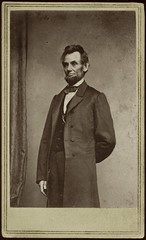
Abraham Lincoln (Photo credit: George Eastman House)
by Dean | Nov 29, 2012 | General
It was a funny comic strip, Peanuts was, even if it relied too heavily on eccentric Snoopy for its humor.
The first of all the Peanuts TV specials, “A Charlie Brown Christmas” (1965) was so painstakingly written by Charles Schulz that it ended up being a comic masterpiece which didn’t need any heavy reliance on Snoopy. It just needed a lot of imagination and some top-notch jokes. To Schulz it needed to be meaningful too, and with Linus quoting the Gospel of Luke (and the singing of “Hark the Herald Angels Sing” at the end) it did become meaningful in a way other Christmas cartoons on TV never did.
Vince Guaraldi’s music is famous now, with its hooks and charm, and the voices—Peter Robbins as Charlie Brown, Kathy Steinberg as Sally, etc.—are unbeatable.

A Charlie Brown Christmas (Photo credit: Wikipedia)