by Dean | May 28, 2017 | General
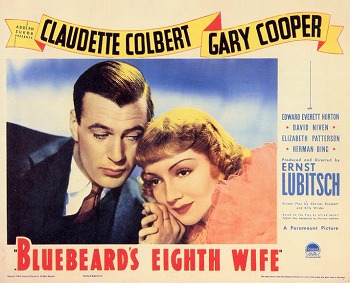
Bluebeard’s Eighth Wife (Photo credit: Wikipedia)
The film, Bluebeard’s Eighth Wife (1938), is an adapted work for sure: it is based on the English translation of a play. And it’s made pleasant by director Ernst Lubitsch, surefooted and keeping the charm flowing, and actors Claudette Colbert, Gary Cooper and David Niven.
Curiously, it deals with a married couple devoid of, well, relations—of any kind. They aren’t even kissing. This is because, not long after marrying him, Nicole (Colbert) wishes to divorce millionaire Michael (Cooper) and get from him a lot of prenup money. Wow, you say. She must be depraved. Er, no. Not quite. Watch the flick to the end. One thing which is certain is that the plot action is not obvious.
Both enjoyable, Colbert and Cooper do everything they can to flesh out their characters, but they’re a bit hamstrung because no real psychology exists here. Still, it’s diverting—for a long time, a happy-go-unlucky movie, which keeps it interesting.
by Dean | May 25, 2017 | General
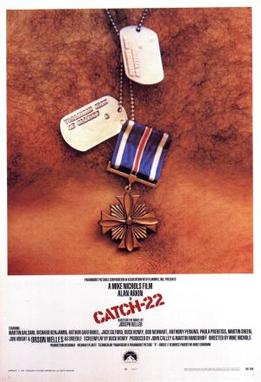
Catch-22 (film) (Photo credit: Wikipedia)
I dislike Joseph Heller’s Catch-22, which never should have been made into a movie. It was, though, by Mike Nichols and half-talented scenarist Buck Henry.
About Nichols, Stanley Kauffmann was correct: “at whatever level, he was born to direct,” and the material in The Graduate and Carnal Knowledge was worthy of him. But the misguided, sophomoric stuff in the Catch-22 screenplay is not. (Not that Nichols’s direction is mistake-free; note the use of the 2001 music by Richard Strauss.)
Really, the Heller novel has little sophistication—not none, but little. What sophistication, what thoughtfulness, is there, however, hasn’t been passed on to the film, because I don’t believe Henry knew how to do it. Spare me Heller’s Snowden episode, but in the movie it’s no good at all. Neither are the caricatures from Orson Welles, Bob Newhart, and Buck Henry himself, and the comedy is sometimes too raffish. A fantasy scene with full frontal female nudity is blatant and unnecessary. I’m glad Catch-22 did not begin a veritable decline in Nichols’s oeuvre.
by Dean | May 22, 2017 | General
The Heartbreak Kid is a 1973 picture directed by Elaine May and written by Neil Simon.
In it, a Jewish newlywed, Lenny (Charles Grodin), sees just how vulgar and tiresome his wife Lila (Jeannie Berlin) is, and he regrets marrying her. But during his honeymoon he himself turns into a deceitful fool-for-love—“in love” not with Lila but with the lovely goy Kelly (Cybill Shepherd), whom he meets on the beach. Kelly’s father (Eddie Albert) is understandably appalled by the guy, and he instinctively hates him. The movie’s ending is not exactly sanguine, and not exactly explicable.
Marriage here, except for that between the Eddie Albert character and his wife, is a joke—turned into one by the people involved. But too much fuzziness brings on some implausible content, such as the virginal Kelly’s cool-woman teasing of Lenny, a married man. . . What’s it all about, Miss May? You have more reason to be proud of your daughter’s, Miss Berlin’s, fine acting than of the film.
by Dean | May 19, 2017 | General

Bathing Beauty (Photo credit: Wikipedia)
Without its music, Bathing Beauty (1944) would have nothing. Red Skelton is deeply unsatisfactory, even repelling, as the leading man in the film, and has no business being the love interest for Esther Williams.
Williams, of course, is the star who swims, who does what people surely regard as “water dancing.” An expert dancer, female, who is also beautiful is not very common. An expert swimmer, Williams is beautiful; but, in truth, swimming is not dancing. To me, Williams’s doings are of limited interest (plus her acting is mediocre). Only the synchronized swimming in BB has any aesthetic merit.
The music can be entertaining. Much of it comes from Harry James, some of it from Xavier Cugat, and its many Latin sounds seem to promise an appearance by Carmen Miranda. (But no.) It’s pretty sapid pop, decently sung, in what is a multifarious movie musical. Not one of director George Sidney’s best, though: consider that Skelton is around a lot of women and a few men, but never seems to maintain a true connection with any of them.
by Dean | May 15, 2017 | General

The Eel (film) (Photo credit: Wikipedia)
The Eel (1997), a Japanese film by Shohei Imamura, adapted from a story, centers on two sinners trying to find peace. One is a man, Yamashita (Koji Yakusho), the other a woman, Keiki (Misa Shimizu). Keiki, who attempts suicide over a romantic attachment to a married man, comes to love Yamashita, but he keeps his emotional distance from her. Possibly this is because Yamashita was habitually unforgiving of his wife until, after discovering her adultery one day, he murdered her. Now an ex-con, he is coming to grips with his clear iniquity.
Pretty Keiki is a pleasant, conventional young woman, and before the murder Yamashita was a quite conventional man, and thereby the film indicates how, sometimes, conventional people are motivated to dreadful extremes.
The ex-con, as it turns out, is now rather odd. He has made a beloved pet of an eel, and there is symbolic weight here. For one thing, the male eel is a creature of certain sacrifice, and Yamashita proves to be this too. This is done for Keiki’s sake: the two sinners looking for peace finally have chaos thrust upon them, and only a particular gesture will eliminate it. It begins to seem as though there will be no peace for Yamashita and Keiki, but we would have to consider ourselves presumptuous for believing such a thing.
Its finish hopeful, The Eel is an impressive picture.
by Dean | May 9, 2017 | General

Cover of The Good Fairy
Ferenc Molnar probably wrote a delightful play when he wrote The Good Fairy, since it was turned into a delightful 1935 movie by William Wyler. With cool subtlety Margaret Sullavan (once married to Wyler) enacts a friendly, callow girl raised in an orphanage and encouraged there to practice good deeds. She does one, willy-nilly, for a professional man (Herbert Marshall), a lawyer whose integrity is sadly losing him money. But to accomplish this, Sullavan’s “good fairy” has to lie to a love-hungry CEO (Frank Morgan), who is generous enough to bestow wealth on the man he believes to be Sullavan’s husband—the lawyer.
Both men are needy in their own way, albeit Sullavan, or Luisa Ginglebuscher (her character’s name), can help only one of them. The CEO is privileged regardless, and it impresses that the film does something many modern-age people would disdain. It looks through a positive lens at “men of privilege.” Yes, the lawyer is poor but, as an educated man, he could gain privilege—and wealth—at any time. And he does.
A true artist, Preston Sturges, wrote the screenplay for Fairy, and even though it isn’t one of his “personal” works, no doubt he understood what Molnar was doing.