by Dean | Sep 6, 2016 | General
There are two reasons you might want to see the new Ben-Hur movie (2016): 1) the vivid, naturalistic visuals (as in the set design) and 2) the performance of Jack Huston as Judah Ben-Hur. Aside from this . . . no sale.
It is literally incredible that Judah Ben-Hur would refuse to name the Zealot who tries to assassinate Pontius Pilate when not only he but also his mother and sister are under threat of being killed. In the hell-for-leather chariot race, Ben-Hur holds on to the horses’ reins while being dragged on the ground, but manages to defy physics and pull himself back to, and climb up on, the chariot. These are just two of the many absurdities in the film.
Here’s another: Jesus Christ is more of a Love teacher than a Redeemer, except that through the death on the cross an awesome miracle occurs with its implications. . . Admittedly I found the ending of Ben-Hur quite edifying (but to me the ending of God’s Not Dead 2 was edifying as well). I readily assert that Roma Downey and Mark Burnett should be executive-producing better Christian movies than this. Many, I fear, would deem the film not only dissatisfying but unwatchable too.
Directed by Timar Bekmambetov.
by Dean | Aug 31, 2016 | General
In a recent Wall Street Journal, Terry Teachout reviewed a play titled A Day by the Sea by N.H. Hunter, a British dramatist who died in 1971. Greatly admiring the play, Teachout asked why it was mounted in New York in 1955 but never after that until now, in 2016. What he believes to be the answer is that critic Kenneth Tynan unfairly crushed the opus in his ’50s review of it, thus creating a hands-off attitude among theatre directors. According to Teachout, Tynan “had little use for plays without a political message” and non-political, I take it, is what A Day by the Sea is.
That a professional critic did such a thing doesn’t surprise me. And I can be confident that Tynan lapped up plays with a political message when the message was one he agreed with (i.e., a leftist message).
by Dean | Aug 30, 2016 | General
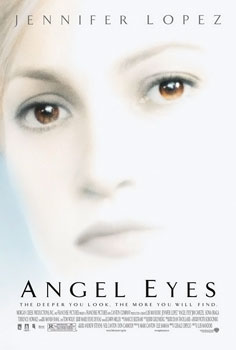
Film poster for Angel Eyes (Photo credit: Wikipedia)
Mark Holcomb of The Village Voice is right: Jennifer Lopez, in Angel Eyes (2001), is “winningly brassy/bashful.” In this Luis Mandoki film, written by Gerald DiPego, she plays a brassy/bashful policewoman, while handsome Jim Caviezel plays a shaken fellow on a moonbeam. The two fall in love.
For about an hour Angel Eyes sustained me because of J. Lo’s performance and pulchritude and the film’s considerable freshness. Indeed, it is not oblivious to the spiritual dimension of human life. But by and by DiPego throws all credibility and unsentimental honesty out the window, as witness the silliness about Caviezel’s newly received blessing of a pet dog named Bob. That spiritual dimension hardly means very much alongside material like this. Let it be lamented, too, that Hollywood folks do not care how sentimental their movies are so long as they’re unabashedly commercial; that’s all that matters. But I want to believe that Lopez and Caviezel rise above the money-mindedness enough to respect their craft of acting, for neither of them lets us down. And there’s still that worthwhile first hour.
by Dean | Aug 28, 2016 | General
After his divorce and a short time in prison, Andreas Winkleman (Max von Sydow) lives a solitary life until, first, he sleeps one time with a lovely neighbor (Bibi Andersson) and, second, he begins a romantic liaison with the damaged Anna (Liv Ullmann). A Passion, not The Passion of Anna, is the actual title of this 1969 Ingmar Bergman film when it is correctly translated, with passion as a synonym for suffering. Needless to say, this being a Bergman movie, Andreas and the other characters do suffer.
What is more, Bergman was impressed by the observation of a particular philosopher that people live strictly according to their needs, both positive and negative. He means for his people here to verify that. At the end of the film, the needs of Andreas conflict with each other and there is painful irresolution. A limited profundity is in this, but much more can be found in A Passion, which is also about isolation and the lies we tell to make it seem there is less isolation.
The film is brilliant, especially visually, but is yet another excessively talky Bergman piece. Predictably, the acting is magnificent. Max von Sydow was never more incisive, more soulful. As well, however, Bergman is the same old skeptic about religion (unlike me). He never—and I mean never—understood it. A Passion is easier to take than the Swedish artist’s other movies, excepting Winter Light, but I finally cannot accept it.
(In Swedish with English subtitles)
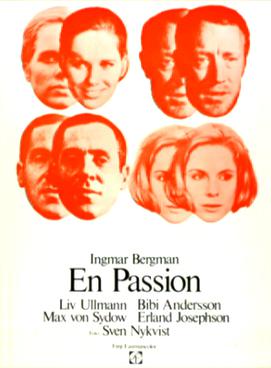
The Passion of Anna (Photo credit: Wikipedia)
by Dean | Aug 24, 2016 | General

Cover of Tadpole
There is fine acting from Bebe Neuwirth, John Ritter, Sigourney Weaver and the newcomer, Aaron Stanford. There is a fairly funny and unpredictable script by Heather McGowan and Niels Muller. Gary Winick‘s decision to shoot the film in DV is acceptable because Tadpole (2000) is, to use another critic’s proper adjective for it, unassuming.
Nevertheless, this Graduate-like film with a 15-year-old Benjamin and Neuwirth’s Mrs. Robinson would have been far better had the precocious boy (Stanford) not been in love, or “in love,” with his fiftyish stepmother (Weaver). With Neuwirth the boy is not smitten; with his father’s wife he is. It’s a sleazy and ill-fitting item. It knifes the otherwise successful confection right in the back.
by Dean | Aug 22, 2016 | General
The characters in the new Japanese picture, Our Little Sister (proper title: Umimachi Diary), hold our attention, but I find the story mediocre because certain things are laid on so thickly (a now dead woman became involved with Sachi’s married father; now Sachi is involved with a married pediatrician). In addition, the film is so humanistic—and finally so sentimental—that all the major characters are, or become, virtual saints. It is as though every fault has melted away. This is not the case with a great film like Ozu’s Tokyo Story, which I bring up since Sister resembles an Ozu production.
The movie is based on a comic-book novel which director Hirokazu Kore-da probably should have left alone.