by Dean | Aug 19, 2016 | General

Cover of Shopgirl
I’ve never read Steve Martin‘s novella Shopgirl, on which this 2008 film is based, but I mostly admire his script for the film—more than I do his wan acting.
Directed by Anand Tucker, Shopgirl stars Claire Danes as an L.A. sales clerk for Sak’s. Lonely and sans a beau, she takes up with a near loser (Jason Schwartzman) whom she can’t possibly love. By and by he changes for the better, but by then the Danes character, Mirabelle, has drifted into the arms of a friendly, fifty-something swell (Martin). The swell is not quite the man for her, though, albeit Mirabelle decisively wants him. But will she, can she, fall for Schwartzman too?
Martin’s little opus surveys the pleasure and heartache of love without mutual commitment, romance which is sexual but of limited potency. Note how falling in love spurs Mirabelle to give up antidepressants, only to eventually find she still needs them irrespective of whether she has a beau or not. . . A histrionic angel, Danes creates a tender Mirabelle, and Tucker makes sure she has presence. There are shortcomings in the film, such as Martin’s unnecessary voiceover and the fact that the last sentence he speaks will not do. But, too, it is feelingful and pleasantly Chekhovian. And, yes, not very comedic but it doesn’t have to be.
by Dean | Aug 18, 2016 | General

Cover of Sudden Fear
Revived this month in a New York City theatre, the 1952 thriller Sudden Fear, by David Miller (who?), presents love being replaced by self-preservation, both belonging to Joan Crawford‘s Myra Hudson. Myra adores, and marries, the unscrupulous actor Lester (Jack Palance) but he starts making out with an old flame (Gloria Grahame), who hatches the idea that the two of them should murder Myra for money.
It’s riveting stuff, nicely justifying its title. With an often sweat-drenched face—playing an armed self-defender who does not want to kill—Crawford deepens the film. And Palance and Grahame are not without their unique appeal.
by Dean | Aug 16, 2016 | General
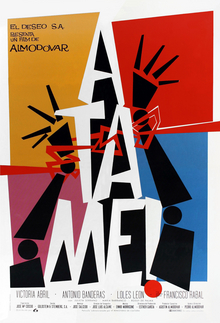
Tie Me Up! Tie Me Down! (Photo credit: Wikipedia)
There really isn’t much to Almodovar‘s Tie Me Up! Tie Me Down! (Atame! 1990) because it exists only to be daring or—if you will—transgressive, not to convey a shared vision of life. It is also decidedly politically incorrect, which is okay by me, since it deals with a woman (a porn star played by Victoria Abril) who falls in love with her unstable kidnapper (and would-be husband, played by Antonio Banderas).
Abril doesn’t quite convince me as a porn star and a drug addict, but it hardly matters: her acting is excellent. It isn’t her fault that her taking up with the kidnapper is a rather hard sell. Tie Me Up! may be rated NC17 for its sex and nudity, but it is utterly minor, if beguiling (or seductive). And, no, the Abril character does not really care about religion.
(In Spanish with English subtitles)
by Dean | Aug 15, 2016 | General

The Nun’s Story (film) (Photo credit: Wikipedia)
Catholic asceticism or self-deprivation, as in a convent, is not for everyone. It is not for every Christian, in fact. In the Fred Zinnemann film, The Nun’s Story (1959), strong-willed Sister Luke (Audrey Hepburn) becomes certain she is failing as a nun, certain she cannot adequately keep the Holy Rule she respects. Her good work as a nurse in the Congo cannot leave her with a sense of spiritual security, and so she renounces the convent life. Before leaving, Sister Luke (real name: Gabrielle) kneels to receive the sign of the cross from a fellow nun, who silently refuses to grant it. Subsequently our heroine looks at the crucifix on the wall and makes the sign herself. Communicated here is that Gabrielle no longer being a nun does not mean she is no longer a woman of God, a Christian.
How faithful the film is to Kathryn Hulme’s book I don’t know, but creditable work has been done by, among others, Zinnemann and screenwriter Robert Anderson. The movie peters out before its denouement, and reactions to the murder of a nun by a superstitious African ought to have been more affecting. All the same, Hepburn is beautifully serious and so is the film. To me it never gets boring; it gets memorable.
by Dean | Aug 9, 2016 | General

Bed and Board (Photo credit: Wikipedia)
Francois Truffaut made Bed and Board (Domicile Conjugal, 1970) to show us his autobiographical character, Antoine Doinel—a former juvenile delinquent—as a married man with a child. Casually he tosses in the revelation that Antoine (Jean-Pierre Leaud) is often selfish, and drama would be absent from the film had he not had Antoine cheat on his wife (Claude Jade) with a Japanese woman.
Less successful than Truffaut’s other Antoine Doinel pictures, Bed is nevertheless pleasurable with its slight goofiness and, well, essentially meaningless high spirits. It is usually the equivalent of a Paul McCartney love song, except that it’s pretty risqué. The Story of Adele H. it ain’t.
(In French with English subtitles)
by Dean | Aug 8, 2016 | General

Cover of The Prince of Darkness (Plantagenet 4)
Was King John of England, who died in 1216, an evil king? Jean Plaidy wrote about him in her 1978 novel, The Prince of Darkness, and to her the answer is certainly yes. It is not long before the book ends that John is forced to sign Magna Carta; before this he demonstrates not only how famously hot-tempered he is but also how infernally cruel, feckless, lustful and selfish.
The novel’s England can barely withstand the royal immorality here, and near the end the nation hits the skids, though not hopelessly. The Prince of Darkness is gripping and engrossing, even if sometimes Plaidy nearly loses control of her sentences. I don’t think there’s a shortage of historical accuracy either.