by Dean | Feb 28, 2016 | General
To a child, a favorite toy acquires a life of its own, with the child as its master. In the 34-minute French movie, Albert Lamorisse‘s The Red Balloon (1956), it is for a child (Pascal Lamorisse) that a balloon acquires a life of its own, magically.
This simple short became famous, and has endured, because it is beautifully and enticingly put together, inevitably in color and with several excellent set pieces. Alas, it is not very moving, but it has the kind of unfailing charm of which a director like Truffaut in his films made such a contribution. Lamorisse proved the worth of his instincts.
(In French with English subtitles)

The Red Balloon (Photo credit: Wikipedia)
by Dean | Feb 23, 2016 | General
With multiple plot strands working in its favor, the most recent Jane the Virgin (last night) was thoroughly palatable.
The cops/criminals strand was intense and surprising, and the not-very-Catholic Jane now wants to have sex. Temporarily. She understandably thinks it’s weird to be “a virgin mom,” but this droll sex comedy ends exactly as expected.
There was a lot of romanticizing, though—of various things—done by Jane, Xiomara, Luisa. We knew it was there because every instance of it made the screen a rosy color. (You had to be there.) You should have been there, if you weren’t, to witness the conceited actor Rogelio (Jaime Camil) playing the First Male Feminist and regularly kissing a young and pretty Susan B. Anthony. A riot. Also, Petra’s gotten bitchy again.
by Dean | Feb 21, 2016 | General
Thomas Vinterberg‘s film of the Hardy novel, Far from the Madding Crowd (2015), is about the occurrence of discovery—discovery of another’s romantic interest, of responsibility, of sexual pleasure, of heartache. The first hour and the last few moments, the coda, of the film are compelling; the rest of it is too hurried, with short shrift given where it should not be given. In addition, main character Bathsheba Everdeen doesn’t seem entirely human because of course she is a nineteenth century proto-feminist.
Carey Mulligan, who plays her, never does anything surprising but is interesting in the role nonetheless. Even stronger are Michael Sheen and Matthias Schoenaerts. There is no greatness in Madding Crowd, as there is in a period piece like 1973’s The Emigrants. I believe it to be a failure, but a very watchable failure—a near-success, in fact.
by Dean | Feb 18, 2016 | General
Stanley Tucci and Campbell Scott, both actors, scored a lot of points in directing the 1996 Big Night, for which they chose an easygoing but not too slow pace, dabs of effective slow mo, wise medium shots of people, and Felliniesque dramatics. They both act in the film too, and Tucci, talented guy, co-wrote the original screenplay, which has to do with the efforts of Italian brothers to keep their traditional Italian restaurant afloat in the big-city America of the 1950s. Sadly, one of the brothers has given up all integrity. He is desperate, even betraying his pleasant girlfriend (Minnie Driver). A novel idea obtains, then: i.e., moral compromise takes place so that compromise with cuisine (traditional Italian) might be eschewed. Not that the filmmakers condone this compromise, you understand; they don’t. But it does go on.
Honest and endearing, Big Night is one of the cinematic big deals of ’96.

Cover of Big Night (Ws Keep)
by Dean | Feb 16, 2016 | General
Occasionally dopey (groan! those women in the cat costumes), the 1934 Cleopatra is nevertheless Cecil B. DeMille‘s not-bad historical drama about Cleo, Mark Antony and others.
Because she never truly exhibits the Egyptian queen’s ambitiousness (and is a paleface), Claudette Colbert is somewhat miscast in the title role, but not badly so. Released just when movie censorship was getting tight, the film is patently sensual. After an apparent split-second shot of her naked breasts in DeMille’s The Sign of the Cross, and then Cleopatra, Colbert, a future conservative Republican, swore off sexy roles; but there is a physical splendor, a real pulchritude, about her in this picture. Also, her acting outshines that of the other performers.
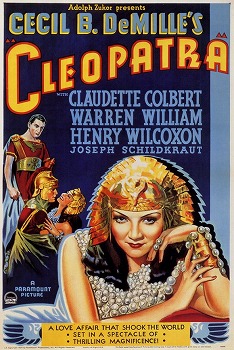
Cleopatra (1934 film) (Photo credit: Wikipedia)
by Dean | Feb 14, 2016 | General
In Room (2015), Brie Larson enacts a woman subjected to the same nightmare the three female victims of Ariel Castro incurred. Remember the kidnapping and imprisonment? The woman has a five-year-old son (Jason Trembley) produced through the Castro-like abductor’s routine rape of the woman. . . Human evil in Room is what it is because it deprives other people of what is good and vital (e.g., freedom). Indeed, it is okay with the abductor (Sean Bridgers) if Jack, the young boy, is deprived of a childhood; it is only his mother who provides him with one to the best of her ability. Childhood during victimization is a theme here.
Though not as well-plotted as it is well-made, Lenny Abrahamson‘s film has riveting dramatic scenes and is deeply moving. The most impressive thing about it, though, is the acting of Larson and young Trembley, who contribute a great deal to making the picture fascinating.
Room is based on a novel by Emma Donoghue, who wrote the screenplay.