by Dean | Jul 21, 2015 | General
I suppose that at bottom Private Hell 36 (1954) is Ida Lupino’s film. Don Siegel directed it, but Lupino starred in and co-wrote it—originally for the screen, hooray!—with Collier Young. She plays a bar singer who falls for a now admirable, now dirty cop (Steve Cochran) intent on making his distressed partner (Howard Duff) dirty as well.
The movie is right up Siegel’s alley, with hard-nosed conflict, unobtrusive mystery, human interest, and a car chase. The cast is estimable: what Lupino and Cochran do cannot be improved on.
I am inspired to add, too, that there is nothing feminist about the Collier-Lupino script. The bar singer, Lillie, is not a “liberated woman” but simply an adult: she talks like an adult, likes to be with other adults, and is never to be patronized. That she isn’t at the center of the cops-and-crime story here doesn’t alter the evidence that Lupino and Siegel were meant to be together.
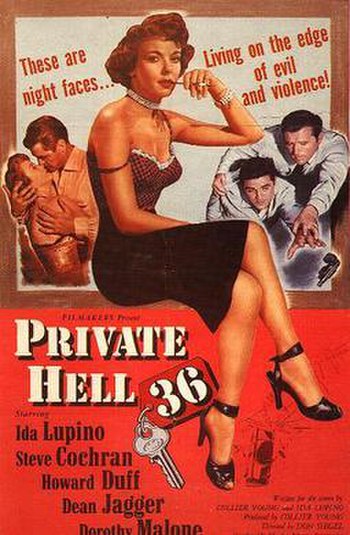
Private Hell 36 (Photo credit: Wikipedia)
by Dean | Jul 19, 2015 | General
Big adolescent Seth MacFarlane has come out with Ted 2 (2015), a sequel to Ted.
Just because the jokes in a comedic flick are sometimes politically incorrect doesn’t mean the flick is a good one. The concept of a talking teddy bear (who’s a stoner) is pretty puny, pretty mediocre, and thus it doesn’t well serve the movie’s plot. Yes, although Ted 2 is too vulgar, it is often funny, and yet some of those jokes seem a bit desperate. Example: a black woman comments on slavery by saying that, first, you’re working beside an African river; then, the next thing you know, “you’re being f**ked by Thomas Jefferson.”
Did Thomas Jefferson f**k a lot of slaves? Or is it just that McFarlane’s movie is f**ked up?
by Dean | Jul 15, 2015 | General
1958’s The Left Handed Gun is a Billy the Kid movie—Paul Newman enacts the Kid—directed by Arthur Penn, who holds his own among other Hollywood directors of Westerns. In fact he proves he can be a bit daring.
Billy and his two buddies engage in a lot of mischief while, at the same time, an undercurrent of dire threat exists—as in Penn’s Bonnie and Clyde. Penn said he and writer Leslie Stevens, adapting a television play by Gore Vidal, tried to demonstrate that in the Old West life was cheap (if that is indeed true). . . Gun is a pretty good movie, and Newman’s attention-grabbing talent is evident. The film is superior to every other Arthur Penn work I’ve seen, though I’ve yet to lay eyes on Mickey One, and miles above his rotten Western The Missouri Breaks.

The Left Handed Gun (Photo credit: Wikipedia)
by Dean | Jul 14, 2015 | General
Author of High Fidelity and Juliet, Naked, Nick Hornby has said he believes reading novels ought not to be hard work any more than watching television is. Certainly he has made good on this view with his latest novel, Funny Girl (2015), but has also, for good measure, set his narrative in the world of television: BBC television. Not the BBC now, but the BBC of the Sixties (the beginning year is 1964), with the novel not so much about comely, ambitious Barbara Parker, the “funny girl” of the title, as about her and her cohorts as they mount a weekly sitcom.
To me the book is a page-turner, as Hornby wanted it to be, although like your typical TV show it doesn’t seem to be saying much. In this it differs from High Fidelity. All the same, I enjoyed the people and the dialogue in Funny Girl, despite the funny girl’s not being a fully realized character. It’s a kick to see Barbara, a.k.a. Sophie, dissociating herself from the celebrity she physically resembles: Sabrina, a British pinup and actress born in 1936 and known for her splendid curves.
by Dean | Jul 12, 2015 | General
The ugly past of 27-year-old Cora (Brittany Snow) consists of helping set a church on fire and badly hurting a female employee therein. Either part or the whole of her sentence is doing community service at a Christian dial-a-prayer site, and Cora, though remorseful, cynically and sourly hates the place. Then she starts accepting it, as she knows she must.
Maggie Kiley’s Dial a Prayer (2015) is a spiritual, even Christian, picture, a would-be Gimme Shelter, and it isn’t very good. If there is one thing the authorities would not have Cora do for her community service, it’s trying to help tormented people by praying for and counseling them. Moreover, the dial-a-prayer ministry is not quite believable with its cheerleader enthusiasm and after-hours volleyball games in which one young employee wears a bikini.
The film can be amusing and affecting, and it’s fine that Cora receives her epiphanies, but the situation with the nice, placid near-boyfriend she meets is hard to swallow. Dial a Prayer needs a far better script. In the realm of cinematic triumphs, it doesn’t have a prayer.
by Dean | Jul 10, 2015 | General
The last episode of the FX series, The Americans (Season 2), was melancholy. An important question the season raised was, what kind of burden do undercover “crusaders” place on their unsuspecting children? Also, the last episode was very artfully made, ending with a whimper not a bang. The acting on the show is utterly expert.
Stan, you’re the man.
What will become of Nina?
I must see Season 3 ASAP.