by Dean | May 13, 2015 | General
Lila, in the 2014 novel Lila by Marilynne Robinson, is a destitute and abandoned child who begins to be cared for by a scrappy woman called Doll (who later dies) and ends up marrying the familiar Robinson figure, John Ames. Being a true believer in Christ, Robinson has made Ames an elderly Calvinist preacher, and it becomes palpable to faulty Lila that her Christian husband is a good man. Not so realistic, even so, is Ames’s wedding the unreligious girl since Christians are prohibited by the Bible (in I Cor. 7:39) from marrying non-Christians.
In any event, it does allow the preacher to ponder for Lila’s sake the “mystery of existence.” Ames can explain very little to her, to a wife who does not know, or understand, God. She gets baptized but also tries to wash the baptism off her. She casually declines to believe that the friends she had as a young girl deserve to go to hell, and, to be sure, the novel seems to convey that the doctrine of hell, or “hell,” is too much for humanity to process and handle. This includes Christians. . . Nevertheless, such a thing cannot negate the truth about a life of faith. Ames’s marriage is a “sorrow’ to him (he married a non-Christian) but his faith in the Savior isn’t. Significantly, marvelously, it is an enduring salvific faith which runs from Ezekiel to Calvin to this old man in 1930s-40s rural America.
I had to read Lila slowly, but found it very rewarding. It is a gentle novel whose concern for theology is surpassed only by a concern for character.
by Dean | May 12, 2015 | General
By now, can a TV episode about a baby’s delivery be made interesting? In its season finale, Jane the Virgin proves it can be. Sure, the delivery itself comes close to being ho-hum, but everything swirling around it produces the bouncy richness I’ve enjoyed in the best episodes.
Consider the gamut of emotions, mostly in Jane: minutes before giving birth and smiling lovingly at her new son, our heroine gets truly angry at Rafael. Then, post-birth, she has a warm feeling for him. Consider also the subplot—or is it plot?—complications yielding a couple of shockers of sorts at the end (e.g., Petra and the . . . sperm).
It’s pretty imaginative. I wrote in an earlier review that the stakes in Jane never seem very high. They do now.
Until the fall, then (when we’ll be saying, “Yay, Rodriguez is back!”)
by Dean | May 9, 2015 | General
Frank Capra blew it in Platinum Blonde (1931), wherein society girl Anne (Jean Harlow) attempts to convert her new husband Stew (Robert Williams), a vigorous newspaper reporter, into a luxury-embracing aristocrat. For a long while it’s an interesting romantic comedy with genuine laughs, but it lacks a well-developed plot. It’s fine that it mocks snobbishness, but it becomes self-righteous about social class as well as, to me, deplorably stupid about marriage and divorce (NO-FAULT all the way).
Continually a certain unlikeliness hangs over the proceedings.
I hate Platinum Blonde.

Platinum Blonde (film) (Photo credit: Wikipedia)
by Dean | May 6, 2015 | General
If there’s any Broadway musical that would benefit from being staged in the open spaces of the outdoors, it is of course Oklahoma!, and that’s where 20th Century Fox put it in the early 50s. Oklahoma itself is a character, and director Fred Zinneman had a knack for filming all that open-air song and dance. Technically the movie is very tight and precise, almost too much so, even if Shirley Jones does not look at all like a farm resident. (On the other hand, she isn’t “starchily unfeminine,” as John Simon said of Josefina Gabrielle in the same role.) Needless to say, though, Shirley has the pipes; likewise with Gordon MacRae, Gene Nelson and . . . well, I don’t even mind Gloria Grahame’s stiff “I Can’t Say No.”
I can’t say no to Oklahoma!

Cover of Oklahoma! (50th Anniversary Edition)
by Dean | May 4, 2015 | General
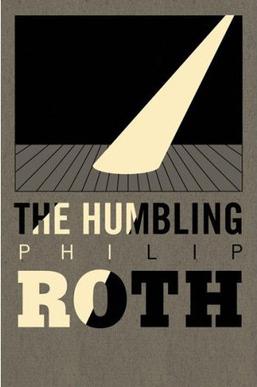
The protagonist in Philip Roth’s 140-page novel, The Humbling (2009), is a lionized stage actor who, being as self-alienated as he is, has lost the ability to act (“He’d lost his magic”). After a stint in a mental hospital, the sad man—Simon Axler by name—begins sleeping with adventurous Pegeen, a lesbian who is 25 years his junior and may be bisexual. Although Pegeen’s parents disapprove of the relationship and utter words that wound Axler’s ego, the strange affair liberates the ex-actor. And yet . . .
That the novel ends tragically leads us to understand that neither sex nor the sexual perversity that Axler and Pegeen experiment with can save an aging person, especially one who has lost all that is normal in his life (the acting, his marriage [early in the book, Axler’s wife leaves him]). Axler takes on a new role—that of the lover of a 40-year-old lesbian—but life repudiates the role. It is too outre. Pegeen calls the relationship a mistake. . . The Humbling is worth reading but, as should be obvious from my review, it is bleak. It has been made into a movie and I assume it, too, is bleak.
The Humbling (Photo credit: Wikipedia)
by Dean | May 2, 2015 | General
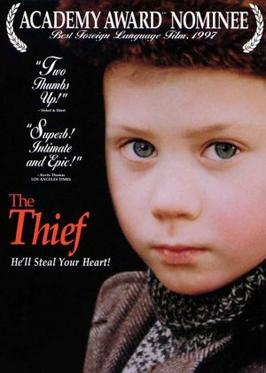
A handsome thief dressed in a captain’s uniform seduces the mother of a young son, with their liaison lasting a number of months before the thief is duly arrested. . . As anyone who has seen the Russian film The Thief (1997), by Pavel Chukhrai, can affirm, Toljan the thief symbolizes none other than Stalin, he who seduced the Russian people (the mother and her son) without loving them but most certainly with the inclination to betray them. And so, to be sure, Toljan is a betrayer.
Thievery? Toljan steals people’s small possessions; Stalin stole farmland through collectivization—and much else besides. A message of politics and criminality is in full force here, as is a vision of the worthlessness of totalitarianism.
The Thief is made and written cleverly enough to be unforgettable. It stars Vladimir Mashkov, Ekaterina Rednikova and Misha Philipchuk, all of whom are splendid.
(In Russian with English subtitles)
The Thief (1997 film) (Photo credit: Wikipedia)