by Dean | Jun 9, 2014 | General
In the sublime Meet Me in St. Louis (1944), Judy Garland plays a teenaged girl even though she was then in her early 20s and divorced. But it hardly matters: she is both convincing and luminous in the role. This is partly due to makeup artist Dorothy Ponedel, but Garland’s technical skills remained first-rate and are the most winning thing about the film. There is never any lack of nuance or proper restraint in her singing; well does she serve such dandy numbers as “The Boy Next Door” and “The Trolley Song.”
Directed by Vincente Minnelli, St. Louis is a 1940s pop masterpiece. After seeing it for the umpteenth time, I noticed something: the characters in the film are strangely sanctified through being a close-knit family. No wonder they sing a lot; they’re usually happy and expectant. They’re far removed from the dark domain Judy chose to create, before the making of the film, by getting both a divorce and an abortion.

Meet Me in St. Louis (Photo credit: Wikipedia)
by Dean | Jun 8, 2014 | General
Hollywood has transferred to the big screen a very popular YA novel, The Fault in Our Stars, about teens with cancer (principally two of them—in a romance). Although a strong film in several ways, I found it largely unsatisfying because of the sick boy (Ansel Elgort) who is too well-adjusted to be true (as well as handsome, of course) and the asinine, contemptible writer enacted by William Dafoe. Every time these two elements are thrust before us, the picture struggles to be effectual. It shouldn’t have to.
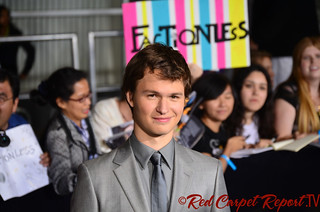
Ansel Elgort – DSC_0113 2 (Photo credit: MingleMediaTVNetwork)
by Dean | Jun 3, 2014 | General
 Those who have never visited Tulsa, Oklahoma—my home town—might be quite taken by the buildings and other sights filmed by Jonathan Rossetti for his low-budget Home, James (2014), a love story set in Tulsa. The movie is clearly a valentine to the city, while the camera sends a valentine to actress Kerry Knuppe in that it plainly loves her.
Rossetti himself, a former Tulsan, plays James, a low-income gent who earns his bread by photographing parties and driving intoxicated people to their homes in their own vehicles. One night he chauffeurs big socializer Cooper (Knuppe), the woman he will begin a now gratifying, now depressing affair with. Cooper drinks a lot, but the real problem for James is that, though she has no good reason to do so, she wants to leave Tulsa for New York. How should James react?
This is most certainly a freshman effort. There are too many clichés of various kinds in Home, James (such as voiceover voicemail on cell phones). What saves the film is 1) the confident performances of Knuppe and Julie Gearheard, who co-wrote the script with Rossetti, and 2) the straightforward realism. No cop-out emerges at the end of this film which tells us that what seems to be easy answers in a love liaison too often are not—and which focuses on the human inclination to spend minutes of our time in a drunken stupor. (Why do people do it?)
I hope that what Rossetti and Gearheard have done augurs good things for the future. And I hope the sophomore effort is set in Tulsa too.
by Dean | Jun 1, 2014 | General
The man who hires the assassins is morally worse than the assassins—that, at any rate, is the case in Robert Siodmak’s The Killers (1946), a dignified and mostly interesting noir mystery.
The titles sequence calls the film Ernest Hemingway’s The Killers since it is based on a story of his, but this is not Hemingway’s creation. It is a cinematic work scripted by Anthony Veiller. (And that’s that.)
The solid allure of Ava Gardner lasts from the minute she appears on screen to the end of the film. Burt Lancaster is the star, but his acting is inadequate. Far better are such performers as Sam Levene and Albert Dekker.
In 1964 Don Siegel released a grittier, very entertaining remake of The Killers starring Lee Marvin and Ronald Reagan (who is a bit beyond passable). Considered too violent for TV, the medium it was made for, it opened in theatres instead and is worth seeing despite some obvious faults.

The Killers (1946 film) (Photo credit: Wikipedia)
by Dean | May 30, 2014 | General
The 24 reboot on Fox (Live Another Day) is getting shockingly intense. Terrorist insanity streams forward and the U.S. President (William Devane) had better start relying on Jack Bauer in a wholehearted way. Er, the U.S. government has really been blowing it. The zealous CIA agent, Kate Morgan, joins Bauer in his anti-Psychopath With A Drone cause, and a Marine commander peevishly complains about Morgan and gets her removed from the case! And this is in the face of an on-coming drone attack that will fry thousands of Brits! Way to go, government!
The action scenes in 24 are adroitly handled and most of the acting is delightfully good. It’s a creepy role, Michelle Fairley, but you’re doing an impeccable job in it.

Title card for 24 (TV series) (Photo credit: Wikipedia)