by Dean | Mar 17, 2014 | Money

The Blood of Jesus (Photo credit: Wikipedia)
Technically The Blood of Jesus (1941) is quite bad, and this includes the acting. An American indie film, it was directed by a black director-writer, Spencer Williams, and features an all-black cast in what is a sincerely, thoroughly Christian piece of work. Beyond the technical shortcomings, though, it offers not much more than theological fantasy, by which I mean its theology is usually dubious or even nonsensical. But not always.
A new convert, Martha Jackson (Cathryn Caviness), is accidentally shot by her feckless husband and undergoes what I take to be a near-death experience. Her spirit leaves her body and, in a transcendent world, she is persuaded by a henchman of the Devil to enjoy the pleasures of the juke-joint life she undoubtedly never knew when she was on earth. But the Devil has prostitution in mind for Martha, and of course she flees. She resists the temptation. Running to what is called the Crossroads in this supernatural sphere, she beholds an image of the crucifixion and is treated to the salvific blood of Jesus.
Okay, but why Martha would encounter such goings-on in the next world I have no idea. Being a Christian, she dies—or “dies”—in a state of grace, and yet the Devil is there to tempt her. Possibly we can see an implication here that the blood of Jesus Christ is to be applied to human beings for the whole of eternity, for the moral perfection of man can never, or will never, be dissociated from it. The movie’s appreciation for the salvific blood, in any case, is real and deep, and the scene where the blood starts dripping on the prostrate woman’s face has an impact. I sense that it’s one thing that does make the film worth watching.
There is also some enjoyable music and dancing in The Blood of Jesus. It’s a low-budget curio more interesting than good, and, yes, it is worth watching.
by Dean | Mar 14, 2014 | Movies

Night Must Fall (1937 film) (Photo credit: Wikipedia)
In 1937, what I assume to be a suspenseful play by Emlyn Williams became a suspenseful motion picture. I mean Night Must Fall, superbly directed for the screen by Richard Thorpe and featuring crisp and clever acting from Robert Montgomery, Dame May Whitty and Rosalind Russell.
In it, an extroverted page boy (Montgomery) wins the heart of, and is hired to work for, a nasty old woman and pseudo-invalid (Dame Whitty) who is daily disappointed by the ministrations of her live-in niece (Russell). The page boy is sexually attracted to the niece and she to him, except that a news report of a missing girl in this English vicinity induces the niece to suspect that the page boy is in reality a Jack the Ripper. Of course this leaves her cold but also fascinates her. In fact both characters are eccentrics, one of them creepy and the other, the niece, repressed. The latter makes the claim, in effect, that the page boy has taken away her reason.
Night Must Fall is about a world of ordinary petty spite (the old woman’s) and ordinary vulnerabilities when it confronts a devilish phenomenon. It has to do with when there arises a perversion greater than your own—greater, that is, than the old woman’s, but also greater than the niece’s temporary perversion when she loses her “reason.” Moreover, it is about the mystery of human motives. It is a thriller about terror, made by Thorpe with an eye for cinematics.
by Dean | Mar 12, 2014 | Movies
 The excellent Chilean film Gloria (2014), by Sebastian Lelio, concerns a woman in her (late?) 50s who desires a man, acquires one, and then suffers because of his curious behavior. Intercourse takes place right away, followed by pleasurable hanging-out, followed by the overcautiousness and divided attention of Rodolfo, the near-elderly “boyfriend.” For Gloria, the heroine, a mini-disintegration goes on, and her conduct is sometimes repellent. When a reasonably strong person is agonized is a concern here, and the simple uplift at the film’s end amounts to very little. But it is there.
The picture is like an extended artistic short story, with enticing cinematics (everything from the cinematography to the white peacock). The middle-aged nudity is ugly, though; Gloria does the full frontal. In truth, this is part of the evidence that actress Paula Garcia (Gloria) goes the whole nine yards for her stellar role, but I wish Lelio had not required her to go that far.
She does an extraordinary job of acting, however—now amiable, now solemnly bitter—and Sergio Hernandez is unbeatable as sheepish, unthinking Rodolfo.
(In Spanish with English subtitles)

by Dean | Mar 9, 2014 | Movies
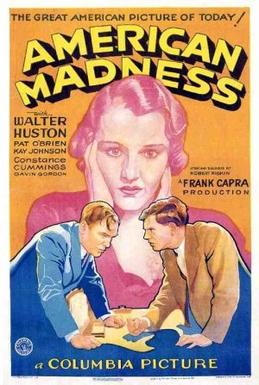
American Madness (Photo credit: Wikipedia)
Tom Dickson (Walter Huston) is a bank president who nobly considers depositors his friends and is unconcerned about profit. Though serious about banking, he is the most humane of businessmen—and the hero of Frank Capra’s Depression-inspired film, American Madness (1932).
The madness of the title is a foolish run on Dickson’s bank by depositors terrified by a big loss of money owing to an embezzler named Cluett (Gavin Gordon). Dilemmas befall the bank president: he begins to fear losing both the bank and, as it happens, his marriage.
Hollow optimism about human nature—Capra’s familiar trait—finally springs up in the film, and there is an inconsistent tone (which is why Madness is a semi-comedy). Yet Robert Riskin’s script is a pretty effective character study, not incisive but humanly appealing. Too, it’s beguilingly smart, filmed by a dedicated and likable craftsman who worked well with his actors.
by Dean | Mar 6, 2014 | General, Movies

Français : Logo de la minisérie THE KENNEDYS. Français : Logo de la minisérie THE KENNEDYS. (Photo credit: Wikipedia)
To me, one of the best “movies,” if you will, of 2011 aired on TV and was eight hours long (eight episodes long). It was The Kennedys, a docudrama not entirely free of blandness but also workmanlike and discerning.
Greg Kinnear is good as JFK, Tom Wilkinson terrific as Joe Kennedy Sr. in all his corruption. As the elegant Jackie, Katie Holmes looks the part but histrionically lacks conviction. The show’s focus is always on the mark, with the Cuban missile crisis covered vividly and painstakingly. An air of sympathy and compassion never goes away even as hagiography never intrudes.
The Kennedys is available on DVD.