by Dean | Mar 4, 2014 | General, Movies
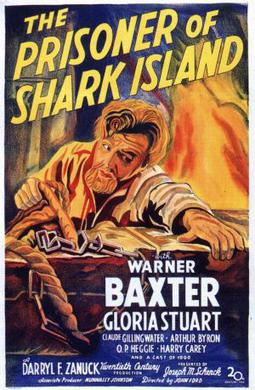
The Prisoner of Shark Island (Photo credit: Wikipedia)
The John Ford film, The Prisoner of Shark Island (1936), is about Dr. Samuel Mudd, who treated the broken leg of John Wilkes Booth shortly after Booth murdered Lincoln and was consequently arrested for conspiracy to assassinate (!) and sent to serve a life sentence in the Dry Tortugas.
When a decent man is victimized by the authorities—this is the message conveyed. As the terrible incidents roll, also conveyed are all kinds of values (and virtues): courage, persistence, belief in God, marital love and, despite the country’s injustice to Dr. Mudd, patriotism. Plus there is military pride, as demonstrated by Mudd’s crotchety father-in-law, an elderly Southern colonel (Claude Gillingwater). Today both he and Mudd would be seen as politically incorrect (yawn): the doctor, you see, is a decent, estimable SLAVER.
Prisoner is still riveting, and I agree with film critic Otis Ferguson about the strength and worth of the prison escape sequence. Nunnally Johnson’s script provides more depth than we generally get from Ford’s Westerns, even if the old American movies never enabled us to feel the ineradicable wound of life. Their unpleasantness was limited.
by Dean | Mar 2, 2014 | General
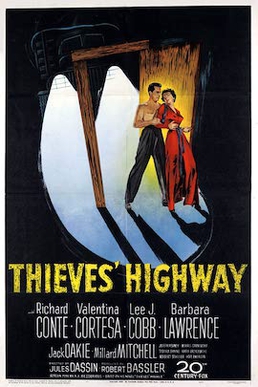
Thieves’ Highway (Photo credit: Wikipedia)
Highways, delivery trucks, post-Ellis Island immigrants, fierce competition—all this makes Jules Dassin’s 1949 Hollywood piece, Thieves’ Highway, a distinctly American film. But that’s not all.
Many, many bad things are done by the people in this film. The chief theme is the struggle to make a living in the midst of corruption. It’s a shame, in point of fact, that the harsh fruit merchant acted by Lee J. Cobb is a caricature—he’s extremely corrupt—but there you have it. Though the movie’s sophistication starts slipping in its last twenty or twenty-five minutes, Thieves’ Highway—screenwritten by A.I. Bezzerides (whose novel Thieves’ Market is the source for this picture)—is not only exciting but also gritty and as concerned as it can be about verisimilitude. A corker.
by Dean | Feb 26, 2014 | General

Cover of Libeled Lady
Financial disaster is always looming, for someone—in this way the screwball rom-comLibeled Lady (1936), directed by Jack Conway, is highly relevant to early 20th century America and other Western nations. The disaster in question will hit a city newspaper threatened by a staggering lawsuit unless a jobless fixer (William Powell)—he needs the money—can smoothly deceive Myrna Loy into dropping the suit. Ah, but the hurdles arise because of a conflict between two traditional institutions. Jean Harlow demands a marriage, right now, from the paper’s managing editor, Spencer Tracy, panicky over the business. Powell, predictably, falls for Loy and refuses to see any real danger to the business. There does come to be a danger to himself, though.
Like Noel Coward’s Hay Fever, Libeled Lady is (in my opinion) not all that funny, but it hardly matters since, again like Hay Fever, its plot and characters are supremely interesting. This describes MANY of the Thirties screwballs. The movie is based on a story and adapted by three writers—how could
that many heads ruin it?—and its actors have no trouble with comedy or farce (albeit it’s a non-farcical role for Loy). But hold it: Loy plays a party girl!? . . . Go ahead and suspend disbelief. The only thing that will worry you slightly is the possibility of Hollywood remaking this notable confection.
by Dean | Feb 23, 2014 | General, Movies
 A true sense of tragedy intermittently comes through in August: Osage County (2013), the John Wells film of Tracy Letts’ play, as the troubled Oklahoma characters blow it big-time. Successfully Letts adapted it, confidently Wells directed it.
The complaint has been made that the movie contains too much Meryl Streep (as the ranting, pill-addicted Violet Weston). I’d say that considering the thoughtful, unself-conscious magnificence of Streep’s performance, she has exactly the right amount of screen time. Julia Roberts is stunningly impeccable as a candid and discontent wife and mother, while Margo Martindale is very good at making Violet’s sister complex.
Chris Cooper delights with common-man qualities, but the British actor Benedict Cumberbatch, for all his effort, is not meant for the role he was given. Julianne Nicholson and Juliette Lewis are engaging enough that we miss them after they drop out of the film. (I do, anyway.)
Wells’s movie was made a lot closer to where I live, which is OK’s Tulsa County, than other movies are. It’s a funny-bleak work not without faults, but whose acting means a lot and is not to be underrated.
by Dean | Feb 20, 2014 | General

Cinderella: From Fabletown with Love (Photo credit: Wikipedia)
Cinderella in Cinderella (2010), a “graphic novel” by Chris Roberson (writer) and Shawn McManus (artist), is a fairy tale figure-cum-action heroine. Sound bad? Not quite. In fact, it’s okay. It’s a breezy, pleasantly drawn and colored page-turner with a cable-TV miniseries plot. . . Granted, Cinderella is too strong for a girl, but it must be remembered that she is what is called a “fable” and thus not human. Nor is there any indication that she does what she does—spy stuff—to make a feminist point. She is just the uncomplicated female spy we want her to be—in a comic book.
The second novel in the series is Cinderella In A Bikini. Well, no, it’s Cinderella: Fables Are Forever (2012), but it’s more harmlessly sensual—for several pages Cindy is in a bikini, and so is her adversary: a grown-up Dorothy from The Wizard of Oz!—than the first book. It’s better than viewing P***y Galore in an objectifying James Bond picture.