by Dean | Jul 5, 2013 | General
Written and directed by Neil LaBute, The Shape of Things (2003) is based on LaBute’s play of the same name. What the four-character piece tells us is that amatory love is squalid, innocence is repulsively assaulted, and contemporary art—yes, there’s even something about art—or pseudo-art is ludicrous, sometimes hurtful, folly. Indeed, it is something for the Messalinas of the world to obsess about.
Unfortunately LaBute has wrought a specious plot, thus causing a misshaping for The Shape of Things. But at least the film isn’t frivolous or boring. The bulk of the acting I l like since, for one thing, Gretchen Mol, like Rachel Weisz (the film’s Messalina), knows how to be nuanced. Paul Rudd, on the other hand, does not quite convince as a man who changes into something other than a shy naif.

Cover of The Shape of Things
by Dean | Jun 30, 2013 | General
Re Traffic (2000), I like this movie’s thoughtful rejection of the U.S. war on drugs, but not its relative lack of sophistication. Michael Douglas’s newly appointed drug czar has a teenage daughter constantly hungry to shoot up, and Douglas’s wife (Amy Irving) has known about it for months without breathing a word to her husband. Two DEA agents (Don Cheadle and Luis Guzman) are stupid enough to let their sole informer in a big narcotics case get poisoned while eating breakfast. A married socialite (Catherine Zeta-Jones), attempting to protect her little son from her drug-dealing husband’s creditors, knows exactly how to deal with assassins and aggressive pushers. All this and more are too improbable to pass muster. One critic complained that Traffic is insufficiently exciting, but in my view the trouble is that it’s naively, immaturely written.
It’s ambitious, though, however indifferent I am to director-cinematographer Steven Soderbergh’s gussied-up style. Not that this style is never powerful, what with its handheld camera, bright light and graininess. It’s just that it’s rather showy and generally unnecessary—in truth, neither good nor bad. By contrast, the acting is often superb. Cheadle and Guzman, to give two examples, offer some nice variation and even nicer facial play. Douglas and Benicio Del Toro are winningly manly, perfect as authority figures.
![Cover of "Traffic [HD DVD]"](http://ecx.images-amazon.com/images/I/51XHEJXKXVL._SL300_.jpg "Cover of \"Traffic [HD DVD]\"")
Cover of Traffic [HD DVD]
by Dean | Jun 27, 2013 | General
There is a lot of darkness in Francois Truffaut’s films, but he never had a well-developed sense of tragedy. We see that in 1972’s Two English Girls. He could certainly handle pathos, though, and we see this too in Girls’ terrifically lyrical framework. The film tells of Claude, a Frenchman who slowly becomes amorously and then sexually involved with Muriel and Anne, the two English girls of the title. It’s a lesser movie than Jules and Jim and even The Story of Adele H. (both by Truffaut) because it’s rather talky and most of the acting ranges from bad to mediocre. But, like other Truffaut films, it is guileless, humane and personal—in its own way, rewarding.
Two English Girls (Les Deux Anglaises) is based on a novel by Henri-Pierre Roche.
(In French with English subtitles)
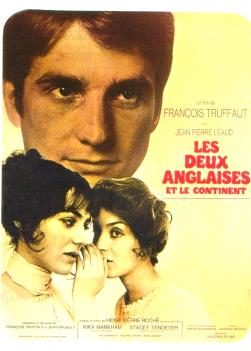
Two English Girls (Photo credit: Wikipedia)
by Dean | Jun 23, 2013 | General
The plot of the new Fast and Furious 6 (2013) has Dwayne “The Rock” Johnson’s cop approaching Dom Toretto (Vin Diesel) and his ex-criminal crew to help him vanquish the toughest, smartest international crime team, based in London, you’ve presumably ever seen. Dom agrees to it since this may be the only way he can reach his still-alive lost love, Lettie (Michelle Rodriguez), who seems to have some connection with the London-based baddies—and is now an amnesiac (!)
Not surprisingly, so much propulsive action goes on in Justin Lin’s lark that it ends up diluting its thrills. Yet some of this stuff is irresistible—the cutthroat fight between Lettie and a policewoman (Gina Carano), for instance. And the main villain’s act of blowing up the bridge the London police are standing on as they fire at his getaway car. As for the auto chase material, I loved the shot of Tyrese Gibson leaping from one speeding car to another and that of hapless Lettie getting flung into the air before Toretto’s silly, superheroic rescue of her. And the wicked tank is cool too.
Now this:
The movie has a way of making British folks look bad; what’s up with that? Dom is hypocritically religious, though it’s interesting that religion is in the film at all. Moreover, I found myself wishing Furious 6 was a little less stupid—Dom’s crew locates the tough, smart crew for a final battle with a bit too much ease (etc. etc.)—for all the fun it supplies.
I give it a B.
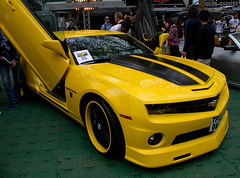
Fast and Furious 6 Premier 6 (Photo credit: ahisgett)
by Dean | Jun 20, 2013 | General
Sooner or later we come to understand that quality in life is what we want and will strive for. For young Benjamin (Dustin Hoffman) in The Graduate (1968), this quality is represented by the daughter of the forty-something mother Benjamin is adulterously sleeping with. The graduate changes in the course of the film and, unlike Mrs. Robinson (Anne Bancroft), was never interested in mere Acquisition in the first place. It’s no wonder the seducer can’t keep seducing.
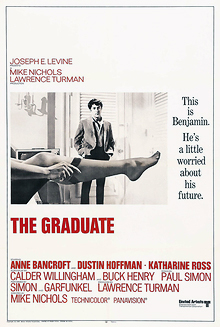
The Graduate (Photo credit: Wikipedia)