by Dean | Apr 15, 2012 | General
Gore Verbinski’s The Ring (2002) is a Hollywood remake of a 1999 Japanese film, and I could hardly figure out what was happening in it. A horror concoction, it is strikingly creepy (aren’t they all?), but for me creepy isn’t scary.
Even so, congrats to Verbinski for his directing and to Charles Gibson for his supervision of visual effects. They make it palpable that evil exists. The sequence with the freaked-out horse is wildly, weirdly effectual, and the image of Naomi Watts holding a small, clothed skeleton while standing waist-deep in well water is sobering. I wish The Ring had been better. It has its virtues, but confusingly complex writing in a freakfest is not for me. More simplicity, please.

The Ring (2002 film) (Photo credit: Wikipedia)
by Dean | Apr 8, 2012 | General
Re El Crimea del Padre Amaro (2002):
No matter how pervasive Catholicism is, or how much headway Protestantism makes, in a country like Mexico, there will still be Latino directors and other artists who reflexively declare that Christ-followers are hypocrites.
A novel written by Eca de Queiros in the 1870s, the basis for this film, afforded Carlos Carrera the opportunity to communicate this wonderful insight. He’s the director of this enterprise involving a corrupt fool of a senior priest, a girl-chasing fool of a junior priest, and the pious but sensual girl he chases. All three live decidedly worldly lives, and they’re not the only ones who do. The film is both sexy and dark, and the sexiness, I have to concede, is beautifully done. Not at all uninteresting, El Crimea (The Crime of Father Amaro) is nevertheless basically pedestrian. And ignorant–ignorant enough, by the way, to shed a measure of sympathy on “liberationist” Christianity, but not on any other form.
(In Spanish with English subtitles.)
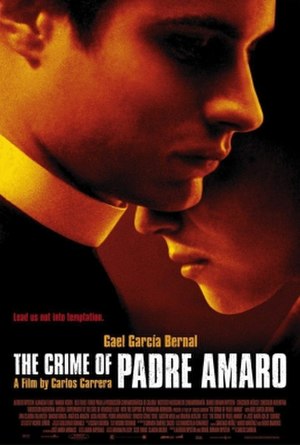
El crimen del Padre Amaro (Photo credit: Wikipedia)
by Dean | Apr 1, 2012 | General
Ralph Fiennes has directed for the screen Shakespeare’s Coriolanus (2012). Placed by Fiennes in a modern setting, it tells of Caius Martius, a Roman general given the title-surname of “Coriolanus,” who has valiantly defeated the current enemies of Rome. Extolled for this, the general is meant to receive the political position of consul, but there are tribunes who bitterly oppose him for his pride and his lack of love for the common people. The dirt-poor mob that begins to support him is prodded by the tribunes into rejecting him, and at last it is decided that Coriolanus will be banished from Rome. The general then seeks to betray the ungrateful country by joining the very enemies he bested: the Volscians.
As James Bowman has asserted, the film is about honor and loyalty, but it also contains a sea of implications that makes it wonderfully relevant to our times. For one thing, it shows us that the electronic media does not, cannot, present honor (owing to its “radical leveling” of people–Bowman). It is clear, nevertheless, during the first 40 minutes of the movie that the world needs honor, even if, unfortunately, the honor here emanates from a tragic hero.
Further, the scandalized tribunes remind us of men of the Left who deplore all things “conservative”: They undervalue Coriolanus’s military prowess and, as I indicated, hate his non-love for the common people. And they do not win our sympathy. On the other hand, what is to be done for the Roman mob when it demands bread? (More relevance to our times.) It seems Rome is a place of neither scarcity nor economic strength.
Predictably, in its contemporary setting the film is not wholly convincing; not by a long shot. But it mainly succeeds, and is lively and engagingly performed. As both actor (he plays Coriolanus) and director Fiennes is effective.

Cover of William Shakespeare
by Dean | Mar 25, 2012 | General
I’ve been suspicious of the 2011 film, Young Adult, and so resisted seeing it at the theatre. The other day, though, I watched it on DVD and realized my suspicion was justified.
The movie is about a successful but extremely impractical–in fact, mentally ill–woman called Mavis Gary, impeccably acted by Charlize Theron. The screenplay flops: it is written in such a way as to suggest that the author–Diablo Cody–is settling a score. The compassion she bestows on Mavis at the end is simply compassion Cody has for herself. Or so it seems.
Moreover, there is a scene with a fellow in a wheelchair which is essentially stupid, and a mildly upbeat conclusion to the film which is nothing but phony. Diablo Cody did a good job on the script for Juno, but director Jason Reitman, a valuable filmmaker, shouldn’t have bothered with this one.

Charlize Theron (Photo credit: Wikipedia)
by Dean | Mar 20, 2012 | General
He may be a Christian, but Bono is a pretentious performer, and the filmed concert in U2 3D (2007) is often propagandistic. Admittedly, however, the 3D in this IMAX presentation makes the event–a U2 Latin American tour–even more exciting than it already is, and the crowd footage fascinates. The musicianship pleases, in my estimation–that of guitarist The Edge, bass player Adam Clayton and drummer Larry Mullen Jr. As for the songs . . . well, “Vertigo” is a stirring number on disc, but in concert it sounded wretched. “With or Without You” is hardly good even on disc, but “New Year’s Day,” a stand-out, is indestructible. “Pride (In the Name of Love)” is catchy; it too sounded good.
Not so “Sunday Bloody Sunday,” worthless lyrics and all, around which Bono crafted a political didacticism about co-existence among Christians, Jews and Muslims–a message your average dedicated Islamist will fiercely reject. And there’s anti-war propaganda as well, which is fine, but U2’s obtuse, political Christian witness is not my kind of witness.
The music here usually sounds tuneless, but even on CD it’s not all that memorable. To be sure, there are some likable things about U2 3D. A lot of rock music fans will eat it up, notwithstanding, to me, it has little to recommend it.

U2 3D (Image via RottenTomatoes.com)