by Dean | Mar 10, 2011 | General

Image via Wikipedia
The Davis Guggenheim film, Waiting for “Superman” (2010-now on DVD), is a good if imperfect documentary about public schools in the U.S. Guggenheim is a liberal who is rightly critical of teachers’ unions.
The Village Voice‘s Melissa Anderson, who didn’t like the film, mentions in her review that the doc-maker asks the question, “What is our responsibility to other people’s children?” She answers the question thus: “Maybe, for starters, demanding a stronger, securer social safety net”–and she knocks Guggenheim for failing to bring this up. But how, exactly, do we obtain this stronger safety net, Ms. Anderson? By increasing spending for unemployment benefits, Medicaid, CHIP, the food-stamp program, and Social Security? Sorry, that just adds to the 14 trillion-dollar federal debt. Do we hike the minimum wage? I actually believe in the existence of a minimum wage, but hiking it now (or even later) is very inadvisable. No, it’s fine that Waiting for “Superman” avoids demanding Anderson’s safety net.
She also writes that “few would disagree that the unions’ bloat and bureaucracy have often had a deleterious effect on public education . . .” Why, then, haven’t people from the liberal elites voiced their opposition to the teachers’ unions?
The parents of five lovable children in the film try to get their kids into charter schools–public schools independent of the public system. Anderson says these schools “do not have high success rates,” and if that’s true, it is to her credit that she points it out. Frankly, it means things are even worse than Guggenheim realizes. Do see his documentary, though. It’s worthwhile. It does our society more good than do the impracticalities of armchair Progressive idealism.
by Dean | Feb 22, 2011 | Movies

Image by .bobby via Flickr
Derek Cianfrance’s Blue Valentine (2011) deals with the deeply troubled marriage of Dean and Cindy (Ryan Gosling and Michelle Williams).
Have you ever seen the Swedish film, The Passion of Anna, by Ingmar Bergman? It, too, has a lot to do with relationships between men and women. I don’t consider it a success because, for one thing, it’s too talky, but it makes Blue Valentine look utterly lousy by comparison. At least Bergman (in Passion) cared about character development; Cinafrance doesn’t. We learn very little about Dean and even less about Cindy. (Why, really, is their marriage such a failure? The movie more than hints that it’s all Dean’s fault, but that explains nothing.)
At least Bergman fashioned quite a few powerful scenes; too many of Valentine‘s scenes get boring. Ross Douthat of National Review finds the couple’s courtship “very charming.” I don’t. Usually, when people in movies are shown falling in love, it’s sleep-inducing.
There is a certain degree of artistic strength in Cianfrance’s film, but mainly it’s a draggy work of pseudo-art.
by Dean | Feb 15, 2011 | General, Movies
”]
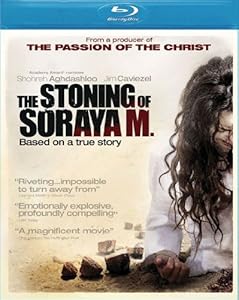
2009’s The Stoning of Soraya M., directed by Cyrus Nowrasteh, dramatizes the true story of a woman who was victimized in an “honor killing” in an Iranian village. The charge of adultery against Soraya was false, but her vile husband wanted her dead so that no financial support would have to follow a desired divorce. A verdict was reached and Soraya was put to death by stoning.
Don’t act like the hypocrite,
Who thinks he can conceal his wiles
While loudly quoting the Koran.
These words by a 14th-century Iranian poet are written on the screen before the film begins. Hypocrisy both religious, represented by a phony mullah and the village mayor, and nonreligious, represented by the husband, is attacked in Soraya M. So, of course, is the backward, depersonalizing attitude toward women in the Islamic world. Soraya’s energetic aunt, played by Shoreh Aghdashloo, tries to save her niece from what is being plotted, but is constantly pushed to the side. As the stoning begins she is nearly hysterical: she understands the horror of this brutal treatment. The stoning sequence is one of the most disturbing things I’ve seen in a movie–infuriatingly bloody and ugly.
Nowrasteh’s film is worthy of comparison with the neorealist cinema of De Sica. It is a straightforward, grim, compassionate indictment of theocratic authorities in Iran. Mozhan Marno is first-rate, with her fortitude and anguish, as Soraya.
by Dean | Feb 8, 2011 | General, Movies

Image by HowardLake via Flickr
Written and directed by Nicole Holofcener, the comedy-drama Please Give (2010) has to do with moral responsibility when it is unmet (except in the case of Rebecca [Rebecca Hall]) and with feeling guilty. Kate (Catherine Keener) hands out money to the homeless and contemplates doing volunteer work only in order to assuage her guilt over exploiting the deaths of elderly people who own valuable furniture. Only near the film’s conclusion does she conduct a form of giving which is not just a means of reducing guilt, as when she agrees to buy her teenaged daughter a pair of costly jeans. Her culpability is nothing, however, compared with that of some other characters, who are nevertheless guilt-free. Whence comes this reality?
Holofcener (Friends With Money) is a true artist–and an intelligent one. This despite the fact that Please Give provides an unearned happy or optimistic ending. It resolves itself with scenes of family affection, which is inadequate.
Even so, the film is absorbing and the acting is utterly winning.
by Dean | Jan 25, 2011 | General
Philip Saville’s The Gospel of John (2003) believes in what Jesus is doing, in His mission. Heretical it ain’t. It’s reverent–and, for the most part, sensibly done.
Why, it even obeys all but one of critic Dwight MacDonald’s rules of success for biblical films, propounded in 1965. One of these rules is Use the original script. Another is The story of Jesus should be told with reverence for the text in the New Testament . . . but with irreverence for the sensibilities of contemporary religious groups–Buddhist, Moslem, Taoist, Catholic or Jewish.” Hear, hear! That’s The Gospel of John all over!
Henry Ian Cusick enacts Jesus Christ with necessary charisma and aplomb. He’s very good, just as he was on the TV series “Lost.” There is much in Saville’s directing that is very good too, as witness the Cana wedding scene. There, much to a servant’s quiet amazement, water becomes wine and a happy feast remains happy. Jesus stands apart from the celebrants, whereas before he was sitting with them, and wears a serious look on his face, as though thinking of future events, such as the Atonement, more important than this one. Also worthy is the shot-series where Mary, the sister of Martha, washes the Lord’s feet in ointment and dries them with her hair–a scene of intimacy not even interrupted by Jesus’ mild rebuke of Judas Iscariot. I love the ending of the film, too, with Christ walking ahead of His disciples on the seashore, reminding the perplexed Peter to “Follow Me,” before the final shot of John occurs in a freeze frame. Lovely.
Gospel moves with a proper rhythm, but, as in John’s account, there is a great deal of sermonizing by Jesus. The movie is for those who understand or at least suspect there is genuine value in the evangel, or for those with an interest in the life of Jesus, or for those disciples of His who seek to be edified. Many of them have been, I’m sure.