by Dean | Jan 21, 2018 | General

The Hanging Tree (Photo credit: Wikipedia)
I hope the novel The Hanging Tree, by Dorothy M. Johnson, is better than the Delmer Daves movie adapted from it, for the flick, a Western, is frequently quite dumb. For example, the Montana townspeople here are willing to execute their only doctor (Gary Cooper) for a killing they know absolutely nothing about (it was done, in fact, in self-defense).
Yes, it is entertaining—it is gripping that Cooper gets rough with a sexual harasser (Karl Malden) who becomes a sexual assaulter (let this be a warning to YOU, Al Franken)—and Nile, Washington, where the film was shot, must be a gorgeous place. But it’s a wonder The Hanging Tree, available on TV, DVD and Blu-Ray, is still hanging around.
by Dean | Jan 17, 2018 | General

Lafayette Escadrille Memorial Arch, 1928 (Photo credit: Wikipedia)
In the 1957 Lafayette Escadrille, a punk kid (Tab Hunter) at the time of the Great War travels to France to join (with other Americans) an elite air force corp—the Lafayette Escadrille. The corp is training to fight before the U.S. has entered the war. In Paris, the young rebel falls in love with a French prostitute (Etchika Choureau) but he also aggressively strikes his drill sergeant and, after being sprung from jail by his Yank buddies, runs away. He is now a deserter until he is given a second chance.
A personal project for Hollywood’s William Wellman, this is not one of the director’s better movies. Not only does it seem partly dishonest, it is also rather imperfectly directed and Tab Hunter’s acting is utterly by-the-numbers. Further, for a long time it makes French men, soldiers and otherwise, look like fools. By the time it reaches midpoint, however, it gets a bit better. Its anodyne love story, though it receives too much screen time, assuredly has its moments; and there is some nifty stuff involving the old WWI fighter planes. But it’s a shame for Lafayette Escadrille to have to be a half-enticing failure.
by Dean | Jan 14, 2018 | General

The Aviator’s Wife (Photo credit: Wikipedia)
The 20-year-old college student, Francois, in Eric Rohmer‘s French film, The Aviator’s Wife (1981), needs to find himself a woman other than Anne, the one he is obsessed with. Anne is generally indifferent and rude to him, even after her married lover (an aviator) goes back to his wife. It ought to be driven home to Francois that he is essentially empty-handed. Lucie, an intelligent 15-year-old girl—the actress who plays her looks much older than fifteen—gradually tells him the truth about Anne (based on Francois’s information); but Lucie behaves as though she is attracted to Francois. Is she? And should this mean anything to the young man? Is there still empty-handedness?
The first picture in Rohmer’s Comedies et Proverbes series, this has another impressively written script by Monsieur Eric, notwithstanding I recommend seeing half of it, on disk, at one time and the other half at another time. There is so much talk I don’t see how boredom can be prevented otherwise. The film lacks the whimsy and crispness of Rohmer’s best work (e.g. A Tale of Winter), but I do think it’s a smart success.
Marie Riviere (Anne), Philippe Marlaud (Francois) and Anne-Laure Meury (Lucie) are acting and yet not acting; they’re embodying people in a screenplay and it’s magnificent. Contrast this with the performance of Mathieu Carriere as Anne’s ex-lover, which is less natural, less interesting.
(In French with English subtitles)
by Dean | Jan 13, 2018 | General

Cover of Jubal
Western time again. In the beautiful Jubal (1956), properly in color and directed by Delmore Daves, Glenn Ford stars as a cow hand made near-aimless and solitary by life. Hired to work at Shep Horgan’s ranch, he—Jubal Troop by name—is the Joseph to the Potiphar’s wife of Mae Horgan, who is the boss man’s missus. Mae tries vigorously to coax Jubal into a sexual relationship, but the cow hand will have none of it. He isn’t like the odious, hypocritical Pinky (Rod Steiger), who often gets fresh with the dissatisfied Mae and who turns into Jubal’s most dangerous foe. Fact is, Jubal has eyes for a young female member of a Mormon-like sect that moseys onto Shep’s land and that Pinky callously wants to stomp on and Jubal is nice to.
Kindness meets bullying, amorous desire meets wounded vengefulness: this is the riveting Jubal. Valerie French plaays Mae and Felicia Farr plays Jubal’s eventual girlfriend, and both are exquisite-looking. Ford is ever the Westerner, as he was in 3:10 to Yuma, and Ernest Borgnine is forcefully enjoyable, and believable, as Shep the ranch owner.
by Dean | Jan 8, 2018 | General

Cover of 3:10 to Yuma (Special Edition)
A big sky above a stagecoach moving across the plain in a true long shot—now this is a title sequence for a Western—and this particular Western is the original 3:10 to Yuma (1957), not the Aughts remake. This is the good one, adeptly directed by Delmer Daves and starring Glenn Ford as the robber-killer who must be escorted to the 3:10 train to judgment-seat Yuma.
The man escorting him is a financially strapped rancher (Van Heflin), doing it for money. The train can be caught in tiny Contention City, appropriately named because, for sure, contention is coming from reprobate underlings who wish to rescue Ford. . . Arising in the film is an interesting interaction between lawful people (Heflin and many others) and unlawful people. They’re thrown together enough that Ford necessarily eats dinner at Heflin’s home and gets intimate with the female bartender (Felicia Farr) oblivious to the robber-killer’s awful doings.
Adapting an Elmore Leonard story, Halsted Welles did some bang-up writing, despite the limited realism. At the end it is VERY limited, and all in all Ford’s character receives a bit more sympathy than he deserves. But what a decent Western this is!
by Dean | Jan 4, 2018 | General

Cover via Amazon
Luis Bunuel‘s Belle de Jour (1967) is so bad it’s riveting.
A French woman (Catherine Deneuve) happily married but sexually unresponsive to her husband gradually becomes, of all things, a daytime prostitute at a brothel. Repelling kinkiness is shown, but there is also Bunuel’s usual surrealism which, at the end, causes the film to scurry away from, well, real life. From human catastrophe.
In Belle, at bottom, Senor B. likes neither people nor traditional Western morality (it’s so bourgeois). Practically the only good thing about the film is Catherine Deneuve’s marvelous beauty. I’m glad her character is a daytime beauty, a belle de jour, since she’s so easy to see that way.
(In French with English subtitles)
by Dean | Jan 2, 2018 | General

Cover of Angel and the Badman
John Wayne resists being entirely convincing as a badman (a compound word?) in the 1947 Western, Angel and the Badman. This is the first movie Wayne produced, and he wanted it to have capital acting, but he himself does not really fill the bill. Gail Russell does, however, as the “angel,” the naive Quaker girl who, like the other devout Friends, approves of generosity and disapproves of violence. Russell is capable of innocence—and quiet appeal.
Wayne plays Quirt, a man not of the quirt but of the gun, for his outlaw ways. Harry Carey shows strength and depth as the middle-aged marshal who wants to hang Quirt, and who bluntly tells Russell’s Penelope not to gaze “bug-eyed” at the varmint. “There’s no future in it,” he murmurs, but Penelope loveth Quirt. . . The beliefs of the Quakers slowly induce Quirt to change for the better, even if he retains a take-charge, aggressive mind. Except at the very end, this change is presented subtlely, wisely, in director James Edward Grant‘s script.
Besides Russell and Carey, other actors shine here as well. Probably the only dreadful performance is by Lee Dixon as Randy McCall, Quirt’s former partner in crime. Enacting a slimy nerd, he’s facetious.
by Dean | Dec 29, 2017 | General
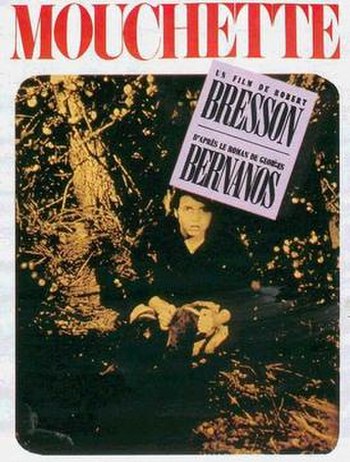
Mouchette (Photo credit: Wikipedia)
There is no repentance of sin in Robert Bresson‘s Mouchette (1967), though there should be. Plus there is an old woman, a layer-out of the dead, who talks like a pagan. Yet it is the Christianity of Georges Bernanos, on whose novel this film is based (and faithful to), that consistently matters here, even as the novelist’s negative mood over a youngster’s suffering becomes the filmmaker’s negative mood.
It so happens that many years before Bresson’s death, there was a rumor that he was calling himself a “Christian atheist.” But no evidence of this ever emerged: Someone must have merely assumed there was so much misery in the Sixties and Seventies films of Bresson that only an atheistic sensibility could have produced them. This is nonsense. Although his short novel might transcend orthodoxy, Georges Bernanos was a Christian man who wrote a Christian book (Mouchette) and, as I said, Bresson’s film is faithful to it.
The girl Mouchette is an unhappy Catholic non-Christian; she is persecuted. Surely, however, she likes the thought of being among the dead who are gods: The old woman tells her that certain pagans used to believe that the dead are gods. But the film begins with a shot of Mouchette’s mother (Maria Cardinal), who is fatally ill, inside a church. People need to be redeemed but, also, can life itself be redeemed? Granted, it can’t be done by dead pagan religion, but can it be redeemed at all?
The answer in Mouchette is yes. It was the view of St. Augustine that unbaptized babies go to Hell if they die. Not so Bresson and Bernanos, for, here, a young girl, the Catholic non-Christian, goes to Heaven—after taking her life. No one in the film is said to be in danger of Hell; the world alone seems pretty Hellish. Mouchette escapes it by dying into that which redeems life. The Monteverdi music at the end is certainly not a music of despair. In some ways, it must be said, Bresson’s picture is weird but, in my view, it is not weird that it transcends orthodoxy. This takes it to a terrain different from that of Diary of a Country Priest and Au hasard Balthazar.
(In French with English subtitles)
by Dean | Dec 27, 2017 | General
Actor Tony Randall (Photo credit: Wikipedia)

English: Edie Adams in a 1965-1966 commercial created for Muriel Cigars. Actress and singer Edie Adams was also Mrs. Ernie Kovacs. (Photo credit: Wikipedia)
Quite a bevy of characters shows up in Lover Come Back (1961), a Rock Hudson-Doris Day farce. There is a highly competitive (and rightly so) female professional at an advertising agency (Day), a smart but unprincipled Lothario (Hudson), a top-tier insecure neurotic (Tony Randall), a not-quite-innocent Southern cutie (Edie Adams), a grumbling, misanthropic chemist (Jack Kruschen). They live in a nonthreatening New York City, albeit the only good character is Day.
As in other early ’60s Hollywood comedies, a colorful, lighthearted title sequence precedes the fluffy, likable action. With talent Stanley Shapiro and Paul Henning have churned out a script which is a cross between Mad Men and You’ve Got Mail.
And I’m sure, after they finally get together, that the Lothario will treat the female pro as right as rain.
Directed by Delbert Mann.
by Dean | Dec 26, 2017 | General
In 1965, with Fist in His Pocket, Italy’s Marco Bellocchio proved he was an able film artist. His movie is about a wretched family living wretched lives. They, the people, are morally and existentially wretched: One of them (Lou Castel) is an epileptic who dabbles in incest with his sister. Disturbingly dark stuff.
Families, the film says, are often invaded by existential nightmares, although the oldest son in the present clan (Marino Mase) has a good chance of escaping it in the family he will start with his nice fiancee. Who knows? Life is hell, though.
To me, Fist in His Pocket is a bit tiresome. It has been called nihilistic. Actually, if it is, it slowly becomes so preoccupied with pathology that the nihilism—and everything else—seems like an afterthought. This is a flaw. To be honest, there isn’t much to the film. Bellocchio, all the same, directs scintillatingly, and Castel, Mase and Paola Pitagora (pitiful Sis) have interesting faces and perform compellingly.
(In Italian with English subtitles)