by Dean | Nov 2, 2017 | General

Little Fugitive (Photo credit: Wikipedia)
The Morris Engle-Ruth Orkin picture, Little Fugitive (1953), probably influenced European cinema of the late Fifties and early Sixties, but I could never claim it has much to say. What I do claim is that it is a dandy representation of boyhood in America, and is refreshingly honest about young-male emotions and concerns.
With his tough-as-nails little voice (necessarily dubbed), Richie Andrusco plays the “little fugitive,” he who, because of a prank, believes he has killed his 12-year-old brother; but has not. Afraid, the boy takes off and—what do young New Yawkers like to do? Go to Coney Island, which is what the little fugitive does. For the most part, as the lad amuses himself at C.I., he is emotionally unaffected by the “killing” of a brother whose relentless teasing the boy hates. . . Little Fugitive is an urban, primitive-looking independent film with nonprofessional actors. It was released at a time when American movies, though usually inartistic, were very gradually taking chances (as witness Beat the Devil, Night of the Hunter, The 5000 Fingers of Dr. T., The Girl Can’t Help It). We’re fortunate the Engel-Orkin movie, not so inartistic, was made.
by Dean | Nov 1, 2017 | General
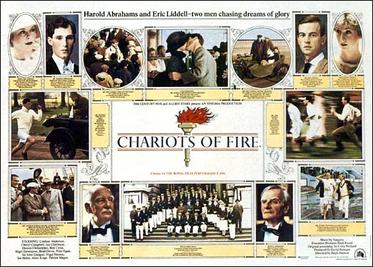
Chariots of Fire (Photo credit: Wikipedia)
Early in the film Chariots of Fire (1981), a working class chap comments apropos of two Cambridge students that British young men fought a hellish war (World War I) so that “shits like [the two students] could get a decent education.” But the wealthy need not be ashamed—here, they’re clearly not a bad lot—and the fought-for Great Britain is loved by its citizens, young men and the rest.
Of course Great Britain is imperfect, as is the twentieth century. If it is not banal to say so, where perfection exists is in commitment to something worthwhile, and so Cambridge student Harold Abrahams (Ben Cross), a Jew, is committed to a Jewish victory in competitive running. This in the midst of British anti-Semitism. There is also commitment in Eric Liddell (Ian Charleson), a Scottish Christian and another runner, and this is good. A modern Britain, after all, seems to pose a desultory threat to religion: it balks at Liddell’s refusal to run a heat on Sunday. It is a favor done by a particular Cambridge student which enables the young man to participate (in the 1924 Olympics). In Chariots of Fire, many moments of light, in England, follow the terrible war years. Granted, there is nothing redemptive in all the Olympic running, but what about the religious lives of people—religious dedication?
by Dean | Oct 30, 2017 | General
I simply do not like the films of Nicolas Roeg.
Don’t Look Now (1973) is a fancy, fatuous occult-heavy—and thus supernatural—thriller. Hitchcock’s scary Frenzy, which came out close to the same time as Roeg’s movie, is offensively misogynistic, but at least it relates a sensible story. Don’t Look Now is an infernally messy puzzler.
Hilary Mason, as a psychic named Heather, is wonderful in the film, and so is Clelia Matania as her sister. They deserve a better movie—but then, so does almost everyone else in the film’s cast.
by Dean | Oct 29, 2017 | General

Roxanne (film) (Photo credit: Wikipedia)
John Simon asserted that Rostand’s Cyrano de Bergerac is not a great play, merely a perfect one (which amounts, of course, to a great deal). The 1987 movie that Fred Schepisi and Steve Martin derived from Cyrano—entitled Roxanne—is neither great nor perfect, but it is mightily amusing and slightly literate. It has a pleasant cast too: a not-bad Daryl Hannah, a comfortable Shelley Duvall and Rick Rossovich.
Steve Martin, the film’s modern Cyrano, can go overboard as both actor and writer. Approvingly, Pauline Kael wrote that Martin “seems to crossbreed the skills of W.C. Fields and Buster Keaton . . . ” Well, he has some of Keaton in him, but certainly none of what Fields had. He isn’t down to earth. But he too is pleasant: in Roxanne, he is an actor of personality, of zany savoir-faire.
by Dean | Oct 26, 2017 | General
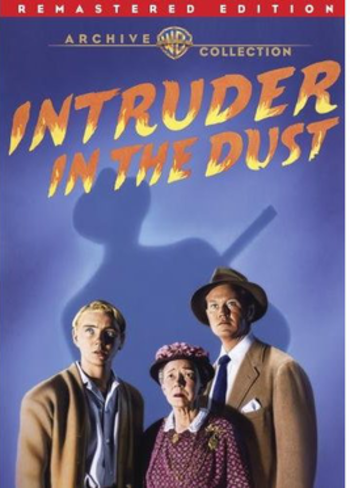
Intruder in the Dust (1949 film) (Photo credit: Wikipedia)
A brave old lady (Elizabeth Patterson) initiates the digging up of a dead body after nightfall to see what kind of bullet was used to kill the person. The boys who assist her are brave too. What prompts this action—a plot device in Clarence Brown‘s Intruder in the Dust (1949)—is the swift arrest of a black man, Lucas Beauchamp (Juano Hernandez), for the murder of a white man.
The film, based on a William Faulkner novel, is set in the South and was shot in Faulkner’s home town of Oxford, Mississippi. A finely directed piece, it concerns the perennial struggle for the rule of law, for just procedures for every accused individual (a lesson needed in today’s America). Lucas has a friendly relationship with a white boy called Chick (Claude Jarman, Jr.) and, in fact, with money, for he is a well-off farmer in a slowly changing America. But the townspeople disdain his pride, and desire a lynching, and yet scriptwriter Ben Maddow does supply a few essentially good people. In the case of the murdered man’s father (a strong Porter Hall), this seems to be due to the gent’s having been seasoned by harsh life—the very thing Faulkner never ignored.
by Dean | Oct 24, 2017 | General

Cover of All the King’s Men
The 1949 All the King’s Men is crisp and fluid as it tells of a flatly indecent governor (Broderick Crawford‘s Willie Stark). It has a better, if blemished, script than Citizen Kane, another film about a powerful man, because it’s adapted from Robert Penn Warren’s novel. There is recklessness and perfidiousness that remind us of Jack Kennedy and Ted Kennedy (Chappaquiddick), and demagoguery that reminds us of many of the most offputting politicians.
I would declaim to my dying day that the remake of King’s Men starring Sean Penn is a stupid movie, but that is not my opinion of the ’49 original. Moreover, most of the chief cast members in the ’49 film actually outact the later chief cast members, with a Crawford who is not mannered at all, purveying a Willie Stark who is not a caricature. For all this, why the former newspaper reporter (John Ireland) stays with the naughty Stark to the end is anybody’s guess.
by Dean | Oct 19, 2017 | General
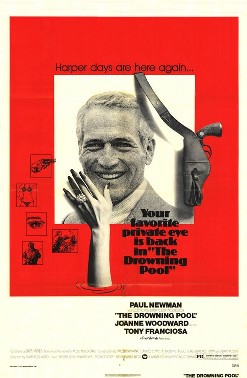
The Drowning Pool (film) (Photo credit: Wikipedia)
With the car washing scene in Cool Hand Luke, director Stuart Rosenberg was a bit of a sexist, but not in The Drowning Pool (1975), which hardly means it is a good film. The fault is not Rosenberg’s, though, but that of the writers, including, I assume, Ross MacDonald, whose novel is the source for this.
A detective movie starring Paul Newman as Lew Harper, The Drowning Pool serves up two villains, one of whom is an inadequate actress and hard to swallow as a villain, the other of whom is an appalling oil man. (Ho hum.) The oil man is so stupid he makes it possible for someone to rip off an incriminating account book of his (he’ll kill to get it back). It’s pretty underwhelming material, made in such a way as to make it seem more than that. But underwhelming is all it is. From car wash to drowning pool—not a step up.
by Dean | Oct 18, 2017 | General
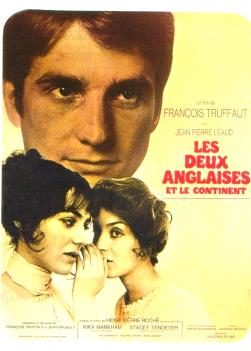
Two English Girls (Photo credit: Wikipedia)
Francois Truffaut‘s fine 1971 film, Two English Girls, seems intent to tell us that young men and women cannot be close friends, that personal sacrifice cannot withstand non-conjugal physical desire. Based on a novel by Henri Pierre Roche, just as Jules and Jim is, it revolves around two women (sisters) and one man, unlike the two men and one woman of Jules.
Stylistically Truffaut is probably a bit over-imaginative, but he also proves what an excellent eye he has. He gives us a likable overhead shot of Claude (the man) and Muriel (one of the women) atop a high hill with the tiny figure of Muriel’s sister Anne—before she disappears in an iris-out!—at the bottom of the hill. He provides a smart scene in which Muriel, a thirty-year-old virgin—circa 1900—has her full-cover 19th century apparel slowly removed from her by the aforementioned Claude, whom she loves. Standing at last with her attractive mammaries exposed, she virtually symbolizes all humanity poised before an era of gradual sexual freedom (and all its unfortunate consequences).
In an earlier review of Two English Girls, I said it is inferior to Jules and Jim. Not so. Girls is not tedious. It is sad, which indeed is connected to its real feeling for suffering (mostly Muriel’s). It remains what I called it earlier: guileless and humane. If I live to be very old, chances are I’ll read the novel.
(In French with English subtitles)
by Dean | Oct 15, 2017 | General

The Earrings of Madame de… (Photo credit: Wikipedia)
In my view, the Max Ophuls film The Earrings of Madame De . . . (1953, a.k.a. Madame D . . .) is not art, but rather a lovely, outstandingly directed and edited work of craft. Adulterous love arises in French aristocratic culture, as it does in Renoir’s The Rules of the Game, but here there are no lower class folks playing the game as well. Plus Ophuls keeps a certain distance from his characters, going in for tragedy instead of sardonic farce (as in Renoir).
Charles Boyer, as a general, knows how to enact a man who can both express love and keep his dignity. Danielle Darrieux keeps hers too, and is right for romantic tragedy. Also just fine as an aristocrat is Lia de Lea, the general’s mistress. Vittorio de Sica, as Madame de’s lover, might have been inspired enough by this film to direct his own male-female stuff (e.g. Marriage Italian Style).
(In French with English subtitles)
by Dean | Oct 11, 2017 | General

Cover of North Dallas Forty
Was football controversial in 1979? No. It was considered pretty innocent stuff, albeit, as North Dallas Forty demonstrates, it brought plenty of pain to athletic bodies no longer young.
This is convincingly depicted (by Nick Nolte and director Ted Kotcheff), but NDF presents a problem. It is the most cynical sports movie I’ve ever seen, as well as annoyingly coarse. For a long time I thought it was insulting to women, but not really. It’s harder on men than on women, and is, in point of fact, insulting to Christians: Art the quarterback (Marshall Colt) in particular. Partly comedic, it is well directed but unwell in spirit. Its mild nudity is not gratuitous but it seems to be, because the movie itself is gratuitous.