by Dean | Oct 10, 2017 | General, Movies
 In the West, the lives of most little girls are hardly devoid of privileges and delights. In China of the 1930s, however, little girls were rigidly undervalued and sold by their impoverished parents (or keepers) to ensure all-around survival.
“Doggie” (Zhou Ron-Ying), the child in the Chinese picture The King of Masks (1996), has keepers, not parents. An elderly street performer, Wang (Zhu Xu), is fooled into thinking she is a young boy and buys her, only to be shocked and dismayed when it transpires she is a girl. It is only a boy who can inherit Wang’s silk mask entertainment trade after he dies. Not without pity, the old man allows “Doggie” to work for him, but a string of awful misfortunes makes it, for a while, impossible for him to support her.
Many a theme receives attention in Wu Tianming‘s rich film: childhood destitution, the ubiquity of injustice, the seeming need (when it is a need) for accepting fate, pariahism. For all its dramatics, King is no masterpiece of drama—it needs a sturdier plot—but it is interesting and beautifully chaste. It ends on sentimental note but it is also an affecting film.
(In Mandarin with English subtitles)
by Dean | Oct 8, 2017 | General

Guys and Dolls (film) (Photo credit: Wikipedia)
Brando sings! Yes, and he spoils the song “Luck Be a Lady” in the 1955 movie adaptation of Guys and Dolls. He is miscast as a crooning illicit gambler, whereas Frank Sinatra clearly is not. It’s a pleasurable role he is in, with Vivian Blaine, as his inamorata, holding her own. Musically, that is, Betty Boop voice and all.
Songsmith Frank Loesser did himself proud, although I truly do not know whether “If I Were a Bell” is a good ditty or not. This is because Jean Simmons—an embarrassment—loses the melody by shouting rather than singing the song. It’s a disastrous performance, and the entire sequence with her and Brando in Havana is unamusingly poor. Over and above, the musical’s book (adapted by Joseph Mankiewicz) lacks any real charm, any cakes-and-ale sparkle and bounce. Music, singing and dancing manage to entertain, though.
by Dean | Oct 5, 2017 | General

Cover of Notre Musique
I want nothing to do with Jean-Luc Godard‘s Notre Musique (2004), which I had to see on DVD since it was never shown in a Tulsa theatre. No wonder. It has no entertainment value despite a few moments of striking insight, and its middle section is interminable. Without being otherworldly, its three sections correspond to the Hell, the Purgatory and the Paradise in Dante’s Divine Comedy, but it makes its points through exposition, not drama. So it’s talky—a talky elegy for a war-afflicted world.
Godard himself appears in the film, posing as the indubitable Intellectual Of Cinema. After lecturing at a literary conference in Sarajevo, during “Purgatory,” someone in the audience asks him whether little digital cameras will ultimately “save” cinema. Frowning like Laurence Olivier, Godard sits and never answers; and, yes, even though it’s a stupid question, the scene is smugly patronizing.
Now, the politics. A Jewish girl, Olga (Nade Dieu), martyrs herself in protest against Israel’s aggression toward the Palestinians. Godard has a right to his views about Israel, but he’s far more seduced by leftist tunnel vision about the country than by a cautious appreciation for history and present complexity. When he made this film, did he not care a whit about Ehud Barak’s concessions to the Palestinians in 2000? Was he aware of them? He makes a comment in the movie about non-revolutionaries: “Humane people don’t start revolutions. They build libraries.” “And cemeteries,” another man chimes in. (Oh, dear.) Of course Godard has forgotten that in these cemeteries there are plenty of Israeli civilians killed by Palestinian terrorists. Twenty-six of them died in 2002 at a Passover celebration in Netanya.
Notre Musique is the worst kind of art film: offbeat but also a myopic bore.
by Dean | Oct 3, 2017 | General, Movies
 A terrific film noir produced in China, So Close to Paradise was made in the late Nineties, banned for three years by the Red government, and—hooray!—subsequently released in the U.S. It didn’t make me think of Forties and Fifties Hollywood, though, but rather of the lofty Euro film of Antonioni and lesser artists, what with its angst, its silence and its careful visuals. The “music” of the picture are the sounds of a tugboat, heavy rain, high heels on pavement and—well, sober tones. Lamentably, serious cutting was done by the Chinese studio, but filmmaker Wang Xiaoshunai‘s talent still shines through. The thin plot is quite digestible, and actress Wang Tong is lovely as she credibly plays a worldly nightclub singer.
A character called Gao Ping (Guo Tao), a man of greed and lust, is one of the film’s three losers. The other two are Gao’s young pal Dongzai and Wang’s nightclub singer, Ruan Hong. After his partner-in-crime makes off with Gao’s stolen money, Gao tracks down Ruan because she knows where the jerk can be found. In fact he has to abduct her, and he rapes her. Amazingly, the two become a couple (don’t tell the feminists). Thereafter there is trouble. Angst. Also, however, the plot loses its hold on us (it did on me). Only the technical sophistication begins to matter, but so be it. I still had a good time with So Close to Paradise.
by Dean | Oct 1, 2017 | General
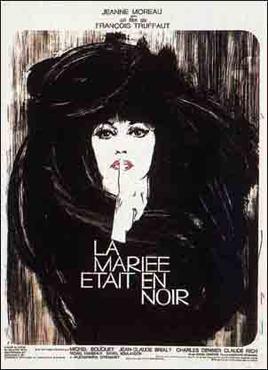
The Bride Wore Black (Photo credit: Wikipedia)
Francois Truffaut admired the films of Hitchcock, but his thriller The Bride Wore Black (1968) is certainly more Truffaut than Hitchcock, which is wise. However, this is the only good thing about the movie—an utterly lousy one. It is much, much sillier than Truffaut’s The Woman Next Door, which nevertheless manages to satisfy. Bride only manages to make us chuckle in disbelief, and somehow makes even Jeanne Moreau look (histrionically) bad.
by Dean | Sep 27, 2017 | General

Cover of M*A*S*H (Widescreen Edition)
The fools among us are desecrating the monuments to Robert E. Lee, Thomas Jefferson and others. I agree with the writer for The Federalist website who propounded that these monuments “mark our progress as a nation,” but this would never occur to the fools. It’s only a matter of time in fact before they start destroying, if they can, massive copies of the Robert Altman movie, M*A*S*H. This 1970 work is not only anti-military and anti-religion, it also denigrates homosexuals; and numerous young vandals won’t tolerate that. For my part, I have never liked M*A*S*H, but I wouldn’t respect any grand removal of it from American venues.
by Dean | Sep 26, 2017 | General
Filmmaker Rama Burshtein is able to make believable the peculiar, unlikely actions of her chief character, Michal (Noa Koler), in the fascinating, not-very-comic The Wedding Plan (2017). Michal deeply yearns to be married that she might be “normal” and “respected” and, oh yes, loved; but she pleases almost no one and is even jilted by her fiancé. An Orthodox Jew, she starts maintaining that God will bless her with a new groom, to replace the man who jilted her, 22 days hence on the eighth day of Hanukkah. She proceeds to hunt for the unknown groom. A better examination of long-lasting deprivation for an unmarried soul could not be imagined. Burshtein and actress Koler render Michal a nice but weary woman, frowning with confusion, nervously hopeful, struggling for faith. Koler’s acting is incisive, great. The Wedding Plan, though rather thin, is meaningful un-arty art. Michal reminds me a little of Lily Bart in Wharton’s The House of Mirth except that she isn’t a tragic heroine, which is certifiably appropriate.
(In Hebrew with English subtitles)
by Dean | Sep 24, 2017 | General
In the John Wayne Western from 1944, Tall in the Saddle, land seizures are interrupted when a man threatens to tell the authorities about the sell of marked playing cards. The man, never shown, is killed. John Wayne plays the newly hired worker and good shot who, naturally, discovers the truth.
Wayne plainly attracts the haters here, including an insufferable biddy. A saucy cowgirl (Ella Raines) believes Wayne has made a fool of her, and she intends to fire him from his ranch job, but—aw—she becomes infatuated with him. There is a pleasing little moment in Saddle when a fellow female looker, Raines’s competition, praises the cowgirl’s prettiness and Raines gives a verbal indication that she knows about her looks and intends to use them to her advantage.

Tall in the Saddle (Photo credit: Wikipedia)
Director Edwin L. Marin‘s movie is a fun romp in which Wayne’s character is refreshingly less contemptuous of certain people than some other Wayne characters. The cast is not wholly effective but it comes close, especially with the admirable fire of Ward Bond and Miss Raines.
by Dean | Sep 21, 2017 | General
Carl Theodore Dreyer‘s Ordet (“The Word”, 1955) is tedious and too theatrical—it is adapted from a play—but also sufficiently strange to end with an astonishing miracle the likes of which humanity never sees anymore. The film shows us the persistence of religious faith despite what life does to ordinary hopes and pursuits: possessing a sane mind, having a healthy family, getting married. But it shows us, too, a madman who thinks he is Jesus Christ before he recovers his sanity (unlikely) performing the aforementioned miracle. He necessarily performs it through the power of Jesus Christ (and certainly not through his own power). Dreyer seems to believe that because God is able to create the universe, He can also work any kind of miracle, and he’s right. His approach for conveying this, however, is not very palatable.
by Dean | Sep 20, 2017 | General

Cover of CQ
In the late Sixties, Roger Vadim directed Barbarella. In the late Sixties of the movie, CQ (2001), a young film editor named Paul directs Dragonfly, a silly sci-fi picture with a toothsome heroine. Like Barbarella.
This the debut feature of Roman Coppola (Francis’ son) takes place in Paris and blithely examines the fine arts of making cinematic mediocrity and pining, or half-pining, for a beautiful woman. The mediocrity subsists not only in Dragonfly but also in the personal, Godardian picture Paul is privately shooting on the side. The beautiful woman is the supermodel playing the sci-fi heroine. The problem is that Paul has a French girlfriend, frustrated and sometimes scrappy, whom he is neglecting. (Paul himself is an American.) CQ, which is code for “Seek You,” is good at exposing an ignorant young man’s romantic limbo, his aimlessness.
Although it has little wit or insight, the film is fizzy and unusual. I wish it were better acted. Both Jeremy Davies (Paul) and Angela Lindvall (the supermodel) are colorless. Jason Schwartzman was good in Rushmore but not in this. In contrast, Elodie Bouchez blisters and delights as the French girlfriend, and Billy Zane pleases drolly as a cast member of Dragonfly. Sturdy Gerard Depardieu is also on hand. Coppola penned as well as directed this Gallic curio, made in English, and unwittingly pays homage to the most cordial of French-American relations. You don’t mind watching snow fall on the moon before getting to that homage, do you?